· Investment Strategies · 3 sources
Apollo Atomics Raises $31M Seed — YC-Backed Factory-Built Reactors for AI Power
MIT spinoff Apollo Atomics raised $31M seed (FCVC lead; YC, Alumni Ventures) for compact PWRs built in factories and trucked to site — >20 GW LOI pipeline claimed.

Editorial team
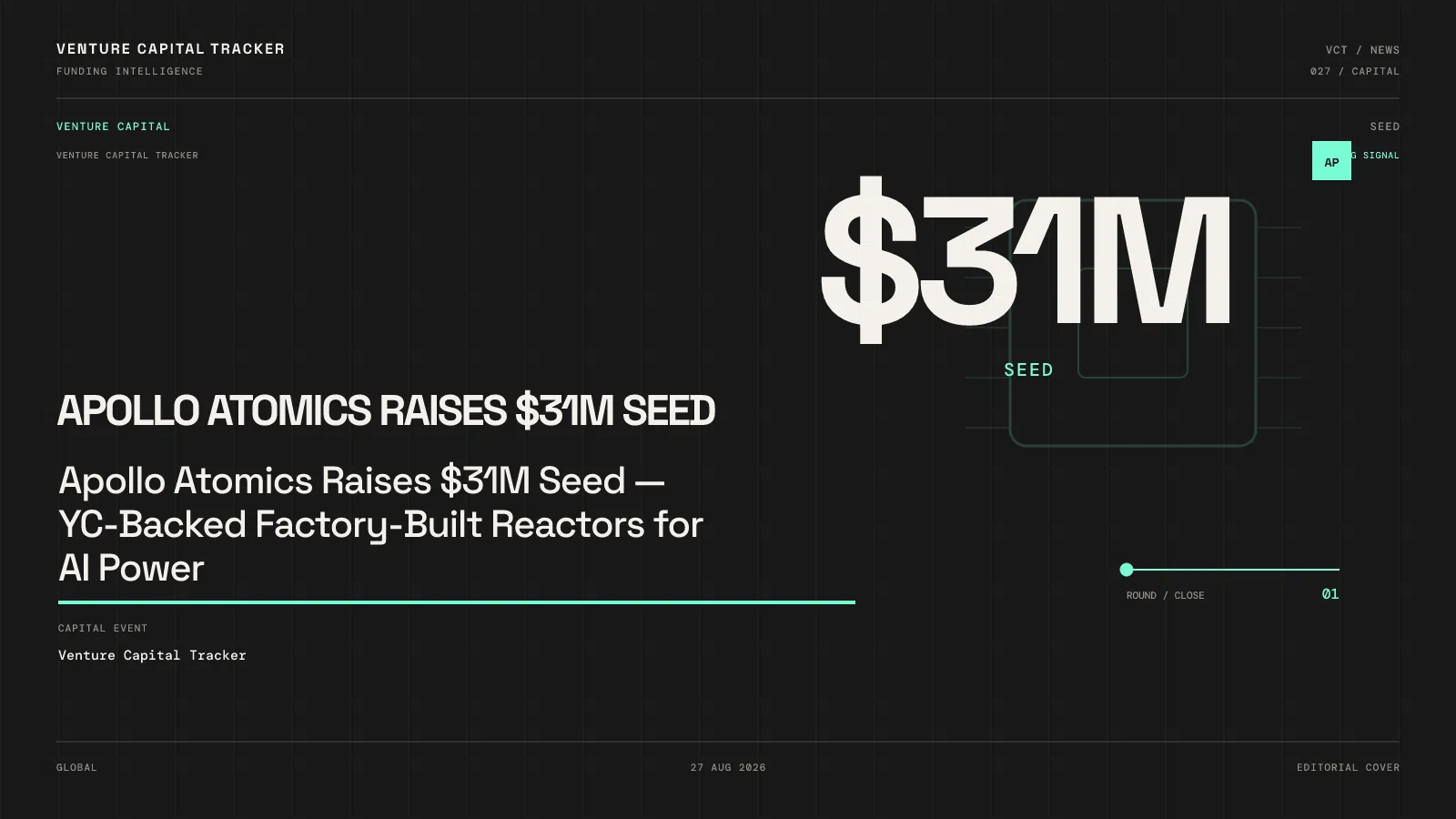
Apollo Atomics raised about $31 million in seed funding (announced ~August 20, 2026), led by FCVC, with Y Combinator and a deep hard-tech syndicate. The Cambridge, MA MIT spinoff (YC Spring 2026 per some coverage) is building factory-made compact PWRs aimed at AI data centers and industry.
Deal details & investors
Funding event
Apollo Atomics
Key facts
- Company
- Apollo Atomics — compact factory-built PWRs (Cambridge, MA)
- Round
- ~$31M seed (oversubscribed); some reports split ~$26M equity + equipment financing
- Date
- ~August 20, 2026
- Lead
- FCVC
- Directory-linked
- Y Combinator
- Others
- Telesoft, Alumni Ventures, Robinhood Ventures, Nucleation, Pelion, Duke Capital Partners; angels incl. Paul Graham, Ray Rothrock
- Products
- A-10 (10 MWe), A-50 (50 MWe), A-300 (300 MWe); A-1 1 MW demonstrator next
- Pipeline claim
- >20 GW signed LOIs (company via press)
- Regulatory
- NRC engagement plan submitted; seeks fuel-config authorization by end-2026 (company)
- Use of proceeds
- A-1 demo, manufacturing processes in-house, team, NRC work
Who uses the product — and for what job
Users: hyperscalers, data-center developers, industrials, and utilities that need firm megawatts on a schedule chips cannot solve.
Job: buy a reactor that ships like a product — factory-built, trucked, online in under 24 months — instead of a decade-long megaproject.
Apollo’s bet is almost conservative on physics (PWR lineage) and radical on packaging: shrink the steam generator, cut footprint ~40× (company), manufacture repeatably.
Why now
- AI campuses are securing generation years ahead of interconnect — nuclear is back in term sheets (Valar, others).
- Software flex (Emerald AI) helps but does not create firm night-time power.
- LOI pipelines >20 GW (claimed) give VCs a customer narrative even before commercial deployment (targeted 2028).
- YC + FCVC timing matches a batch of energy-for-AI hard tech.
Why Y Combinator — portfolio fit
Y Combinator has become a credible first institutional stamp for nuclear and energy hardware when founders combine MIT/ops pedigree with a productized manufacturing story. Apollo fits the “ambitious but falsifiable” mold: demonstrator → NRC path → factory.
Likely founder rationale: YC network for talent and AI-customer intros; specialist nuclear/climate angels for diligence; FCVC to lead a seed large enough for a 1 MW demo.
| Investor type | What they bring |
|---|---|
| FCVC | Lead seed size for hardware demo |
| Y Combinator | Brand, talent, AI customer adjacency |
| Nucleation / hard-tech angels | Nuclear diligence |
| Alumni / university-adjacent | MIT spinout credibility |
Competitive map
| Player | Lane |
|---|---|
| Valar Atomics | Later-stage advanced nuclear megaround |
| Traditional nuclear EPCs | Megaproject construction |
| SMRs from large OEMs | Utility procurement cycles |
| Gas / renewables+storage | Alternate firming stacks |
Market signal
A $31M seed with >20 GW LOIs (claimed) shows investors will fund nuclear packaging for AI load even at pre-commercial stages — but LOIs are not interconnection or NRC licenses.
When not to use this as a template
- Wrong if you invent novel fuel/coolant without a licensing path.
- Wrong if LOIs are treated as backlog without site, offtake, or NRC milestones.
- Wrong if factory-build claims skip supply chain for nuclear-grade components.
Practical takeaway
- Founders (nuclear): Sell manufacturing + licensing timeline; physics novelty is optional.
- Investors: Underwrite NRC critical path and LOI quality before GW headlines.
- Operators / hyperscalers: Ask truck envelope, MWe class, and earliest energize date with contingencies.
Follow Venture Capital Tracker on Google
Add VCT as a preferred source to see more of our venture-capital reporting in Google Search.
Editorial note: AI tools assisted with research, structure, or drafting. Venture Capital Tracker retains human editorial responsibility for factual accuracy, relevance, and source quality before publication.