· Venture Capital · 7 sources · Updated · Verified
OpenAI Pre-IPO: What $30 Billion Funding Talks Mean for Investors
OpenAI is reportedly seeking $30B at a $1.4T valuation while preparing for a potential IPO. What is confirmed, what isn't, and why private-share terms matter.

By Venture Capital Tracker
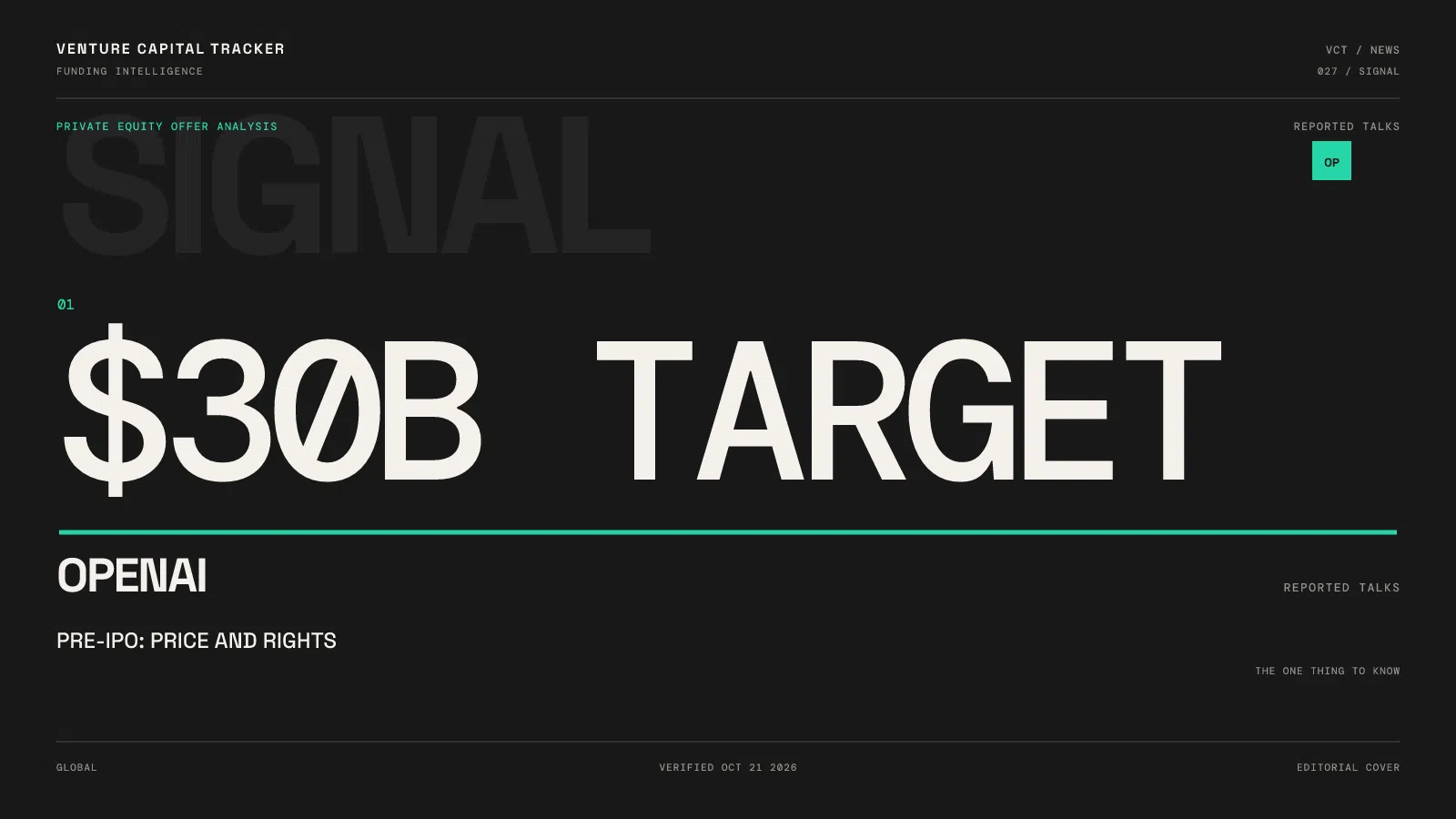
OpenAI is in talks to raise at least $30 billion in private funding at a valuation of about $1.4 trillion, according to Bloomberg. The proposed deal highlights investors' appetite for a stake in the ChatGPT maker before a potential stock-market debut.
Deal details & investors
Investment event
OpenAI
But the fundraising is not confirmed as closed. And for buyers offered “pre-IPO” access, a company's headline valuation tells only part of the story. The price, ownership rights and selling restrictions of the actual investment can matter just as much.
OpenAI has filed for an IPO—but hasn't set a date
OpenAI confirmed on June 8 that it had submitted a confidential draft S-1, the registration document used to prepare for a US stock offering. The company said it had not decided when to go public.
That is an important step, but a confidential filing is not a completed IPO. OpenAI has not announced a public offer price or first trading day in the sources reviewed. Reuters has reported a possible 2027 listing, but the timetable remains uncertain.
The separate $30 billion funding round is still in discussion. Bloomberg first reported the proposed size and valuation on September 29. Reuters said in October that investors including SoftBank and MGX were in talks to participate. Neither report establishes final allocations or a completed round.
Why the $1.4 trillion valuation matters
The reported $1.4 trillion is a proposed value for the entire business before new money comes in—not money in OpenAI's bank account.
If OpenAI sold $30 billion of entirely new shares on those terms, its valuation after the investment would be about $1.43 trillion. The new investors would collectively own roughly 2.1%. These are simple calculations; actual ownership would depend on the final securities and deal terms.
The proposed price is also well above the $852 billion valuation in OpenAI's March financing announcement, when it disclosed $122 billion in committed capital. A higher fundraising valuation is not the same as a realized gain for investors.
The financial test is whether OpenAI's fast-growing revenue can support the price. Reuters reported in September that its annualized revenue pace was nearing $70 billion. At a $1.4 trillion valuation, that works out to about 20 times that sales pace. This is a rough comparison with revenue—not profit—and an annualized pace is not the same as a full year's reported sales.
What private-share buyers need to know
A private offer may involve existing OpenAI shares, an interest in an investment fund, or a contract whose value is linked to the shares. Those are different products. An investor buying a stake in a fund does not necessarily own OpenAI shares directly.
OpenAI's equity-transfer policy says direct and indirect transfers require written consent. It warns that some offers involving pooled investment vehicles and other arrangements may be unauthorized.
Fees can also change the outcome considerably. Consider a hypothetical $10,000 investment with a 5% upfront fee and a manager entitled to 20% of investment profits. Only $9,500 would initially be invested. If its value rose by 40%, the investor would receive $12,540 after those illustrative fees—a 25.4% gain, rather than 40%. Taxes and other costs are excluded. These are example terms, not terms of any known OpenAI offer.
The key documents should establish the underlying shares or claims, authorization, all fees and how an investor can eventually receive their money. Even an IPO would not necessarily let holders of private fund interests sell immediately.
OpenAI's potential listing is significant. For anyone considering an investment today, however, the more immediate question is not when the stock might trade. It is what they are being offered, and at what effective price.
For a comparison with another leading AI developer approaching the public market, see VCT's Anthropic IPO coverage. Our guide to different startup share rights explains the terminology behind private equity deals.
Reporting checked October 22, 2026. The proposed $30 billion round is reported, not confirmed as closed. Financial examples are illustrative.
- ipo
- private-markets
- valuation
- +1 more
Last updated:
Editorial note: AI tools assisted with research, structure, or drafting. Venture Capital Tracker retains human editorial responsibility for factual accuracy, relevance, and source quality before publication.