· Venture Capital · 6 sources · Verified
Zipline Raises $1.5B at $21.5B: Walmart's 300 Drone Sites and the Delivery Economics
Zipline's November 5 raise, investors and valuation explained—plus 300 planned Walmart sites versus 21 active, real drone-order steps, company GMV caveats, alternatives and regulatory risks.

By Venture Capital Tracker Editorial
Funding event
Zipline International
Led by Paradigm , WCM Investment Management +1 more
Reported valuation $21.5B
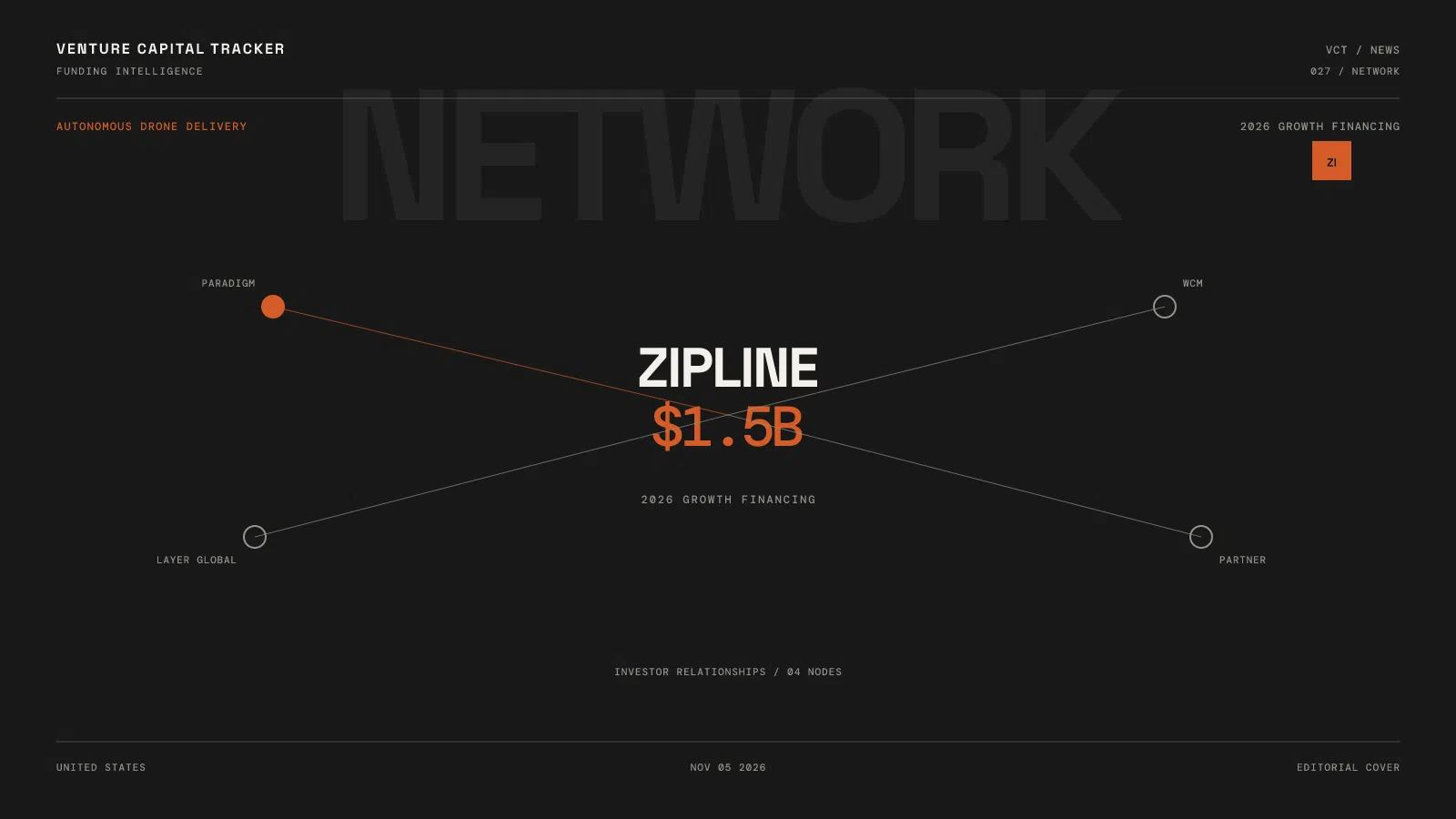
Zipline announced $1.5 billion in funding at a $21.5 billion post-money valuation on November 5, 2026, co-led by Paradigm, WCM Investment Management and Layer Global. The South San Francisco drone-delivery company also unveiled a multiyear agreement to add 300 Walmart delivery sites across the United States. Those 300 locations are planned additions, not 300 operating sites. The combined announcements connect a dramatic valuation increase to a measurable distribution commitment, but neither one proves that drone delivery has reached national scale or profitability.
| What was announced | Verified figure | What it actually means |
|---|---|---|
| November 5 financing | $1.5B | New company-announced capital; formal series label and security terms not disclosed |
| November 5 valuation | $21.5B post-money | Financing price, not sales, enterprise revenue or investor proceeds |
| January 21 financing | More than $600M | Earlier 2026 announcement; not part of the $1.5B new round |
| January valuation | $7.6B | Earlier post-financing figure; different date and deal |
| Walmart expansion | 300 additional planned sites | Multiyear rollout; sites are not yet all operational |
| Existing Zipline–Walmart sites | 21 active, per TechCrunch on November 5 | Current footprint cited by independent reporting, not Walmart's total drone program |
The company's November 5 financing announcement, Walmart's own release and TechCrunch's independently reported active-site count establish these distinctions. We do not assume an undisclosed precise legal closing date.
What Zipline actually sells
Zipline is not primarily selling a consumer drone. It operates a logistics service combining aircraft, autonomous flight control, launch and charging sites, merchant integrations, delivery software and ongoing operations. A retailer or restaurant wants an eligible order moved from its fulfillment point to a customer's address without sending a ground courier. Zipline supplies the air-delivery machinery and service behind that promise.
The company's original Platform 1 serves longer-distance logistics, including medical supplies. Its Platform 2 (P2) is designed for short-range home delivery: the aircraft can carry roughly eight pounds and serve customers within approximately a 10-mile radius of an appropriate site. A P2 aircraft hovers above the destination while a separate delivery mechanism lowers the package by tether. That avoids landing a rotorcraft in a customer's yard but still requires a suitable location, clear operating conditions and regulatory permissions. These are design and service characteristics, not a guarantee every consumer will qualify.
Zipline's medical-delivery operations began in Rwanda in 2016 and subsequently expanded. Its experience operating medical routes is a real operational distinction from a company that has only demonstrated prototype drone flights. It does not automatically remove the much harder economics of small, high-frequency US retail purchases.
A customer and merchant journey: what really happens?
This is an illustrative eligible Walmart order, based on Walmart's November 5 product explanation, not an account of hands-on testing by VCT.
- Eligibility: A household enters its delivery address in Walmart's app or website. Drone delivery is available only where a supported site serves the address and the order meets service constraints.
- Order selection: The customer chooses from eligible stocked goods. Walmart says tens of thousands of products may be available to eligible shoppers, but drones still have payload, size and operational restrictions. A bulk grocery basket is not equivalent to a small pharmacy or snack order.
- Picking and handoff: The store prepares the order and transfers the bag to Zipline's site infrastructure. Staff picking time and queueing are part of the delivery duration, even if the aircraft's actual flight takes just minutes.
- Autonomous flight and drop: The aircraft flies the permitted route and lowers the parcel without landing at the home. Weather, airspace approvals and obstacles may interrupt or prevent a flight.
- Delivery confirmation: The consumer receives the package, while the retailer and logistics operator reconcile successful deliveries and exceptions.
The economic buyer is the merchant or logistics partner seeking faster, predictable fulfillment; the end user orders goods. Zipline does not disclose a standardized merchant price per delivery, merchant gross margin, aircraft payback time or fully allocated cost per order in this financing announcement. An advertised consumer promotion, if offered locally, is not evidence of Zipline's enterprise price.
What the $21.5B valuation does—and does not—prove
Zipline disclosed more than $600 million of earlier funding at a $7.6 billion valuation on January 21. The November $21.5 billion post-money figure is approximately 2.83 times January's stated post-money valuation. That is a comparison of prices implied by two financings, not a 2.83-times realized return for every earlier investor: share classes, liquidation preferences, dilution and secondary transactions could materially change an individual holder's economics.
The November investment was co-led by Paradigm, WCM Investment Management and Layer Global. Participating investors named by Zipline include Valor Equity Partners, Fidelity Management & Research Company, Uber, Tiger Global, J.P. Morgan, ARK Invest and Salesforce Ventures. Zipline identifies new US manufacturing capacity and hiring as uses of proceeds.
The investors' stated theses are also revealing. Paradigm partner Matt Huang emphasized the robotics network's operating experience; WCM portfolio manager Alan Tu characterized drone delivery as a change in ecommerce and food-delivery experience; Layer Global's Anton Levy pointed to merchant relationships and repeatable expansion into new markets. These are investor arguments expressed in Zipline's issuer announcement, not independently demonstrated unit economics.
The precise split between primary shares, any secondary transactions and potential preferential rights was not disclosed. Nor was a conventional Series G/H label. VCT therefore classifies this as a 2026 growth financing with series undisclosed and does not conflate it with earlier rounds in the Zipline startup profile.
Three figures that are easy to misread
300 Walmart sites: Walmart's release describes 300 new Zipline locations planned under a multiyear contract. TechCrunch counted 21 active Zipline–Walmart locations when the agreement was announced. Walmart also reported more than 2 million cumulative drone deliveries across its retail drone program, which includes providers beyond Zipline. Neither figure should be presented as 300 active Zipline sites or as 2 million Walmart orders fulfilled by Zipline alone. Zipline separately says it completed more than 1 million Dallas–Fort Worth deliveries during 2026, a company-reported local count whose scope differs from Walmart's network-wide number.
A 19-minute median: Zipline says October orders arrived a median 19 minutes after checkout, versus 30-plus minutes for traditional delivery. The company did not release a matched, independently audited comparison adjusting for distance, merchant mix, weather and peak-hour demand. It is a useful operating claim, not a general guarantee to every address.
Restaurant sales: Zipline reports that, among a selected cohort of long-tenured restaurant partners, its share of those partners' delivery revenue rose from 10.8% in March to 34.9% in October. The cohort reportedly had 26% higher delivery gross merchandise value (GMV), with 80% of the increase attributed to Zipline orders. Restaurant GMV is not Zipline's revenue. The company has not disclosed the cohort size, a control group, how costs moved or a causal method proving that Zipline alone produced the sales increase.
Those distinctions matter more to an investor than repeating a large delivery-volume number. A healthy delivery network needs a high utilization rate per site, predictable order density, merchant retention, weather resilience and fully allocated costs below the economic value to the buyer.
An original expansion scenario—not a forecast
To understand the gap between signed plans and operating scale, consider 300 planned sites × 100 completed daily orders × 30 days = 900,000 monthly orders, if every site eventually opens, runs every day and reaches the assumed daily volume. At 50 orders per site the same illustration would be 450,000 monthly orders; at 200, it would be 1.8 million. These are simple volume scenarios, not Zipline guidance, audited capacity or a statement of the contracted launch schedule.
The missing investment variables are crucial: site installation cost, regulatory approval timetable, hardware manufacturing yield, utilization during bad weather, customer acquisition spending, field maintenance, merchant fees, actual fulfillment labor and operating gross margin. Financing buys runway and capacity; it does not by itself reveal whether per-order economics work.
What can compete with Zipline?
| Alternative | Strongest use case | Trade-off relative to Zipline |
|---|---|---|
| Wing (Alphabet) | Small-package retail drone delivery; also a Walmart partner | Competes directly for eligible suburban orders; different aircraft and network operations |
| Amazon Prime Air | Amazon-controlled fulfillment and drone delivery | Deep commerce integration but narrower compatibility with independent merchants |
| Flytrex | Suburban food and retail drone delivery | Similar local-demand problem with different geographic coverage and aircraft choices |
| Ground couriers and gig fleets | Heavier orders, dense urban streets and bad-weather service | Broader payload and route flexibility, but road congestion and labor costs |
| Conventional medical couriers | Regulated medical routes where ground access exists | Established service history; Zipline can be compelling where urgency and difficult geography matter |
The core comparison is not simply air versus road. It is total cost and reliability for a specific shipment class, compared with a viable incumbent at that address. A drone that carries a small meal quickly cannot replace the van carrying a week's groceries.
Regulation, safety and the 2027 execution test
Zipline obtained US FAA Part 135 air-carrier certification in 2022. That is an important real operational credential, but it is not universal permission to launch hundreds of new routes anywhere. Beyond-visual-line-of-sight permissions, site approvals, community impact, local conditions and airspace constraints remain relevant to expansion.
DroneXL's specialist November 5 reporting documented two emergency parachute descents in Texas in 2026, with no reported injuries. Zipline described at least one parachute deployment as its safety mechanism operating as designed. That does not establish catastrophic failure, but it illustrates why broad company descriptions such as operating without a safety incident require a clear definition and independent incident review. Local sound exposure and reliability also matter to the sites Walmart intends to open.
Uber's stated one million Zipline deliveries per day by 2029 is an ambition, not an achieved throughput number or committed minimum order volume. Similarly, the companies have not specified the states or a binding activation timetable for all 300 new Walmart sites. Future network economics depend on converting permits, factories and retailer commitments into operating deliveries.
What investors and merchants should monitor next
The most useful disclosure would be a cohort of fully launched Walmart sites, with approval dates, median daily volumes, on-time success rates, cost per fulfilled order and share of orders actually profitable after maintenance and store labor. The current releases give a clear financing amount and large planned rollout, but not that economic dataset.
There is a meaningful opportunity: Zipline has spent a decade learning air logistics in real operating environments and now has major retail distribution partners. The countercase is equally concrete: vehicle limits, site-by-site regulatory work, weather, neighborhood acceptance, competitors and uncertain unit economics could slow or dilute the return on a very large valuation.
For a different model of physical autonomy and its deployment risks, see VCT's analysis of Humble Robotics' $51 million Series A and Agility Robotics' capital-markets transition. Those are distinct autonomous-technology markets, not direct drone-delivery competitors.
Editorial note: AI tools assisted with research, structure, or drafting. Venture Capital Tracker retains human editorial responsibility for factual accuracy, relevance, and source quality before publication.