· Venture Capital · 18 sources · Updated · Verified
What Is OpenRouter? AI Gateway Explained, Pricing, API Keys, Free Models & Stripe Acquisition
What is OpenRouter? An independent explainer of how its API gateway works, free models, pricing, BYOK, privacy, competitors, API examples and Stripe ownership in 2026.

Editorial team
Acquisition
OpenRouter
OpenRouter is a platform that lets developers access many AI models through one API, with one account, model routing, provider fallbacks and shared usage controls. Instead of wiring an application separately to OpenAI, Anthropic, Google or independent inference hosts, you can choose among models and providers through a single interface. OpenRouter is not a new foundation model, a GPU provider or the consumer ChatGPT app. It is a marketplace and orchestration layer between your application and inference providers.
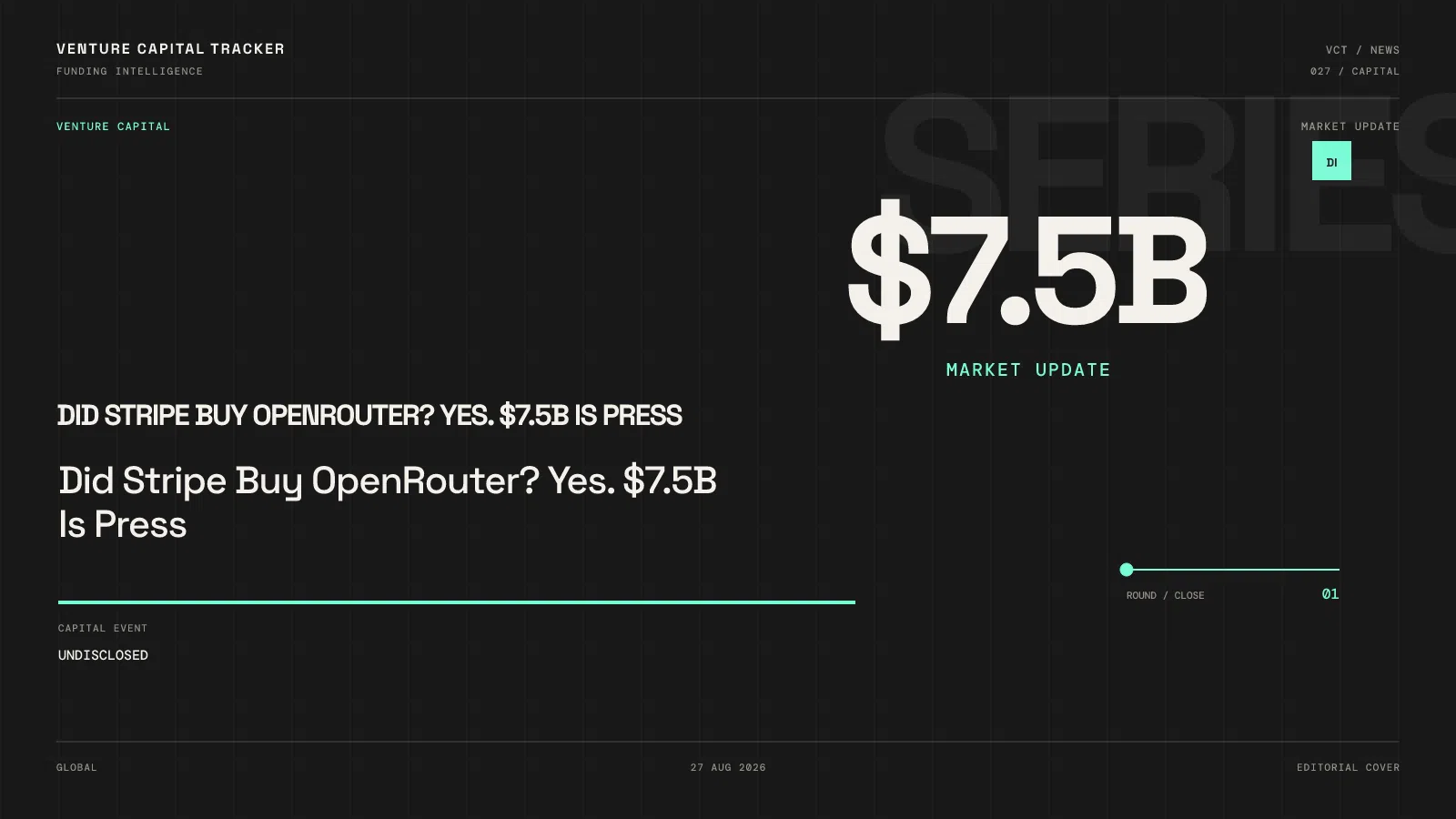
Current status (November 11, 2026): OpenRouter is owned by Stripe. The purchase agreement was announced on August 19, and both companies confirmed completion on November 10. The final purchase price was not disclosed; reporting put it around $7.5 billion. Read VCT's acquisition analysis.
OpenRouter explained in 30 seconds
| Question | Short answer |
|---|---|
| What does OpenRouter do? | Gives one API to 600+ models from 80+ providers, according to its current developer and pricing pages |
| Who is it for? | App developers, agent builders, platform teams and organizations using multiple models |
| Does it create models? | Primarily no: it brokers inference access and manages routing across model and hosting providers |
| Is it free? | A free plan offers 25+ free models, subject to daily and per-minute limits |
| What do paid plans cost? | Standard: provider list prices plus 5.5% on credit purchases; Business: 8% on credit purchases |
| Does it host my models locally? | No; standard OpenRouter requests are sent to eligible upstream inference services |
| Who owns OpenRouter? | Stripe, following the completed November 10, 2026 acquisition |
| Is it open source? | The hosted OpenRouter marketplace is not an equivalent self-hostable open-source gateway, although it offers open SDKs and developer tools; LiteLLM is a different, self-hostable option |
The key distinction is that a model is not the same thing as a provider. For example, an open-weight model may be hosted by several infrastructure companies. OpenRouter can offer multiple endpoints for the same model, which creates fallback, regional and performance choices not present when tied to one endpoint.
How OpenRouter works: the request path
A simplified request follows five steps:
- Your app sends a request to the OpenRouter API endpoint with a model identifier and a user message.
- OpenRouter authenticates the account, checks key limits, remaining credits, available models and configured policies.
- The routing layer selects an eligible endpoint. A customer may pin a particular provider or allow the system to consider cost, latency, throughput and reliability. Some configurations use an Auto Router to choose among models.
- The inference provider processes the prompt. The upstream endpoint runs the model and returns its response; application-level streaming can relay tokens as they arrive.
- OpenRouter meters and records usage, and charges credits or applies a bring-your-own-key arrangement. A provider failure may trigger an eligible fallback; errors can still affect response time.
This distinction matters commercially. A conventional single-model API sells inference access. A multi-model gateway can additionally sell the convenience of model selection, failover, procurement and cost control.
For regulated workloads, do not mistake "one API" for "one data processor." Inference may still involve multiple providers, regions and subprocessors, depending on the selected model and policy.
How to use OpenRouter: your first API request
These steps use OpenRouter's public developer documentation. No paid plan is required to try an eligible free model, subject to availability and quotas.
- Create an account at OpenRouter.ai, then create an API key in the dashboard.
- Choose a model on the model catalog. Free model IDs and supported features can change; copy the current identifier from the model page rather than relying on an old tutorial.
- Set an environment variable called
OPENROUTER_API_KEY. Do not place the key inside a public webpage or client-side JavaScript. - Send an OpenAI-compatible request to the documented endpoint.
- Inspect the model identity, returned tokens, finish reason and actual usage cost before introducing retries or automatic fallback.
Example: minimal cURL request
curl https://openrouter.ai/api/v1/chat/completions \
  -H "Authorization: Bearer $OPENROUTER_API_KEY" \
  -H "Content-Type: application/json" \
  -d '{
    "model": "openai/gpt-4o",
    "messages": [{"role":"user","content":"Explain AI model routing in one sentence."}]
  }'
The model above is an illustration of API syntax, not a promise it is free or the least expensive model. Replace it with a model that is currently available on your account. To use the OpenAI Python SDK with OpenRouter, use the same model string and set base_url="https://openrouter.ai/api/v1".
Example: Python using the OpenAI-compatible interface
import os
from openai import OpenAI

client = OpenAI(
    api_key=os.environ["OPENROUTER_API_KEY"],
    base_url="https://openrouter.ai/api/v1",
)
response = client.chat.completions.create(
    model="openai/gpt-4o",
    messages=[{"role": "user", "content": "What is a model gateway?"}],
)
print(response.choices[0].message.content)
OpenRouter also publishes its own SDKs for TypeScript, Python and Go, a CLI, an MCP server and a Terraform provider. Those are different interfaces to the hosted service; the interface alone does not mean the hosted inference becomes local or free.
OpenRouter pricing in 2026: free, Standard, Business and Enterprise
OpenRouter's current pricing page lists four plans. The platform fee generally applies when purchasing credits rather than as a separate per-request inference markup.
| Plan | Public platform fee | Useful capabilities | Important constraints |
|---|---|---|---|
| Free | No platform fee | 25+ free models; chat and API; activity export | 50 requests/day, 20 requests/minute for eligible free models; no paid-model access without credits |
| Standard | 5.5% on credits | 600+ models, provider selection, API keys, fallback, budgets and policies | Pay provider list prices; provider capacity and policy restrictions still apply |
| Business | 8% on credits | Standard capabilities plus expanded administrative, region-routing and spend features | Some special controls remain enterprise-only |
| Enterprise | Contracted | Custom commercial arrangements, advanced governance, SLAs and support | Pricing, committed volumes and eligibility require a quote |
Free-model quota: OpenRouter says free usage is typically limited to 50 requests per day and 20 per minute. Buying at least $10 of credits can increase the daily free-model allowance to 1,000; provider availability and upstream limits can still interfere. Read the live rules before automating a free workload.
A worked price comparison
Assume your chosen models generate $1,000 of inference charges at the upstream provider's list prices and you purchase exactly enough Standard credits. The credit purchase fee would be $55, bringing the illustrative total to $1,055, excluding tax, other services and payment effects.
On Business, the same $1,000 of purchased credits would attract an $80 fee, or $1,080 total. This comparison says nothing about which plan offers superior operational value: Business adds capabilities Standard does not have.
What is OpenRouter BYOK?
Bring Your Own Key (BYOK) means using your existing provider credentials through OpenRouter. The upstream model provider bills the inference to your own account, while OpenRouter can still provide gateway capabilities. As of November 2026, Standard and Business include $25,000 of provider list-price inference per month through BYOK without an OpenRouter fee. Beyond that allowance OpenRouter says it charges 5% of equivalent list-price inference. Enterprise terms are custom.
Do not add the ordinary 5.5% credit fee to BYOK inference as if both automatically apply to every request. BYOK and credit-purchased inference have different charging arrangements.
Does OpenRouter automatically choose the cheapest model?
Not always. There are three decisions that are easy to conflate:
- Model choice: choosing, for example, a fast small model versus a large reasoning model for a task.
- Provider choice: choosing the upstream provider hosting a selected model.
- Failover: choosing another eligible endpoint when the first one returns an error or is unavailable.
OpenRouter supports explicit model IDs, ordered lists of fallback models, provider rules and an Auto Router. Its normal provider-routing algorithm tries to balance factors such as cost, observed speed and availability; the lowest nominal price is not always the best value when latency or retries affect task success.
For a production application, compare dollars per successfully completed task, not only dollars per million tokens. Caching, retries, output quality and tool-call reliability can move the economics substantially.
OpenRouter versus OpenAI: what is the difference?
OpenAI develops models and exposes first-party APIs. OpenRouter provides an intermediary API that can route requests to eligible OpenAI models and other model families from different companies. ChatGPT is an application for end users; an OpenRouter API credit balance is not the same thing as a ChatGPT subscription.
A useful rule of thumb:
| If you want... | Better starting point |
|---|---|
| Deep integration with features specific to a single provider | The provider's own API |
| One SDK, budget and provider-selection layer for many models | OpenRouter or another multi-model gateway |
| Full control of deployment and gateway logs inside your cloud | Self-hosted LiteLLM or another owned proxy |
| A ready-made conversational application | ChatGPT or a similar end-user product |
No gateway makes every model API feature perfectly interchangeable. Tool calls, multimodal payloads, reasoning controls, structured outputs and rate limits must still be tested.
Is OpenRouter safe and private?
Safety depends on the configured model endpoint, data policies, application logging, contractual terms and regional routing, not the brand name alone.
OpenRouter documents Zero Data Retention (ZDR) routing. In plain terms, it aims to ensure an eligible model endpoint processes input without retaining prompt and response content. However:
- The inference provider still sees the prompt to run the model.
- ZDR is not the same as staying inside your own infrastructure.
- ZDR does not by itself guarantee EU-only processing or cover third-party tools.
- Application and agent logs, traces, attached services and request metadata need separate controls.
- Model and provider availability may shrink when strict data policies are enabled.
For European organizations, examine the exact in-region-routing eligibility and the DPA for the chosen plan. OpenRouter's EU-region definition includes the EU/EEA and certain neighboring jurisdictions, which is not identical to processing exclusively inside European Union member states. If strict EU-only data residency is required, verify every participating processor rather than relying on a marketing label.
For security reviews, audit provider allowlists, endpoint retention, key rotation, regional coverage, access controls, telemetry destinations and behavior when no compliant fallback is available.
Is OpenRouter open source? Can I run it locally?
OpenRouter makes SDKs and integrations available, but its hosted multi-provider marketplace is not a drop-in self-hosted copy of OpenRouter's commercial service. Running Ollama or a self-hosted model is another choice entirely: you own the model hosting and compute costs.
For a local or private-cloud gateway that connects your own provider accounts, look at LiteLLM or Portkey's self-hosted offering. A self-hosted gateway improves control but requires maintaining its availability, keys, rate limits, instrumentation and upgrades.
See our independently organized OpenRouter alternatives comparison for the hosted versus self-hosted trade-offs.
When OpenRouter is a good choice—and when it is not
Good fit: a team experimenting with different frontier and open models; an AI product without established multi-vendor procurement; a coding agent workload needing backup endpoints; a fast-moving team that values one key and centralized usage reporting.
Less compelling: a team exclusively using one provider with an attractive direct contract; workloads requiring all model processing inside a private network; an enterprise needing provider-specific capabilities that are not yet exposed through the gateway; or a high-volume team with a sophisticated internal proxy and zero need for marketplace purchasing.
OpenRouter's value is real only if its operational benefits exceed its fees, new dependencies and migration complexity.
Who founded OpenRouter, how much funding did it raise, and who owns it now?
OpenRouter launched in 2023. Alex Atallah, one of its cofounders and its CEO, previously cofounded OpenSea. It evolved from developer tooling that helped switch among AI models into a model marketplace and inference control layer.
Its fundraising and exit history is especially relevant to infrastructure investors.
| Date | OpenRouter milestone | Evidence status |
|---|---|---|
| 2023 | Company founded | Company and investor history |
| June 25, 2025 | $40M combined Seed and Series A financing announced, led by a16z and Menlo, with Sequoia | OpenRouter press release |
| May 2026 | $113M Series B led by CapitalG; ~$1.3B valuation | Company-confirmed amount; media-reported valuation |
| August 19, 2026 | Stripe acquisition agreement announced; ~$7.5B reported price | Company agreement; press price |
| November 10, 2026 | Stripe and OpenRouter confirmed acquisition completed | Both companies |
Why the June 2025 amount needs care: OpenRouter's own announcement calls $40 million its combined Seed and Series A financing. Menlo described the investment as a Series A, while external databases vary in how they split the funding history. We use the company's description for VCT's canonical funding-event record rather than inventing additional financing.
For the company and investor data, see OpenRouter's startup profile, May 2026 Series B and Stripe acquisition deep dive.
The business model: how does OpenRouter make money?
OpenRouter charges a platform fee on purchased credits and sells higher-tier organizational and enterprise capabilities. It also offers BYOK with a defined free allowance and fee above it. Its model catalog lists provider inference prices separately.
Recognized revenue, total customer inference spending, gross credit purchases and number of tokens are different concepts. In October 2026 OpenRouter said it processed 790 trillion tokens, 76% on API keys it classified as agentic. These are strong activity signals, but are not audited financial statements and cannot be converted directly into a net revenue figure.
Stripe's acquisition can expand the product into richer usage metering, payments and cost management. Whether this improves customer economics while preserving model neutrality will be one of the key post-deal questions.
Frequently asked questions about OpenRouter
What is OpenRouter AI?
It is a hosted marketplace and API gateway for accessing multiple AI models and inference providers through one integration.
Is OpenRouter the same as OpenAI?
No. OpenAI builds AI models; OpenRouter routes requests to eligible models, including those from OpenAI and competing providers.
Is OpenRouter free?
There are free models and limited daily requests. Paid models and higher usage require credits or an eligible commercial arrangement.
How do I get an OpenRouter API key?
Sign in to OpenRouter, create a key in the dashboard, store it server-side as a secret, then use the documented API endpoint.
What is the OpenRouter API base URL?
For the OpenAI-compatible API, it is https://openrouter.ai/api/v1. Chat completions are sent to /chat/completions.
How much does OpenRouter cost?
Standard credits have a 5.5% purchase fee; Business credits have 8%, on top of the provider's listed inference usage. Enterprise pricing is contractual. Free plans have separate model and rate limits.
How does OpenRouter make money?
Primarily from platform fees on credits, BYOK fees beyond included allowances and enterprise arrangements. Gross model spend is not the same as its net revenue.
Can I use Claude or GPT models through OpenRouter?
Yes, when the relevant model and provider are available in the catalog and your account meets any access requirements.
Can OpenRouter run on my own computer?
The hosted OpenRouter service is not the same as locally hosting inference. You can run local models and a separate gateway, but that is a different architecture.
Is OpenRouter open source?
The hosted marketplace is a commercial service; developer tools and SDKs are available, but you cannot assume the entire production routing marketplace is self-hostable.
Can OpenRouter see my prompts?
OpenRouter and its configured inference pathway process requests to deliver answers. Retention and access depend on your settings and provider contracts; assess ZDR and application logging separately.
What happens if an OpenRouter provider is down?
Eligible provider or model fallbacks can handle some errors, but reliability depends on your configuration, remaining capacity and endpoint compatibility.
Who owns OpenRouter?
Stripe, after both companies confirmed the acquisition completed November 10, 2026.
How much did Stripe pay for OpenRouter?
The companies did not disclose the price; the New York Times reported about $7.5 billion.
Is OpenRouter publicly traded?
No independent OpenRouter stock trades on a public exchange following its acquisition by Stripe. Stripe itself is privately held.
How many models does OpenRouter offer?
Its November 2026 public pages advertise 600+ models across 80+ providers. The catalog and individual model availability change over time.
Which alternative should I consider?
For zero-markup hosted model access, evaluate Vercel AI Gateway; for self-hosting, LiteLLM; for edge-layer policies and logging, Cloudflare AI Gateway; and for production gateway governance, Portkey. Compare the exact features and fees you need.
VCT editorial methodology: product features and pricing are attributed to official OpenRouter documentation, financing to company and investor announcements, valuation to independently attributed reporting. This guide describes products as of November 11, 2026; plans and model catalogs may change.
Last updated:
Editorial note: AI tools assisted with research, structure, or drafting. Venture Capital Tracker retains human editorial responsibility for factual accuracy, relevance, and source quality before publication.