· Venture Capital · 25 sources · Updated · Verified
Stripe Completes OpenRouter Acquisition: Why the Reported $7.5B AI Gateway Deal Matters
Stripe completed the OpenRouter deal Nov 10, 2026. Investigate the reported $7.5B price, complete VC funding history, investor economics, AI gateway rivals and data-policy impact.

Editorial team
Investment event
OpenRouter
Updated November 11, 2026. Stripe confirmed at 19:42 UTC on November 10 that OpenRouter is now part of Stripe. OpenRouter independently confirmed the completion minutes later. This closes the acquisition agreement announced on August 19, 2026, 83 days earlier. Neither company disclosed the final consideration. The widely cited $7.5 billion figure comes from The New York Times, as reported by TechCrunch, not from a Stripe filing or company announcement.
The important question is no longer whether Stripe acquired OpenRouter. It is why a payments infrastructure company wanted to own the gateway through which developers buy, choose, measure and route AI intelligence.
Stripe–OpenRouter deal: the facts at a glance
| Question | Verified position as of November 11, 2026 |
|---|---|
| Has Stripe acquired OpenRouter? | Yes. Both companies said on November 10, 2026 that OpenRouter is officially part of Stripe. |
| When was it first announced? | August 19, 2026, as an agreement subject to closing conditions. |
| What did Stripe pay? | Not officially disclosed. The NYT reported about $7.5 billion; earlier reports ranged above $7 billion. |
| Previous OpenRouter valuation | Approximately $1.3 billion at its May 2026 Series B, according to contemporary financing coverage. |
| Latest published platform scale | 790 trillion tokens processed in October 2026, up 37% from September, according to OpenRouter's own reporting. |
| Users and model access | OpenRouter reports 10 million-plus developers and companies. Its current pricing page lists 600-plus models and 80-plus providers. |
| Will OpenRouter shut down? | The company says no: its brand, product, API and model-neutral mission remain. These are management commitments, not a contractual guarantee of future pricing or policy. |
Editorial distinction: The August announcement was an agreement, not a completed acquisition. November 10 is the new closing milestone. Conversely, the $7.5 billion figure is a reported transaction value, not a company-disclosed purchase price. Keeping those two distinctions separate matters when treating the deal as venture-capital exit data.
What is OpenRouter—and why is it valuable?
OpenRouter is a multi-model AI API marketplace and inference gateway, not a company developing a single foundation model. It gives builders one integration and credit balance through which they can call many different model families and inference providers. Developers can select a model directly or use routing and fallback rules based on cost, speed, availability and data requirements.
That matters because a production AI application might use a fast low-cost model for classification, a stronger reasoning model for difficult work, another model for code, and a backup provider when its preferred endpoint fails. Without a common gateway, engineering teams must manage separate contracts, API keys, data policies, price changes, failure modes and usage reports.
OpenRouter's practical product has several layers:
- Discovery and purchasing: access to hundreds of model options and multiple providers through one account.
- Inference orchestration: route to eligible providers using real observed throughput, latency, effective cost and reliability; optionally select models through Auto Router.
- Resilience: provider fallback and policy-aware routing, subject to eligible alternatives and compatible API features.
- Governance and economics: workspace budgets, API-key controls, usage analytics, organization policies, invoicing and spend visibility.
- Data controls: provider filtering, zero-data-retention settings and region-specific routing for eligible workloads. These are configurable controls, not blanket guarantees about all subprocessors or storage.
OpenRouter began in 2023. Menlo Ventures traces its predecessor to the Window browser-extension project, which initially supported four models. Cofounder and CEO Alex Atallah, also associated with the founding of OpenSea, built it with Chris Clark and Louis Vichy. The early bet was that no single model would be best at every task.
Even within AI gateways, a crucial distinction is frequently missed: OpenRouter's primary wedge was making many models accessible in one place; automatic selection is one additional product capability. Enterprise buyers pay for access, reliability and control as well as for any optimization algorithm.
A company that processed 790 trillion tokens in a month
OpenRouter's newly published October 2026 dataset is unusually useful evidence for assessing this acquisition.
| OpenRouter-reported metric | What it means—and what it does not |
|---|---|
| 790T tokens in October | Prompt plus completion tokens passing through OpenRouter; not verified paid token revenue. |
| +37% month over month | October traffic was 37% above September, on OpenRouter's own measurement. |
| Almost 25× January volume | Strong usage growth across 2026, but measured on this platform, not all AI inference worldwide. |
| 76% of tokens from agentic-classified API keys | About 600T tokens in October; OpenRouter's classifier uses seven signals, so this is its classification, not a census of all AI agents. |
| 57–70% lower effective token prices versus January | A mix of provider pricing, model choices and caching—not proof that gateway revenue fell by the same proportion. |
October's 790T tokens works out to approximately 25.5T per calendar day. OpenRouter said its agentic-key share grew from 8% a year earlier to 76% in October. The significance is structural: autonomous agents make repeated API calls, carry long context, retry failures and need cost controls over whole workflows.
The numbers also reveal a counterforce. Model token prices can decline while volumes increase explosively. That creates a larger need for orchestration but can pressure intermediaries' revenue per token. Do not convert 790T tokens into a dollar revenue figure by multiplying by a single advertised model price. The dataset includes distinct model prices, caching, free or excluded traffic and bring-your-own-key arrangements. OpenRouter does not publish audited gross transaction volume or recognized revenue with this data release.
How much did Stripe pay—and what was OpenRouter worth?
The cleanest price attribution remains about $7.5 billion, reported by the NYT and relayed by TechCrunch on August 19. Stripe's November close post contains no purchase price. Earlier negotiation-stage reports of figures approaching $10 billion should not be treated as the final agreement.
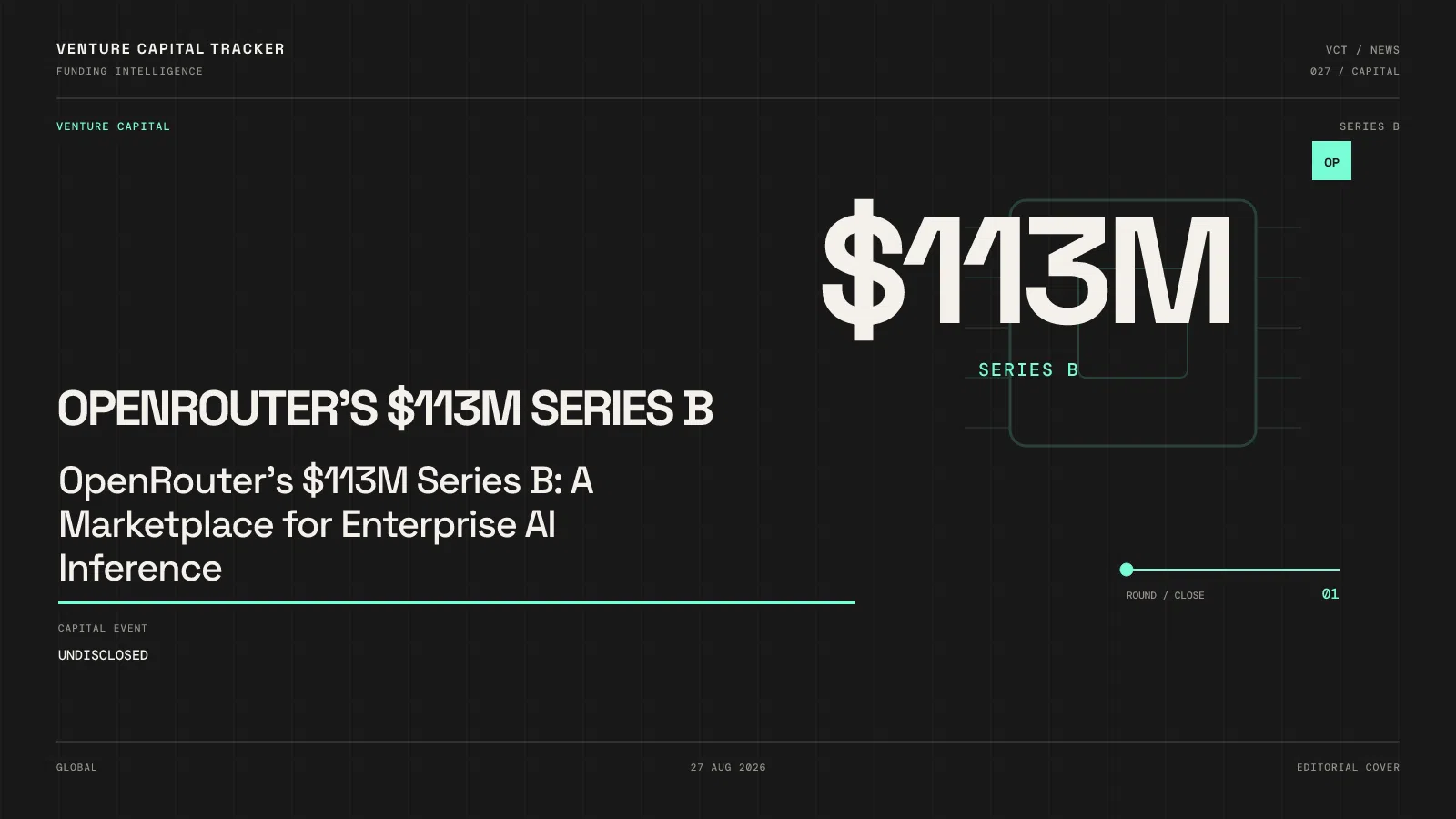
The last widely reported financing was OpenRouter's $113 million Series B in May 2026, led by CapitalG, at an approximately $1.3 billion valuation. If the reported $7.5 billion sale price is correct, that is a 5.8× comparison with the May post-money valuation within roughly six months. It is not a proven investor cash-on-cash multiple, because investor ownership, preferences, dilution, consideration form and distributions are not public.
Revenue multiples require even more care:
| Reference | Reported or estimated figure | Implied $7.5B / revenue |
|---|---|---|
| The Information, July 2026: recent annualized revenue | ~$140M | ~53.6× |
| Sacra, estimated August 2026 annualized revenue | ~$160M | ~46.9× |
Both denominators are annualized revenue estimates at different dates, not independently audited full-year revenue. They should not be described as 2026 GAAP sales or contracted SaaS ARR. OpenRouter earns a fee on credit purchases and offers enterprise contracts and BYOK; gross inference spending by customers is not automatically OpenRouter's own revenue.
The valuation is striking even using the higher August estimate. It suggests Stripe was paying for the growth, developer distribution and strategic position of the router as much as for current earnings.
Why Stripe bought OpenRouter—and why now
1. Stripe wants to manage AI costs as well as AI revenue
Stripe already helps businesses accept payments, detect fraud, handle tax, invoice customers and meter usage. OpenRouter adds the upstream decision about which AI model or provider serves a request, at what cost and with what latency.
Consider an AI SaaS company. Stripe can help it collect subscription or usage revenue. OpenRouter can help it understand and potentially reduce the inference expenses consumed in delivering that revenue. The combination creates the possibility of treating gross margin per agent, feature, workflow or customer as a live operating signal. This is a strategic interpretation, not a product Stripe has promised to deliver in this complete form.
2. The agent economy makes inference a variable cost of doing business
A human sends a few messages. A coding or research agent may generate hundreds or thousands of dependent requests. That turns model choice, cache efficiency, failures and retries into meaningful unit-economics variables. OpenRouter's October data—76% of tokens on agentic-classified keys—offers direct platform evidence that this shift is already under way.
3. Model choice is becoming a continuous optimization problem
Model launches, repricing, new providers and availability changes make a static one-model procurement strategy expensive to maintain. OpenRouter's October 28 provider-routing update said its new algorithm improved time to first token by 16.9%, throughput by 16.3% and reduced capacity errors by 46% in its measurements, with a 6% cost increase. These are vendor-reported experimental results, not a universal SLA. They show why routing infrastructure can create value even when the cheapest endpoint is not always best.
4. Stripe already knew the business
This was not a cold acquisition. In January 2026, Stripe described OpenRouter as an existing customer using its payments, invoicing, tax and fraud products, and described collaboration on token usage and billing. Stripe had also acquired usage-billing specialist Metronome earlier in 2026. The sequence makes a move from metering and billing AI usage to routing that usage commercially coherent.
5. Distribution and demand aggregation can reinforce each other
OpenRouter says more than 10 million developers and companies use it. A large multi-model marketplace has a potential two-sided flywheel: developer demand makes the marketplace attractive to model providers; provider breadth and availability attract more developers. Routing telemetry may improve purchasing decisions over time.
The last part is an investment thesis, not proof of an unassailable moat. Developers can switch gateways, large cloud providers have distribution advantages, and model labs can increasingly sell access directly.
Worked example: when does OpenRouter's fee actually pay for itself?
OpenRouter's current public pricing states 5.5% on Standard credit purchases and 8% on Business credit purchases; inference is billed at provider list prices rather than marked up separately on each request. Enterprise and BYOK arrangements differ.
Suppose an AI business otherwise pays model providers $300,000 per month directly. In this illustrative scenario only, assume a gateway-enabled model mix reduces equivalent inference cost by 15%, while meeting the same quality, latency and privacy targets.
| Illustrative monthly scenario | Amount |
|---|---|
| Original direct model spend | $300,000 |
| New model spend after assumed 15% optimization | $255,000 |
| OpenRouter Standard credit fee at 5.5% | $14,025 |
| Total modeled cost | $269,025 |
| Net modeled monthly saving | $30,975 (10.3%) |
This is not an observed customer saving. It excludes integration, monitoring, migration and payment-related costs, and assumes all relevant spend is purchased under the Standard fee. It illustrates the break-even question founders should ask.
If direct provider prices and OpenRouter credit prices are otherwise identical, an optimization must save more than approximately 5.2% of original model spend to offset a 5.5% purchase fee. At an 8% fee the threshold is about 7.4%. If routing does not lower costs or improve reliability and governance sufficiently, a direct provider account or alternative gateway may be cheaper.
This exposes a key tension in Stripe's strategy: OpenRouter earns platform fees from usage, while customers increasingly want to spend fewer dollars per completed task. A good router needs to preserve task success and output quality, not merely minimize price per million tokens.
Competitive landscape: OpenRouter versus alternative AI gateways
The field is not one homogeneous market. A hosted model marketplace, a self-hosted API proxy, an edge observability service and a hyperscaler model platform solve overlapping but different problems.
| Product or group | Where it competes | Likely customer advantage | Important trade-off |
|---|---|---|---|
| OpenRouter (Stripe) | Hosted multi-model marketplace and routing | Broad catalog, fast model discovery, one account, provider fallback | Hosted dependency, credit fees, ongoing neutrality and policy diligence |
| Vercel AI Gateway | Hosted unified AI access | SDK integration and competitive no-markup positioning | A different ecosystem and management surface |
| LiteLLM | Self-hosted AI gateway/proxy | Control over deployment, keys, routing and policies | Team operates the proxy, observability and reliability |
| Portkey | Managed or self-hosted gateway/governance | Guardrails, routing and production observability | Product configuration and commercial plan complexity |
| Cloudflare AI Gateway | Edge proxy, caching, logging and inference gateway | Edge distribution, traffic controls, analytics and Unified Billing | Different model-access and fallback patterns by configuration |
| Databricks AI Gateway | Enterprise model governance inside data/ML workflows | Alignment with existing enterprise data and ML governance | Best fit depends on Databricks adoption and model deployment |
| AWS Bedrock, Azure AI Foundry, Google Vertex AI | Cloud-native model access and serving | Cloud identity, procurement, regional and security integrations | Multi-cloud and provider portability can be narrower |
Adjacent competitors also matter: Ramp, Rippling and other finance platforms may control AI purchasing or employee spend without being a full model marketplace. Model labs and hyperscalers have their own gateways. These companies challenge the economic control point Stripe wants, though their products are not all interchangeable.
Menlo Ventures, an OpenRouter investor, argued in its August analysis that a router's deeper value comes from real-world model and provider performance data, developer distribution and enterprise trust—not merely choosing the cheapest model. Menlo's perspective is informative but comes from an investor with a financial interest in the transaction.
For enterprise buyers, the winning architecture may be a gateway they control in front of one or more marketplaces, rather than an all-or-nothing choice. That enables policy enforcement, testing and exit options independent of the commercial model marketplace.
Will Stripe change OpenRouter pricing, API access or model neutrality?
No immediate integration rewrite has been announced. OpenRouter says it is retaining its name, product, roadmap and commitment to treating models and providers on equal footing. Stripe and OpenRouter repeated that position on November 10.
But a policy promise is not the same as a structural guarantee. Developers should monitor five issues:
- Pricing and lock-in: whether credit fees, provider rates, enterprise commitments and BYOK allowances change after integration.
- Provider neutrality: whether recommendations or defaults systematically favor any partner, payment arrangement or commercial objective.
- Reliability: real failover behavior when the selected model, provider or routing service is unavailable.
- Privacy and data control: who processes prompts, what is stored and which regional guarantees apply to each service.
- Portability: how easily applications can change base URL, credentials, model IDs and observability exports.
As of November 2026, OpenRouter offers provider-level zero-data-retention controls and region-specific routing. ZDR does not necessarily cover external tools, app logs or all connected services. Its European routing scope includes the EU/EEA, UK and Switzerland, which should not be mislabeled as an EU-only guarantee; operational account and billing data can have different handling. Regulated teams need to inspect the actual agreements and tested request paths.
VC and investor implications: a valuable new exit category
OpenRouter's May 2026 Series B was led by CapitalG. Menlo Ventures has described backing the startup from seed through Series B; the broader investor history includes Andreessen Horowitz and Sequoia. The reported buyer interest from Databricks came from industry reporting, not a company confirmation of a losing bid.
If the reported sale price is right, this is a large potential liquidity event for the AI infrastructure sector. It also changes the exit map: a payment company can be a strategic acquirer of AI spend optimization and model distribution, even without manufacturing chips or training foundation models.
For venture investors, however, do not infer a precise fund return from the purchase price. Ownership percentages, liquidation preferences, rollover equity, cash-versus-stock mix and final transaction documents have not been established. Similarly, some press reports suggested a split of proceeds between founders and investors; that remains reporting, not a verified cap table.
The more durable thesis is that AI's control layers—identity, routing, metering, payments, security and evaluation—may command strategic premiums. The counterargument is that several of those layers can be bundled by clouds or commoditized by open-source tooling.
What could go wrong with Stripe's acquisition?
- Neutrality versus ownership: developers prize independent model choice; the owner has financial incentives to maximize its ecosystem's economics.
- Disintermediation: model labs can negotiate directly with large customers and build provider-side routing.
- Price compression: falling token prices can make per-token economics less attractive even while raw usage grows.
- Operational concentration: one gateway becomes a dependency for high-volume agent workflows, making outage and security controls critical.
- Regulatory and data complexity: AI traffic crosses model providers, regions and data-handling policies; integrating payments increases the surface to govern.
These are risks to monitor, not claims of misconduct or evidence that the integration is already failing.
VCT's assessment: the acquisition is about the AI consumption layer
Payments move money after a business creates value. Model routing sits earlier, where a business chooses which intelligence it buys, how much it pays and how reliably the work completes. Stripe's acquisition suggests it wants infrastructure on both sides of an AI company's operating margin.
A purely financial interpretation is incomplete. OpenRouter also brings a developer audience, provider relationships, a rapidly growing agentic workload and a high-frequency view of how the multi-model market is used. That combination—not simply an endpoint proxy—helps explain the reported premium.
The deal also sets up a testable prediction: if the merger works, product teams should eventually be able to optimize revenue, inference spending, user-visible quality and compliance through increasingly integrated tooling. Whether Stripe achieves that is an open question.
Complete OpenRouter investment and acquisition timeline (2023–2026)
What investors need is a dated funding-and-exit history, not a transaction price copied from an acquisition headline. VCT reconciled OpenRouter's company announcements with reported values and has four canonical investment milestones.
| Date | Event | Amount | Source standard |
|---|---|---|---|
| 2023 | OpenRouter launched | Not a financing amount | Company and investor histories |
| June 25, 2025 | OpenRouter announced combined Seed and Series A financing, led by a16z and Menlo, with Sequoia participating | $40M combined | OpenRouter press release |
| May 26–28, 2026 | Series B led by CapitalG; strategic and existing investors also participated | $113M raised; ~$1.3B reported post-money valuation | OpenRouter, CapitalG and financial reporting |
| August 19, 2026 | Stripe and OpenRouter agreed to the acquisition | ~$7.5B reported price; not officially disclosed | Both companies for agreement; NYT/TechCrunch for price |
| November 10, 2026 | Stripe confirmed OpenRouter is now part of Stripe; OpenRouter confirmed the same | Final consideration undisclosed | Both companies' official statements |
Important correction to common fundraising databases: OpenRouter's June 25, 2025 announcement used the wording combined Seed and Series A financing of $40 million. Menlo's investor note calls its involvement a Series A; some external databases report different underlying seed and Series A allocations. Without reconciliation to full filings, do not record a $40M Series A and also count the same company announcement as an additional $40M seed.
Different vendors have also put the May 2026 post-money valuation near $1.3 billion, and the earlier financing at roughly $500 million. These are reported benchmarks, not a verified current public-market share price.
For entity-linked records and sourcing, consult OpenRouter's company profile, the May 2026 funding article and our practical guide to OpenRouter.
Why do different websites report $7B, $7.5B, $8B and $10B?
These numbers reflect different reporting dates, source types and negotiation stages—not four independently verified purchase prices.
| Figure in circulation | How to interpret it |
|---|---|
| More than $7B | Bloomberg's pre-announcement reporting in August 2026 |
| ~$7.5B | NYT reporting covered by TechCrunch in connection with the August 19 agreement |
| More than $8B | Axios reported a cash-and-stock agreement valuation before the official company announcement |
| Up to roughly $10B | Earlier negotiation-stage reporting; not a verified final close price |
| Actual amount in company completion post | No amount disclosed |
There is no basis for selecting the largest number simply because it makes a more dramatic headline. Different press sources may have had different information, and terms could change from talks to agreement to closing. The published Stripe and OpenRouter completion statements are definitive on status, not price.
For VCT, we retain a reported $7.5B amount with its source attribution and confidence rather than represent the transaction as a confirmed $7.5B cash payment. The cash-versus-stock mix and ultimate investor distributions have not been established from the company disclosures.
Why would Stripe buy an AI model router instead of an AI model company?
The strategic choice is between owning the supply of models and owning the software layer that brokers demand among them. A single model developer competes in a fast-moving race to deliver superior intelligence and infrastructure. A neutral gateway can benefit from a growing number of providers, price changes and developer attempts to use several models together.
Stripe's thesis is that inference is becoming a billable, measurable operating cost. Stripe already helps customers collect revenue, manage payments and meter consumption. OpenRouter makes it possible to optimize or observe the costs that precede the revenue. That fits Stripe's acquisition of Metronome and development of token billing.
A gateway may also gather operational data on which providers work well for particular workloads. The benefit is not simply raw data collection: it depends on permissioned telemetry, reliability, privacy commitments, the breadth of marketplace demand and the team's ability to make good routing decisions.
The counterargument is strong. Model providers, hyperscalers and open-source proxies can implement parts of the same routing logic. Owning the switchboard is valuable only while customers choose to keep using it.
Can users still access OpenAI, Anthropic, Google and open models through OpenRouter?
Yes, eligible models from multiple providers remain available. OpenRouter's November developer documentation lists 600+ models from 80+ providers, and its leadership explicitly recommitted to provider neutrality when closing the Stripe transaction.
There is no published requirement in the acquisition confirmation that every existing user must move their billing to a new Stripe-only account or rewrite their API immediately. However, the absence of a forced migration notice is not a long-term guarantee against changes. Teams should monitor model availability, pricing, provider policies, keys and terms.
For practical specifics—how to create an API key, free-model limits, BYOK and data handling—read What is OpenRouter?.
Does Stripe own a moat—or just an interchangeable proxy?
The most useful distinction is a product moat versus a commercial moat.
Potential defensibility: OpenRouter's developer relationships, catalog breadth, model discovery UX, provider redundancy, aggregated performance signals and accounting integrations. Its October dataset showing 790 trillion processed tokens and a reported 76% agentic-key share gives evidence of meaningful usage scale, though usage figures are self-reported.
Potential weaknesses: the core idea of sending an HTTP request to one of several upstream model providers is reproducible. A self-hosted proxy such as LiteLLM may be attractive to sophisticated enterprises. Vercel advertises no provider-token markup; Cloudflare Unified Billing advertises a 5% credit fee. These alternatives put pricing pressure on OpenRouter's Standard fee.
So the relevant investment question is what a customer loses if it changes gateway, not whether a competitor can implement the same API signature. That may include model access, billing workflows, key policies, reliability, routing telemetry and integrations—but the importance of each differs by customer.
See our independent, source-backed comparison of ten OpenRouter alternatives.
A venture-capital perspective on reported returns—and why not to overclaim
A headline purchase price does not reveal investor ROI.
At a reported $7.5B, the deal value would be roughly 5.77× OpenRouter's May 2026 $1.3B reported valuation and 15× a roughly $500M earlier reported mark. These ratios compare company valuations, not cash returns to specific fund investors.
Calculating fund returns would require the investment cost and final fully diluted ownership for each round, secondary transfers, preferences, dilution, taxes, escrow, rollover equity and earn-outs. The NYT reported an allocation of proceeds among founders and investors, but those figures have not been established as a complete verified cap table.
An external investor analysis may estimate outcomes—for example, Dealroom has published modeled returns—but estimated individual proceeds are not the same as disclosed distributions. VCT does not use those estimates as booked proceeds in canonical investment events.
This transaction nevertheless demonstrates an important exit pattern: an AI infrastructure company without a frontier foundation model can achieve strategic value if it sits at an economically important junction between model producers and software buyers.
What users and investors should monitor after the November close
A completed acquisition is only the beginning of integration. The most decision-relevant next signals are:
- Developer retention and product breadth: do users keep OpenRouter accounts and continue selecting from the whole marketplace?
- Effective fees: do Standard, Business, BYOK and enterprise terms change, and does the average customer save money on completed workflows?
- Provider neutrality: are routing recommendations documented, explainable and contestable when commercial relationships change?
- Agent workload growth: does October's large agentic share continue, and does that growth create profitable usage?
- Enterprise compliance and resilience: are provider-level privacy policies, regions, key management, fallback and service reliability sufficiently transparent?
- Stripe integrations: do invoicing, token billing, spend controls and ultimately revenue-versus-inference-cost visibility become available as real products?
What would invalidate the bullish thesis? A sustained decline in relevant developer adoption, narrowing model access, inability to deliver operational cost savings, or the migration of larger customers to self-hosted or cheaper alternatives. These are scenarios to monitor, not present facts.
Additional questions people search about Stripe and OpenRouter
When did Stripe buy OpenRouter?
The companies announced an agreement August 19, 2026 and completion November 10, 2026. Earlier reporting should not be mistaken for the close date.
Who founded OpenRouter?
OpenRouter was founded in 2023. CEO and cofounder Alex Atallah, who also cofounded OpenSea, helped develop it with colleagues including Chris Clark and Louis Vichy.
Is OpenRouter now a Stripe product?
OpenRouter is owned by Stripe but says its brand and existing marketplace product continue. That differs from claiming every API, account or invoice has already been combined.
Will OpenRouter prices rise after Stripe's purchase?
There is no verified announced blanket price increase in the November completion statements. Pricing can change over time; compare the live plan page and test your particular workload.
Who profited from Stripe buying OpenRouter?
Founders, employees and investors may benefit according to their contractual equity interests. Named earlier investors include a16z, Menlo Ventures, Sequoia and CapitalG. Exact distributions are not company-disclosed.
Can investors buy OpenRouter stock or Stripe stock?
OpenRouter has no separate public listing following its acquisition. Stripe is a private company, so there is no ordinary listed Stripe common stock to buy through a typical public broker. Public funds' indirect exposure, if any, is a separate investment question and should never be inferred from a fund name alone.
Does Stripe's ownership make OpenRouter less private?
An ownership change does not automatically disclose a new prompt-retention or processing policy. Teams should inspect published terms, subprocessors, data retention, routing configuration and updates as they occur, rather than assume either improvement or deterioration.
Is OpenRouter simply an OpenAI reseller?
No. It is a multi-provider API and routing marketplace, with support for models from multiple companies and providers. OpenAI is just one family of models it may expose.
Frequently asked questions
Did Stripe acquire OpenRouter or just announce plans to buy it?
It acquired OpenRouter. The companies announced an agreement on August 19, 2026, then said on November 10, 2026 that OpenRouter was officially part of Stripe.
How much did Stripe pay for OpenRouter?
The final price was not officially disclosed. The New York Times reported approximately $7.5 billion. Use that figure with a clear attribution, not as a confirmed company-reported price.
What is OpenRouter used for?
OpenRouter provides an API gateway and marketplace for accessing many AI models and providers, with unified purchasing, failover, usage analytics, model selection and governance controls.
Is OpenRouter still independent?
No, not as a standalone owner-controlled company after the close. It operates under Stripe ownership while management says it will preserve the OpenRouter brand, model choice and product roadmap.
Is OpenRouter free after the acquisition?
At the November 2026 verification, OpenRouter's pricing page still lists a free tier with limited free models and request caps. Paid Standard credits carry a 5.5% platform fee. Future pricing can change.
Does OpenRouter send my prompts to Stripe?
The closing announcement does not by itself document a change in prompt processing. Data moves through the selected inference providers under configured policies; OpenRouter's documentation describes region routing and retention controls. Review updated DPAs, subprocessors and logging behavior before assuming any data-handling guarantee.
What are the main OpenRouter alternatives?
Depending on the use case: Vercel AI Gateway for managed model access, LiteLLM or Portkey for self-hosting and governance, Cloudflare AI Gateway for edge visibility and traffic management, and cloud-native offerings such as Bedrock, Vertex AI and Azure AI.
Does 790 trillion tokens mean OpenRouter earned billions in October?
No. Token counts are not equal to revenue; prices, caching, free usage, BYOK and pass-through spend all matter. Available revenue numbers are third-party annualized estimates, not an audited October income statement.
Related VCT research: OpenRouter company profile · Stripe company profile · OpenRouter's $113M Series B · The original August acquisition agreement.
Methodology: status and product commitments are attributed to Stripe/OpenRouter posts; platform volume and pricing are attributed to OpenRouter; acquisition price and annualized revenue are separately identified as media reporting and third-party estimates. All financial scenarios are illustrative. Last verified November 11, 2026.
Last updated:
Editorial note: AI tools assisted with research, structure, or drafting. Venture Capital Tracker retains human editorial responsibility for factual accuracy, relevance, and source quality before publication.