· Investment Strategies · 11 sources · Updated · Verified
OpenRouter $113M Series B: Investors, Valuation and Stripe Acquisition
OpenRouter's $113M CapitalG-led Series B, reported $1.3B valuation, June 2025 combined Seed/A financing, and completed Stripe acquisition analyzed.

Editorial team
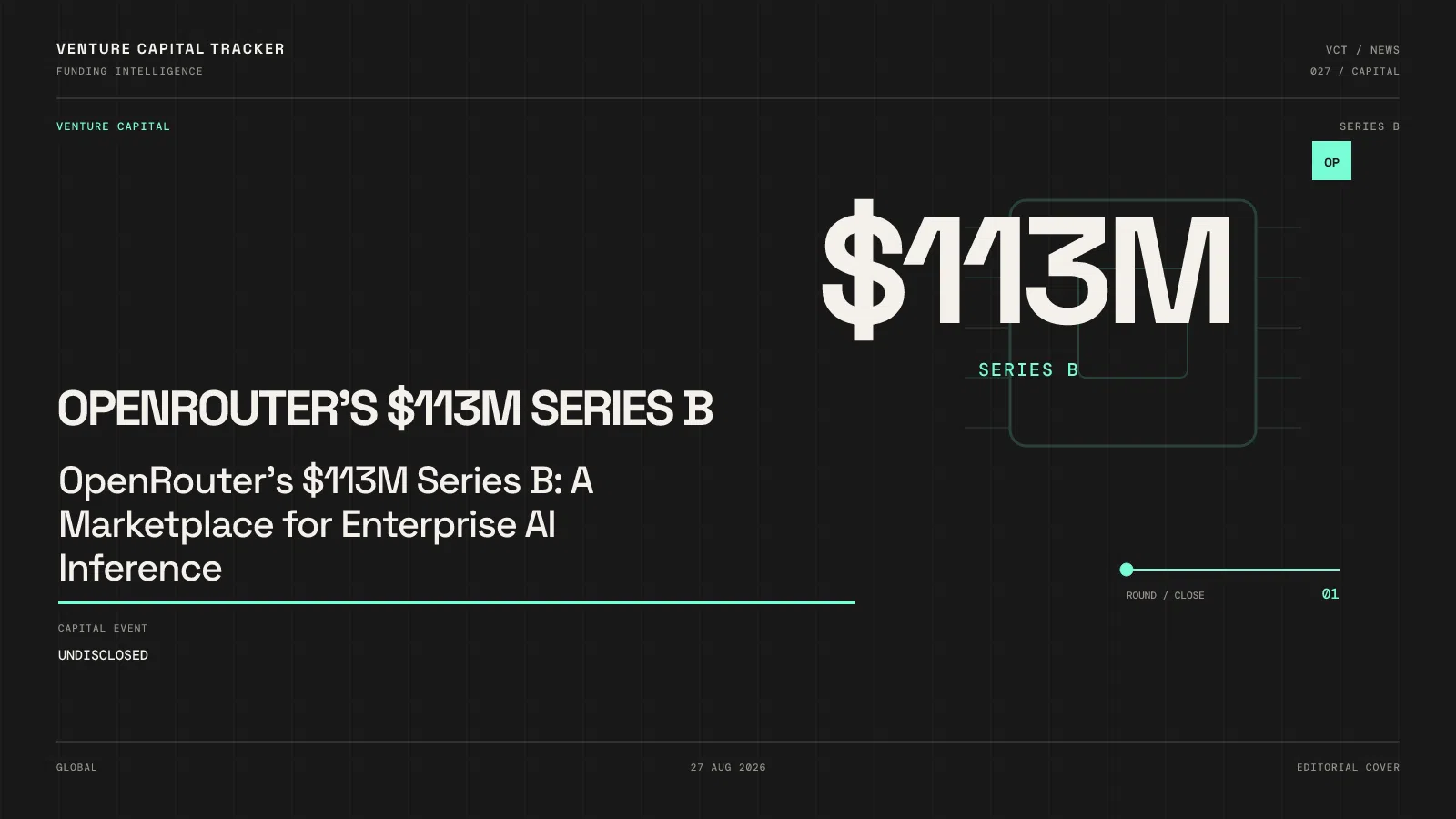
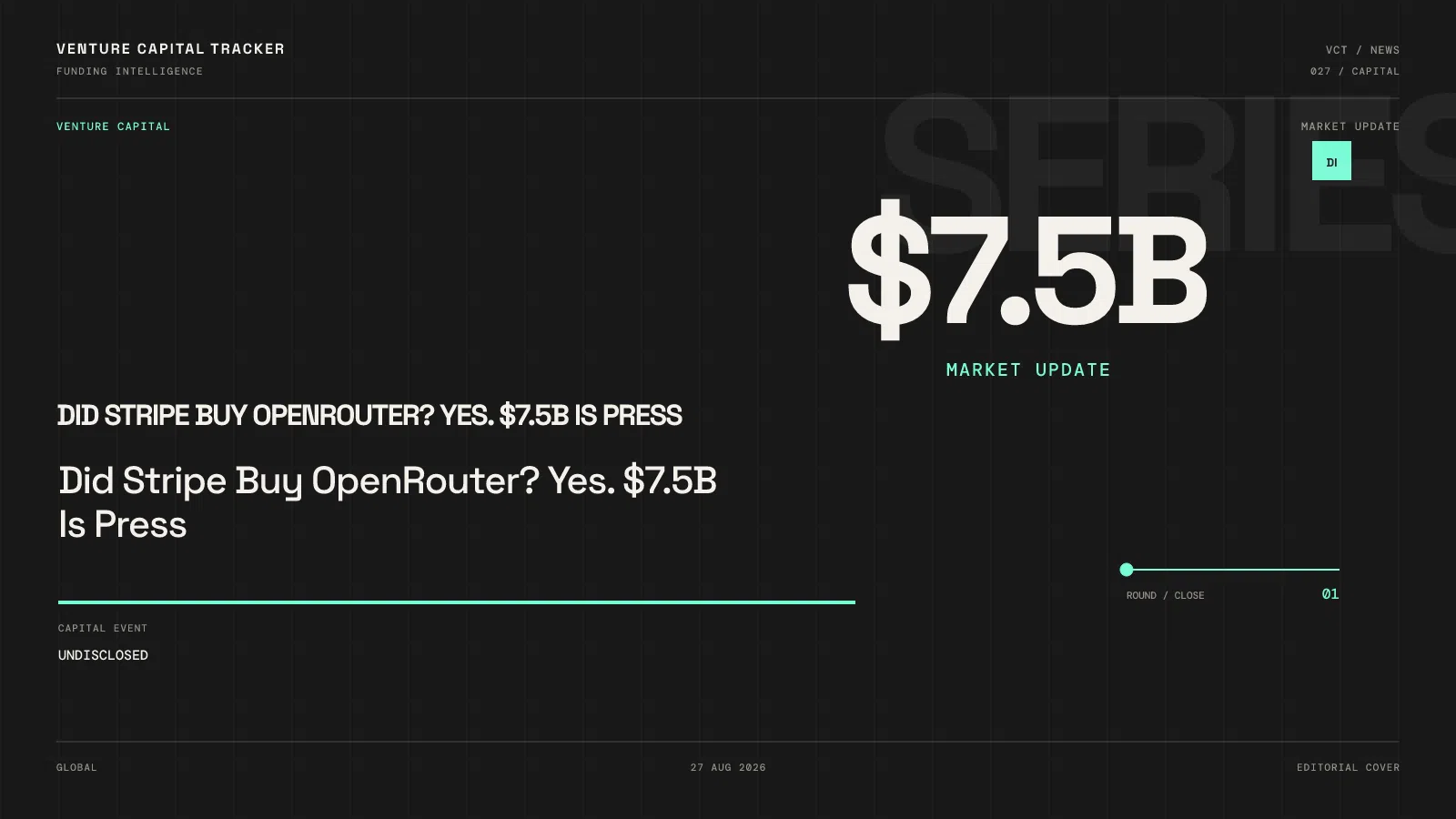
OpenRouter's $113 million Series B, led by CapitalG in May 2026, became a defining investment in the business of buying and routing AI inference. Within six months, Stripe had completed its acquisition of OpenRouter, at a transaction value reported around $7.5 billion—although neither company disclosed the final purchase price.
Deal details & investors
Funding event
OpenRouter
Led by CapitalG
Reported valuation $1.3B
This article separates the verified financing amounts, reported valuations and acquisition status, and examines why investors backed a company that did not build its own foundation model.
OpenRouter fundraising and acquisition at a glance
| Milestone | Date | Amount | What is verified? |
|---|---|---|---|
| Combined Seed and Series A financing | June 25, 2025 | $40M | OpenRouter's own press release says combined Seed and Series A; led by a16z and Menlo, with Sequoia participating |
| Series B financing | May 26–28, 2026 | $113M | OpenRouter's own Series B post and CapitalG's investment statement |
| Series B private valuation | May 2026 | ~$1.3B | Media-reported valuation; not an independently audited public-market figure |
| Acquisition agreement | August 19, 2026 | ~$7.5B reported consideration | Agreement confirmed by Stripe and OpenRouter; valuation is NYT/TechCrunch reporting |
| Acquisition completed | November 10, 2026 | Final price undisclosed | Both Stripe and OpenRouter confirmed completion |
Do not double count the June 2025 financing. OpenRouter's original press release calls the $40 million combined Seed and Series A financing, while Menlo Ventures described the round as a Series A. Third-party databases can split earlier securities or seed financing differently. The clearest source-backed public record is the company announcement; more granular allocations require company filings or reliable investment records.
What was OpenRouter's May 2026 Series B?
In its company announcement, OpenRouter said it raised $113 million, led by CapitalG, Alphabet's independent growth fund. Named participants included:
- Strategic investment arms: NVentures (Nvidia), ServiceNow Ventures, MongoDB Ventures, Snowflake Ventures and Databricks Ventures.
- Other participants: AMP PBC and Pace Capital.
- Existing investors: Andreessen Horowitz and Menlo Ventures.
The strategic-investor mix is notable. Cloud providers, infrastructure companies, data platforms and enterprise software firms all have an interest in making inference cheaper, more reliable and easier to manage across models.
What investors purchased was access to the decision layer: a service that could help enterprise applications decide which model and provider to call, and maintain visibility over the resulting costs.
The Series B valuation was widely reported around $1.3 billion. VCT treats this as an attributed private-market price, not a verified share price usable to infer exact fund proceeds.
What problem does the company solve?
OpenRouter, founded in 2023, provides one API marketplace across many AI models and inference hosts. Its developers can use one commercial and technical integration to buy model access, manage routing, see usage and configure provider policies. Model families may include systems from OpenAI, Anthropic, Google and open-weight model developers.
For production infrastructure teams, those capabilities sit across four costs:
- Procurement cost: accounts, credits, limits and access across providers.
- Engineering cost: integrating and updating different API interfaces and model IDs.
- Reliability cost: failures, rate limits, retries and degraded providers.
- Inference cost: token prices, caching, latency, model selection and workflow success.
OpenRouter's value is not merely the ability to forward an HTTP request. It combines the marketplace, developer distribution and routing telemetry. Whether that becomes a durable moat depends on competition with Vercel AI Gateway, LiteLLM, Cloudflare AI Gateway, Portkey and cloud-native platforms.
For product details, see What is OpenRouter? and our alternatives comparison.
The growth signal: October's 790 trillion tokens
In its October 2026 report OpenRouter said its platform processed 790 trillion tokens during the month, approximately 25.5 trillion per calendar day. It classified 76% of October token usage as coming from agentic API keys.
These are company-reported usage metrics, not a number independently audited by VCT. Nor is 790 trillion tokens the same as recognized revenue: free usage, input/output mix, models, discounts, prompt caching and bring-your-own-key arrangements affect the conversion to billable activity and profit.
The agentic shift matters economically. Agents may call models repeatedly as they plan, evaluate, retry, use tools and write outputs. That makes inference spend and latency a recurring operational variable, not a one-off cost per user message.
OpenRouter's valuation: from reported $500M to $1.3B to a $7.5B transaction
The financing record has several competing reported valuations. External databases have estimated a $500M valuation around the 2025 financing and about $1.3B at the May 2026 Series B. The NYT, as cited by TechCrunch, reported a roughly $7.5B transaction with Stripe.
The arithmetic is straightforward only if you label the inputs:
| Reported comparison | Calculation | What it means |
|---|---|---|
| 2025 to May 2026 | $1.3B / $500M = 2.6× | Private valuation comparison, not investor ROI |
| May to Stripe reported deal | $7.5B / $1.3B = 5.8× | Sale-price-versus-round-valuation comparison |
| 2025 to reported deal | $7.5B / $500M = 15× | High-level company mark comparison |
It would be misleading to say every Series B investor made 5.8× in cash. The fund return depends on ownership, securities, dilution, secondary transactions, escrow, rollover equity, taxes, the acquisition payment structure and the share price applicable to each round. No complete verified cap table or closing distribution is public in the cited company notices.
Similarly, an annualized revenue estimate should not be divided into deal value and labeled a GAAP multiple without explaining the revenue definition. AI model spend flowing through a gateway is not automatically its own net revenue.
Why CapitalG and strategic investors were interested
The investment thesis has three distinct layers.
Diversification: no single model excels at every task. Enterprise applications need to switch or compare model families and hosting providers without maintaining many unrelated integrations.
Operations: authentication, credits, permissions, structured outputs, failover, real-time costs and model-policy enforcement matter when AI is in production.
Network dynamics: developers attract model suppliers; more model endpoints make the platform attractive to more developers; platform usage can support better reliability and routing decisions.
The main counterargument is commoditization. Open-source gateways can reproduce much of the API-proxy layer, and hyperscalers bundle inference with larger cloud services. Model labs can also sell directly to major customers. The marketplace and orchestration product must keep creating enough value to remain attractive at scale.
Why Stripe became the acquirer
Stripe already offers payments, invoices, usage metering and token-billing tools. OpenRouter provides a gateway for the cost of executing AI work. That creates the strategic possibility of connecting revenue and inference spending for a company's AI applications.
The acquisition timeline is specific: Stripe and OpenRouter announced their agreement on August 19, 2026, and both publicly stated on November 10 that the transaction had completed. The final price remained undisclosed; $7.5B is press reporting.
The combined business may help users identify cheaper or more reliable model routes and relate those costs to usage billing. This is a strategic interpretation, not a guarantee that every proposed integration is shipping.
Read VCT's full Stripe–OpenRouter acquisition analysis for the updated event chronology, competitor and fee comparison, open questions and VC exit economics.
Where the investment could succeed or disappoint
Bull case: agent demand grows, provider fragmentation persists, OpenRouter keeps developer trust and its distribution/telemetry delivers better cost and reliability outcomes than direct integrations.
Bear case: token prices decline faster than value capture, gateways become open-source commodities, larger customers bypass marketplaces and neutrality concerns accelerate migration.
Due-diligence metrics worth tracking: active developers, paid inference volume versus free tokens, take rate on purchased credits, BYOK adoption, model breadth, routing failure rates, average task cost, enterprise retention and any change to provider-neutral policies. Those are suggested metrics, not all figures that OpenRouter currently publishes.
FAQs: OpenRouter funding, investors and valuation
How much did OpenRouter raise in 2026?
$113 million in a Series B led by CapitalG, confirmed by OpenRouter's own announcement.
What was OpenRouter's Series B valuation?
Approximately $1.3 billion, as reported by financial media. Treat it as a private funding-round valuation.
Who invested in OpenRouter?
Named investors include CapitalG, Andreessen Horowitz, Menlo Ventures, Sequoia, NVentures and several enterprise strategic investment arms.
Was OpenRouter's 2025 Series A $40 million?
OpenRouter publicly announced $40 million of combined Seed and Series A financing in June 2025. Menlo referred to its investment as a Series A. Do not assume two separate $40M rounds.
Who acquired OpenRouter and when?
Stripe. Agreement announced August 19, 2026; acquisition confirmed completed November 10, 2026.
How much did the founders and investors earn?
Individual realized distributions are not company-disclosed. Press and third-party estimates do not establish investor cash proceeds.
Is the $7.5 billion Stripe price official?
No. It is NYT/TechCrunch reporting, whereas completion is confirmed by Stripe and OpenRouter.
Does OpenRouter's token volume equal its revenue?
No. Volume spans providers, usage types and pricing arrangements. Net recognized platform revenue is different from gross inference spend.
Last verified November 11, 2026; primary source and press figures distinguished throughout.
Last updated:
Editorial note: AI tools assisted with research, structure, or drafting. Venture Capital Tracker retains human editorial responsibility for factual accuracy, relevance, and source quality before publication.