· 7 sources · Verified
OpenAI Acquires Odessia: The $6M Sequoia-Backed Travel Agent, Deal Terms and Booking Economics
OpenAI acquired Odessia on November 10, 2026 for an undisclosed price. Examine its prior $6M Sequoia financing, booking workflow, $60M planned-travel claim, and what changes for ChatGPT.

Editorial team
Funding event
Odessia
Led by Sequoia Capital
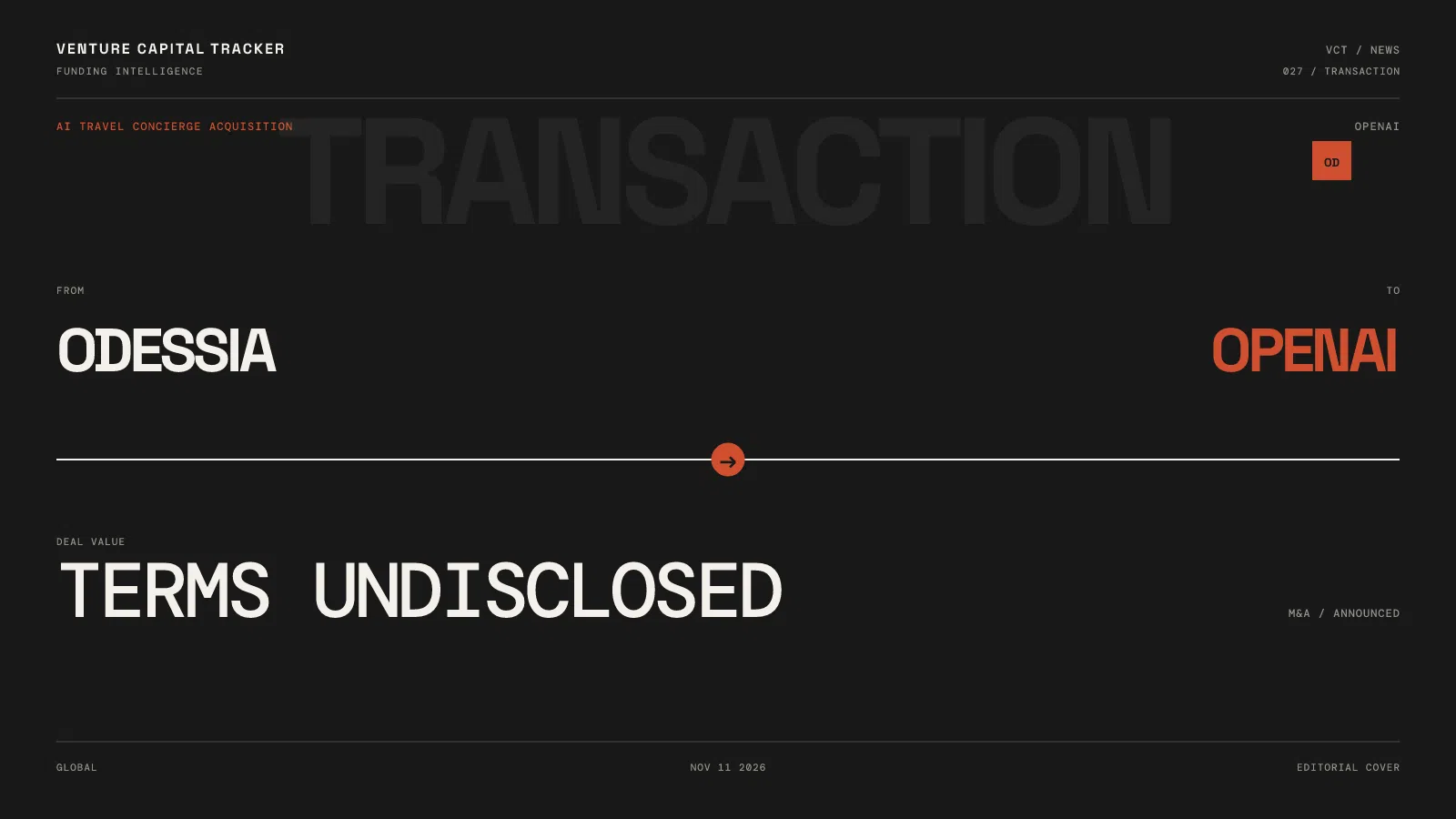
OpenAI acquired Odessia on November 10, 2026, bringing founder Francis Davidson—the former CEO and co-founder of Sonder—into its work on AI-powered travel. The acquisition price was not disclosed. The startup had previously raised a reported $6 million in Sequoia-led early financing, a separate transaction. Odessia's standalone travel service has stopped accepting customers; existing travelers are directed to its support team.
The deal matters because travel assistants cannot become useful booking agents simply by drafting itineraries. Actual transactions demand live inventory, ticketing, payment, refund handling and liability when plans change. Odessia built toward that more difficult end of the market, but OpenAI has not announced a specific Odessia-powered ChatGPT travel product.
What happened, and what is known?
| Question | Verified answer |
|---|---|
| Acquirer | OpenAI |
| Target | Odessia, an AI travel-planning and booking startup |
| Disclosure date | November 10, 2026 |
| Purchase consideration | Undisclosed |
| Prior financing | Approximately $6M, Sequoia-led, reported June 2026 |
| Founder | Francis Davidson, formerly of Sonder |
| Current Odessia service | Discontinued; support remains for existing bookings |
| OpenAI travel rollout | Not announced |
Odessia's own homepage is the strongest primary evidence for the acquisition and service closure. Sequoia's portfolio profile describes the original proposition. TechCrunch independently received confirmation from an OpenAI spokesperson that Davidson had joined. OpenAI's confirmation of the hire does not constitute public disclosure of the acquisition's economics.
What Odessia actually did: from travel idea to bookable itinerary
The product aimed to replace the fragmented workflow of searching Google or metasearch, comparing accommodation across booking sites, maintaining a spreadsheet and then buying each element separately. In an illustrative historical customer journey, not a live test:
- A traveler describes dates, departure city, destinations, budget and preferences through a conversation.
- The agent compares possible transport, places to stay and experiences against those constraints.
- The traveler reviews a consolidated itinerary and price-shopped alternatives.
- Where supported, the product progresses from recommendations to reservations rather than merely exporting suggestions.
- After booking, the traveler relies on the booking provider or agent to resolve changes, cancellations and refunds.
Sequoia says Odessia could make itinerary elements instantly bookable. Specialist reporting by Skift describes an IATA-accredited travel agency and access to hotel content. That is a description of the company's reported operating capabilities, not confirmation that OpenAI inherited a specific ticketing accreditation or will operate as merchant of record.
Crucially, this journey cannot currently be completed on Odessia. Its own website says the service is no longer available and directs people with existing bookings to support.
Financing history: why $6M is not the sale price
Reports published around Odessia's launch identify $6 million of seed/pre-seed funding led by Sequoia Capital, announced around June 2026. Sequoia independently lists the company, although its public portfolio page does not state the investment amount or close date. The acquisition was announced November 10, with no disclosed cash value, stock consideration, retention package or earn-out.
| Period | Event | Amount |
|---|---|---|
| June 2026 (reported) | Sequoia-led early financing | $6M, reported |
| November 10, 2026 | OpenAI acquisition | Undisclosed |
A founder selling a business after raising $6 million does not establish a particular investor return: ownership percentages, preferences, dilution, consideration, transaction expenses and employee retention awards are unknown. Read the Odessia company profile and its canonical acquisition and financing records in VCT's investment feed for the structured chronology.
The $60M headline: planned travel is not revenue
Davidson said tens of thousands of early adopters planned more than $60 million of travel on an annualized basis through Odessia during the summer. PhocusWire's November 10 report attributes that claim to the founder.
There are at least four different financial measures a travel startup could report:
| Measure | What it tells investors | Does Odessia disclose it? |
|---|---|---|
| Planned travel value | Value associated with trips users considered or planned | Founder-reported annualized $60M+ |
| Confirmed gross bookings | Value of reservations actually transacted | Not independently established |
| Net revenue | Fees or commissions retained by the intermediary | Undisclosed |
| Gross profit | Revenue after relevant cost of sales | Undisclosed |
The hypothetical math is revealing. Even if $60 million were actual completed bookings—which has not been shown—a 5% commission would equal $3 million annualized revenue before cancellations, refunds, supplier terms, payment costs and servicing. This is an illustration, not Odessia's disclosed commission rate or revenue.
Why might OpenAI want a travel-booking team?
The market separates into four operational layers: conversational trip discovery, real-time shopping, transaction fulfillment and post-booking service. Many assistants are capable at the first layer. The harder competitive advantage is linking that reasoning to reliably available inventory, payments, air-ticketing rules and human help when reservations fail.
Odessia offers relevant product-development experience, a founder familiar with the hospitality business and reported experience building an agency-backed booking workflow. It is an inference—not an announced OpenAI strategy—that these assets could improve future agent-driven commerce.
The differentiation becomes clearer when compared with existing travel options:
| Alternative | Core strength | Unresolved question for AI agents |
|---|---|---|
| Booking.com | Hotel inventory, transaction and customer-service infrastructure | How much of the purchase journey remains inside an assistant? |
| Expedia | Flights, hotels, packages and travel merchant operations | Which party handles changes, refunds and customer disputes? |
| KAYAK | Travel comparison and metasearch | Can an assistant transact rather than redirect? |
| Mindtrip | Conversational trip planning and itineraries | What inventory and fulfillment responsibilities are integrated? |
| Google Travel | Broad travel discovery and maps context | How does search intent turn into a supported reservation? |
OpenAI already has travel-sector relationships. Buying a startup could complement those integrations—or introduce conflicts with suppliers—but an announced product architecture or commercial transition has not been disclosed.
What should travelers, investors and the industry watch?
For existing Odessia customers, the immediate issue is service continuity. A dissolved front-end does not make an existing flight or hotel booking disappear, but customers should keep confirmations and communicate through the support channel on the company's homepage.
For investors, several crucial terms remain unavailable: acquisition consideration, whether the whole team joined, asset and license transfers, liabilities for existing reservations, revenue, burn rate and any retention arrangement. TechCrunch described the transaction as resembling an acqui-hire; that is journalistic characterization, not an established legal deal structure.
For the industry, the test is not whether ChatGPT can create an attractive itinerary. It is whether a future assistant can consistently provide a current price, disclose the seller and terms, execute a booking with permission, and resolve a real-world interruption. Until OpenAI announces such a service, predictions of an imminent booking product or an immediate displacement of incumbent agencies are speculative.
Bottom line: OpenAI acquired a young, Sequoia-backed travel startup and hired its founder, while the standalone product shut down. The purchase price and future product roadmap are unknown. The story is about potential booking infrastructure and operating know-how—not $60 million of Odessia revenue or a disclosed $6 million acquisition.
Editorial note: AI tools assisted with research, structure, or drafting. Venture Capital Tracker retains human editorial responsibility for factual accuracy, relevance, and source quality before publication.