· Venture Capital Tracker · venture-capital
Taiyi Quantum Adds Undisclosed Round as Funding Tops RMB1B
Taiyi Quantum completed an amount-undisclosed round that lifted cumulative funding above RMB1 billion—rather than raising RMB1 billion in the latest round.
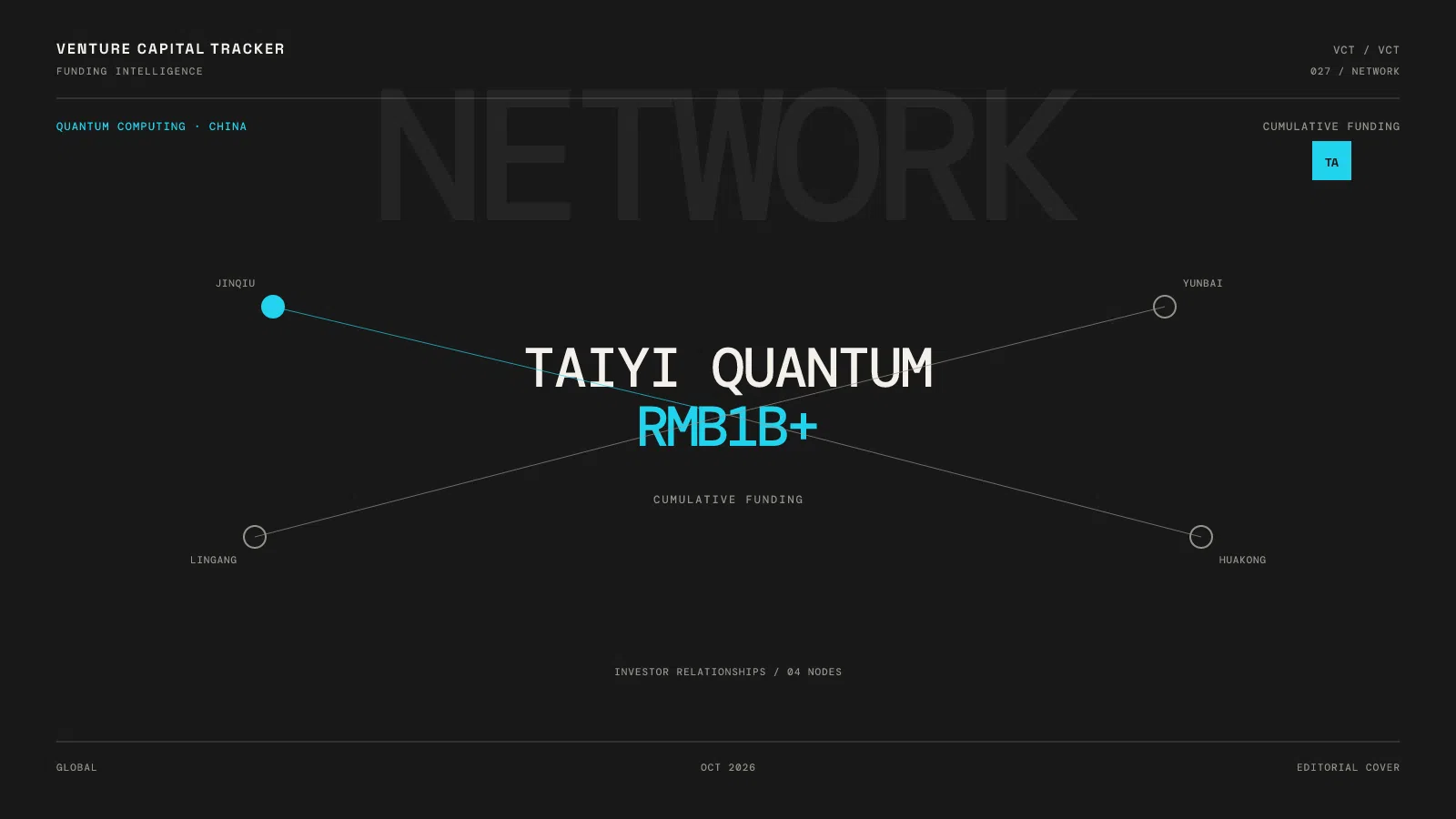
Shanghai-based Taiyi Quantum has completed a new financing round, taking cumulative funding since its January 2026 founding above RMB1 billion—about $140 million. The amount raised in the latest round was not disclosed.
That distinction corrects a misleading interpretation appearing in some English-language coverage. RMB1 billion-plus is the company's cumulative financing, not the size of the October round.
Taiyi Quantum financing: what is known
| Item | Detail |
|---|---|
| Latest round amount | Undisclosed |
| Cumulative funding | More than RMB1 billion |
| Formal stage | Undisclosed |
| New investors | Jinqiu Fund, Yunbai Capital, Hongruida Investment, Chengdu High-Tech Vision Fund and Lingang Frontier Investment |
| Returning investors | Huakong Fund, Hengxu Capital, Boyuan Capital, Gaomai Investment and Yarui Capital |
| Valuation | Undisclosed |
| Headquarters | Shanghai, China |
| Architecture | Ytterbium neutral-atom quantum computing |
Taiyi announced the financing on October 10. Chinese reporting says the capital will support international recruitment, quantum error correction, system engineering, industrial partnerships and an open-source developer ecosystem.
Eight months from founding to RMB1 billion
Taiyi was established in January 2026 by chief executive Fang Zhenghao, a technology investor and incubator, and chief technology officer Liu Hongbin, a former Microsoft Azure Quantum researcher.
Its early financing cadence has been unusually fast. Reporting identifies an approximately RMB100 million angel round followed by a RMB300 million Pre-A in July, led by Gaorong Capital and IDG Capital. The October disclosure lifts cumulative funding above RMB1 billion, but the company did not break out the new money or identify a lead.
That means VCT does not infer the latest-round size by subtracting earlier disclosed rounds. The cumulative figure may incorporate additional tranches, instruments or previously unreported capital.
Why neutral atoms are attracting capital
Neutral-atom systems use lasers to trap and manipulate atoms that act as physical qubits. The architecture can create flexible arrays and does not require the extreme cryogenic conditions used by superconducting systems.
Those characteristics make neutral atoms a plausible route to larger systems, but physical qubit counts are not the commercial objective. Useful fault-tolerant computation depends on fidelity, error correction, logical qubits, uptime and the ability to execute valuable workloads reliably.
Taiyi says it integrated a prototype spanning vacuum, optics, controls and software within six months. It also reports real-time feedback latency below 10 microseconds for atom rearrangement and has open-sourced its Luoshu quantum compiler. These are company claims; public disclosures do not yet provide enough comparable performance data to establish an advantage over international peers.
Capital concentration and strategic policy
The investor group combines specialist funds, state-backed platforms and industrial capital. That mix reflects quantum computing's long development cycle and strategic importance.
China has made quantum technology a national industrial priority, while regional governments are financing laboratories, hardware companies and supply chains. Taiyi's Shanghai base places it near a growing quantum and semiconductor ecosystem.
State-linked capital can fund patient engineering work that would be difficult for a conventional software investor. It can also make commercial discipline harder to assess when technical milestones, regional development objectives and national strategy are all part of the financing case.
Competitive landscape
Taiyi competes with Chinese neutral-atom companies and international developers including QuEra, Pasqal and Atom Computing. It also competes indirectly with superconducting, trapped-ion and photonic approaches.
Each architecture trades off scale, control, fidelity, connectivity and manufacturability. There is no settled winner, and a large financing balance cannot substitute for logical-qubit demonstrations.
Taiyi's claimed full-stack approach may become an advantage if the hardware, control plane, error-correction research and compiler improve together. It also expands the execution burden: the company must coordinate nearly every layer of an emerging computing platform.
Commercialization remains early
Taiyi says it is exploring nuclear engineering, energy and chemicals, advanced materials, pharmaceuticals and finance. These collaborations appear to be research, proof-of-concept and workflow exploration rather than production quantum advantage.
The important distinction is between identifying a problem suitable for quantum methods and demonstrating that a quantum system solves it more usefully than classical high-performance computing.
The next disclosures should include:
- physical and logical qubit counts;
- gate and measurement fidelities;
- error-correction performance;
- system uptime and repeatability;
- customer access and paid usage;
- a clearer roadmap from prototype to manufacturable system.
What the financing actually signals
Taiyi has assembled enough capital to recruit globally and pursue a complete fault-tolerant system. The syndicate also shows that Chinese investors are willing to finance neutral-atom hardware before commercial benchmarks are settled.
But the most accurate headline is not that Taiyi raised $140 million in one round. It is that an amount-undisclosed October financing pushed the eight-month-old company's cumulative funding above RMB1 billion.
Follow Venture Capital Tracker in Google
Add VCT as a preferred source to make our venture-capital coverage easier to find in Google Search.
Editorial note: AI tools assisted with research, structure, or drafting. Venture Capital Tracker retains human editorial responsibility for factual accuracy, relevance, and source quality before publication.