· Venture Capital Tracker · venture-capital
Scarlet Raises $50M Series B to Certify AI Medical Devices Faster
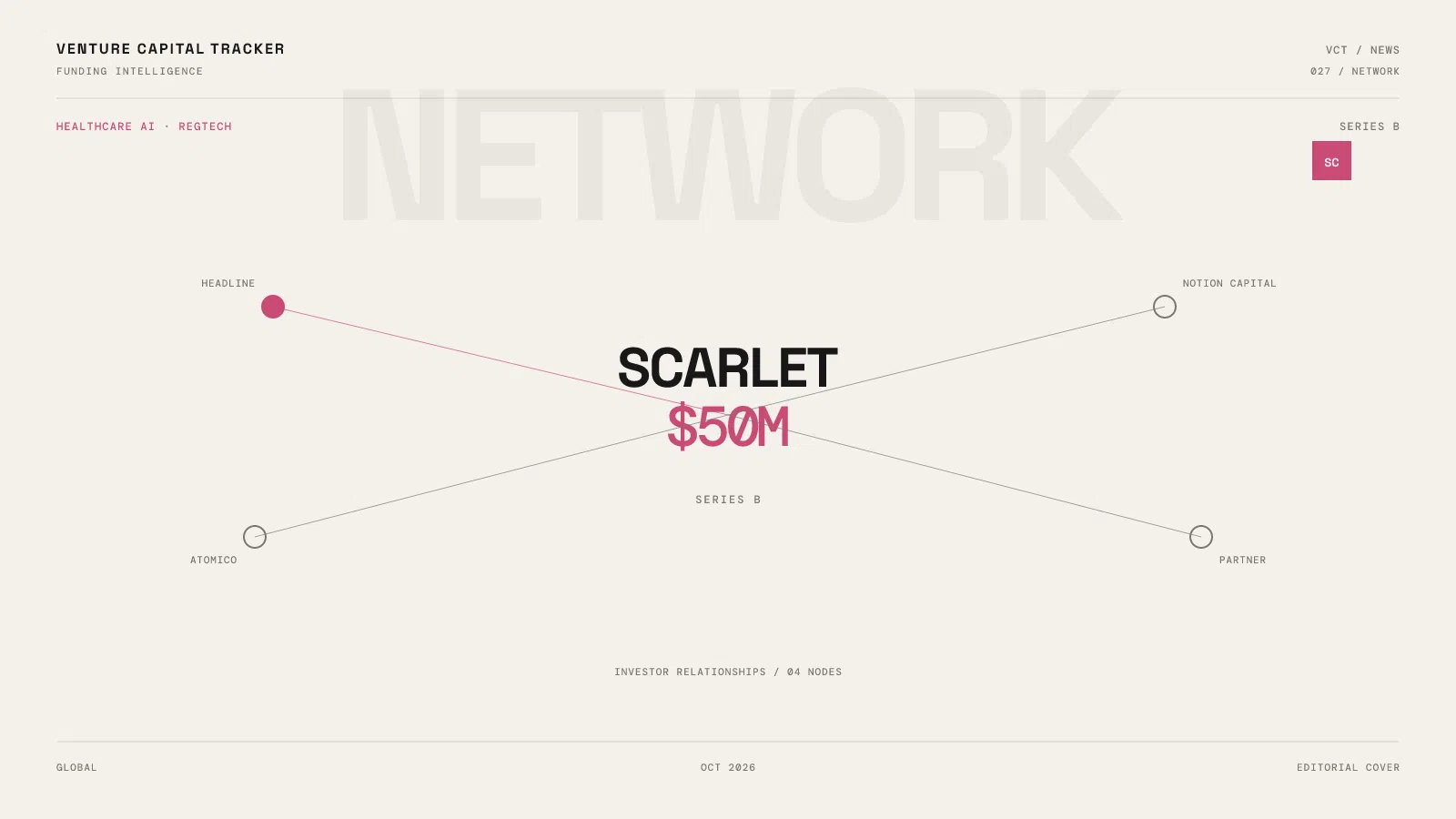
Headline led Scarlet's $50 million Series B, joined by Notion Capital and returning investors Atomico, Creandum, Kindred Capital and Entrepreneurs First.
Scarlet has raised a $50 million Series B to expand its certification platform for artificial intelligence and software-based medical devices.
Headline led the round. Notion Capital joined as a new investor, while existing backers Atomico, Creandum, Kindred Capital and Entrepreneurs First participated again. Scarlet did not disclose a valuation.
The financing brings Scarlet’s disclosed capital to more than $75 million when combined with its £6 million seed round in 2022 and $17.5 million Series A in 2024.
Series B snapshot
| Item | Detail |
|---|---|
| Amount | $50 million |
| Stage | Series B |
| Lead investor | Headline |
| New investor | Notion Capital |
| Returning investors | Atomico, Creandum, Kindred Capital, Entrepreneurs First |
| Valuation | Not disclosed |
| Use of funds | US and Asia-Pacific expansion, more expert reviewers and engineers, broader certification coverage |
The round is large for a company that does not build the medical devices themselves. Scarlet is financing the regulatory infrastructure that determines when those products can reach patients.
Why certification is becoming an AI infrastructure market
Medical-device regulation was designed around products that changed on hardware timelines. AI software can change weekly, yet a clinically meaningful model update may trigger documentation, risk-management and conformity-assessment work that takes months.
Scarlet’s thesis is that certification should become more continuous without weakening the expert judgment behind it. Manufacturers submit technical documentation through its platform; qualified reviewers assess the evidence against the applicable requirements; and the subscription relationship covers surveillance, annual audits and product changes.
That workflow attacks a structural mismatch: software teams iterate quickly, while certification capacity remains scarce and largely document-driven. Scarlet says customers have cut a year or more from some certification timelines and reduced update cycles from months to weeks. Those are company claims, not independently audited performance data, but they explain why investors see a scalable business rather than a conventional consultancy.
Regulatory authority is the moat—and the constraint
Scarlet’s defensibility depends on formal recognition, not software alone.
The UK government lists Scarlet NB UK as Approved Body 8536 for medical devices. The European Commission lists Scarlet NB B.V. as notified body 3022 under the Medical Devices Regulation. Scarlet and its investors also say it is recognized by the US Food and Drug Administration as a third-party review organization for eligible 510(k) submissions.
Those designations create a high barrier to entry, but they also limit how quickly the company can scale. Certification decisions require qualified personnel, documented independence and regulator confidence. AI may accelerate evidence handling, yet responsibility cannot simply be delegated to a model.
That makes the Series B a capacity bet. Scarlet plans to hire more expert reviewers and engineers, extend its services and grow in the United States and Asia-Pacific. The operational challenge is to increase throughput while preserving the consistency and accountability regulators expect.
Competitive landscape
Scarlet competes with broad certification incumbents including BSI, TÜV SÜD and DEKRA. Those organizations have global brands, large reviewer networks and coverage across many product categories.
Scarlet’s differentiation is specialization. It was built around software and AI medical devices, where continuous updates and model behavior create regulatory questions that are different from those surrounding a static physical device. If that focus produces faster, more predictable assessments, it could win a growing share of healthcare AI developers even while larger incumbents retain advantages in scale and geographic reach.
What the funding signals
The investment is a reminder that the healthcare-AI stack extends beyond models, data and clinical applications. Certification, monitoring, security and quality management are becoming investable infrastructure layers.
The commercial opportunity grows with the number of AI medical devices seeking approval, but so does regulatory scrutiny. Scarlet’s success will be measured less by how much automation it deploys than by whether regulators and manufacturers continue to trust the decisions produced by its combined software-and-expert process.
Key milestones after the Series B will be US and Asia-Pacific coverage, reviewer hiring, new certification scopes, and evidence that faster processing does not come at the expense of safety or regulatory acceptance.
Follow Venture Capital Tracker in Google
Add VCT as a preferred source to make our venture-capital coverage easier to find in Google Search.
Editorial note: AI tools assisted with research, structure, or drafting. Venture Capital Tracker retains human editorial responsibility for factual accuracy, relevance, and source quality before publication.