· Venture Capital · 8 sources · Updated · Verified
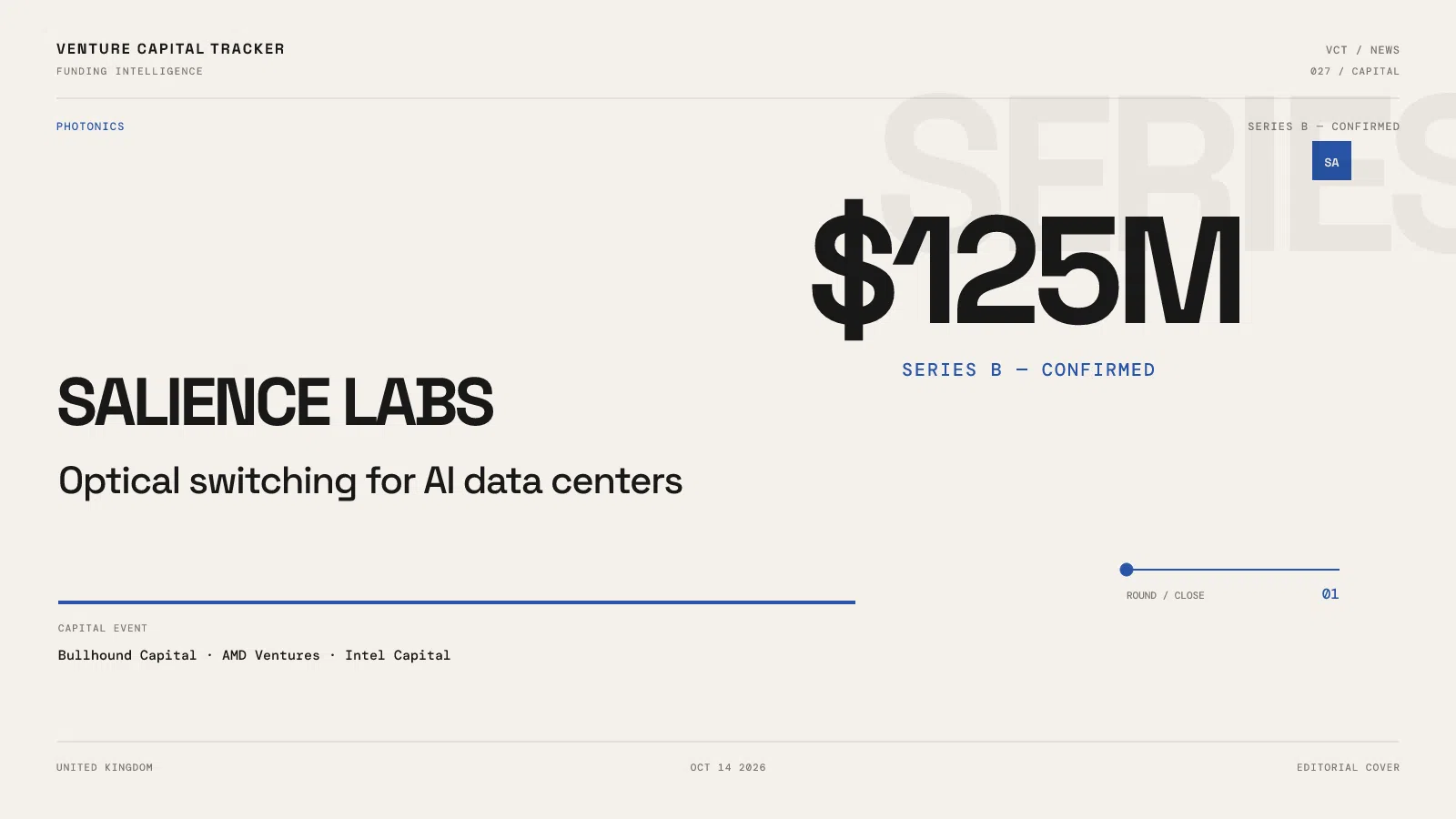
Salience Labs Confirms $125M Series B Led by Bullhound Capital
Salience Labs confirmed a $125M Series B led by Bullhound Capital, with AMD Ventures and Intel Capital, to scale optical switching for AI data centers.

By Venture Capital Tracker
Update, October 15, 2026: Salience Labs has now confirmed the financing first reported by City A.M. This article has been updated in place, with the original URL preserved. The transaction is a closed Series B, not an unconfirmed report.
Deal details & investors
Funding event
Salience Labs
Led by Bullhound Capital
Oxford-based Salience Labs announced the successful completion of an oversubscribed $125 million Series B on October 14. Bullhound Capital led; AMD Ventures, Intel Capital, SBI Group, Hudson River Trading and the British Business Bank joined returning investors. Bullhound principal Callum Stewart is joining the board.
The capital supports optical circuit switching, manufacturing scale-up and a larger Silicon Valley presence. Valuation remains undisclosed.
Confirmed transaction
| Item | Detail |
|---|---|
| Amount | $125 million |
| Stage | Series B |
| Status | Successful completion announced by company |
| Lead investor | Bullhound Capital |
| New participants | AMD Ventures, Intel Capital, SBI Group, Hudson River Trading, British Business Bank |
| Returning investors | Applied Ventures, Oxford Science Enterprises, Cambridge Innovation Capital, Silicon Catalyst Ventures |
| Valuation | Undisclosed |
Optical switching is becoming a cluster-economics question
Salience develops integrated optical circuit switches for connectivity between accelerators and racks. The company recently demonstrated a 64-port switch at ECOC and plans larger 128- and 256-port products.
The commercial argument is that expensive accelerators deliver poor economics if the network leaves them waiting for data. But a switch specification is only one part of the system. Operators must also evaluate reliability, optical loss, integration, software control and the effect on real workloads.
Optical circuit switching is not interchangeable with every kind of packet switch or photonic interconnect. Customers must decide where it fits in their architecture and whether the improvement justifies changing a proven fabric.
Why the syndicate matters
Bullhound is supplying financial sponsorship while AMD Ventures and Intel Capital bring semiconductor ecosystems. Their participation validates investor interest, not a disclosed purchase order or guaranteed design win. The announcement does not give the investors' individual check sizes or establish exclusive supply agreements.
The mix could help Salience navigate customer roadmaps and commercialization. It can also create competing requirements if different ecosystem partners want different product configurations. Maintaining an independent roadmap will matter as the company moves beyond demonstrations.
The manufacturing challenge
The capital can fund packaging, testing, qualification and the commitments required for volume production. Photonics businesses can encounter a difficult transition: a prototype may work while yields, assembly costs or lead times prevent attractive commercial margins.
Customer acceptance also takes time. A laboratory performance result does not tell an operator how the switch behaves through temperature variation, component aging or service disruptions. Nor does it establish that a larger port-count design will preserve the economics of the demonstrated product.
These are VCT's analytical execution risks, rather than claims of defects in Salience's technology.
Competition and the next evidence threshold
Salience sits alongside incumbent networking suppliers and photonic infrastructure developers including Lightmatter. Their products address different parts of the interconnect stack, so headline bandwidth or port counts alone do not create a valid head-to-head comparison.
For investors, the most informative milestones are repeatable manufacturing yields, customer qualifications, paid deployments and measured cluster-level benefits. The new round gives Salience resources to pursue them; it does not make adoption automatic.
Funding history and verification
The company previously disclosed an $11.5 million seed and a $30 million Series A. This Series B is materially larger, reflecting the capital required to turn a networking design into a volume-manufactured product.
VCT's earlier version correctly labeled the City A.M. report as unconfirmed at publication. The company's October 14 announcement now establishes the stage, lead and syndicate. The existing investment event and startup history have been updated, avoiding a second record for the same financing.
Follow Venture Capital Tracker on Google
Add VCT as a preferred source to see more of our venture-capital reporting in Google Search.
Last updated:
Editorial note: AI tools assisted with research, structure, or drafting. Venture Capital Tracker retains human editorial responsibility for factual accuracy, relevance, and source quality before publication.