· Venture Capital · 4 sources · Updated · Verified
Ramp Confirms $1.85B Primary Financing at $60B Valuation
Ramp confirms $1.85B of primary financing led by Dragoneer at a stated $60B valuation. Annualized revenue exceeds $2B, but is not software ARR.

By Venture Capital Tracker
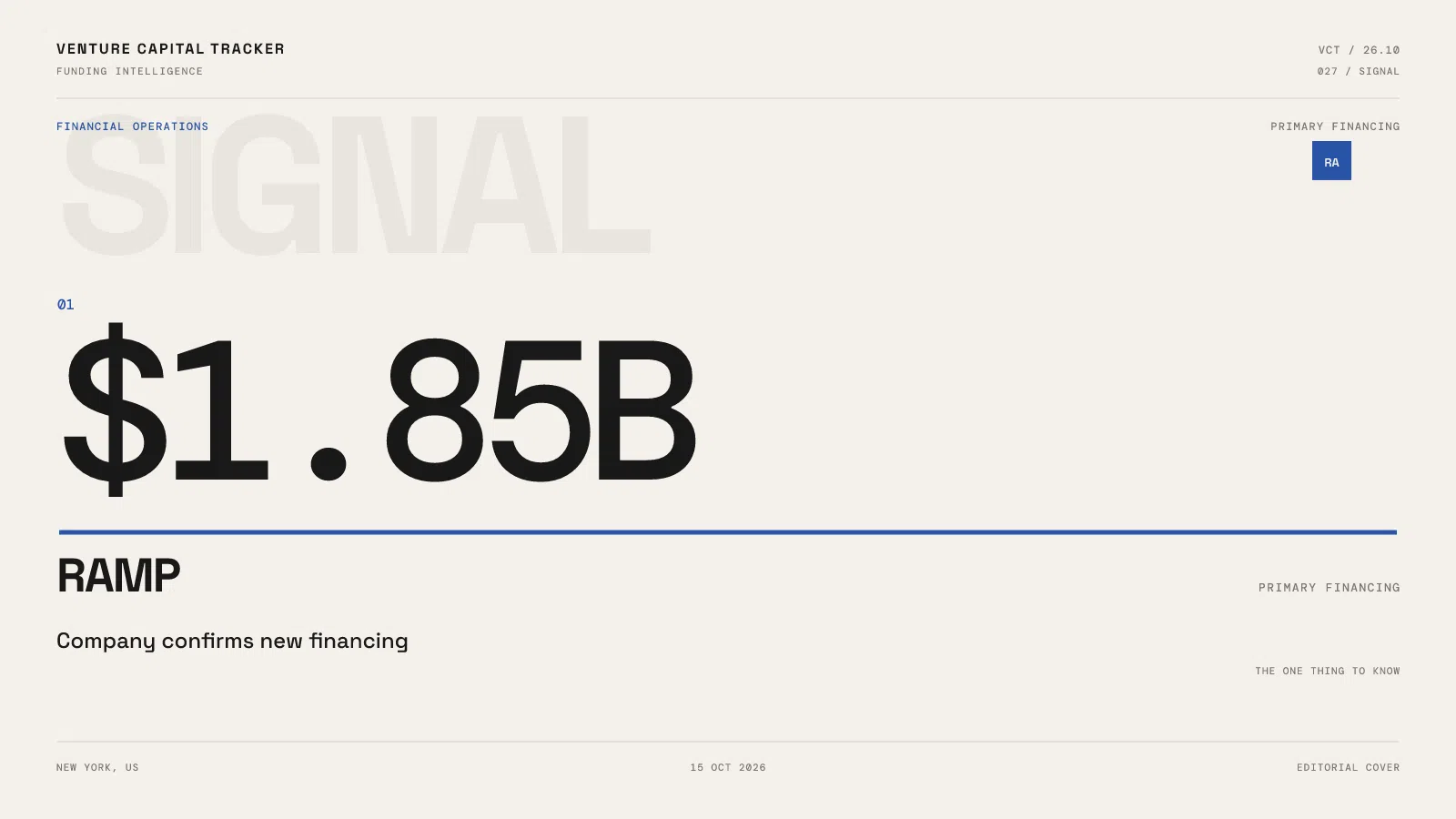
Ramp has confirmed $1.85 billion of primary financing, led by Dragoneer Investment Group, in an October 15, 2026 announcement stating a $60 billion valuation.
Deal details & investors
Funding event
Ramp
Led by Dragoneer Investment Group , Thrive Capital +3 more
Reported valuation $60B
This updates VCT's earlier coverage of the reported transaction. It is the same financing, not another $1.85 billion round.
What changed from the earlier report?
The company announcement establishes that the financing is primary capital. It names Thrive Capital, Founders Fund, Sands Capital and Avenir Growth as co-leads.
The release does not specify a formal series designation or label the valuation pre-money or post-money. Earlier reporting described $60 billion as pre-money. That attribution remains part of the reporting history, but VCT no longer presents a calculated $61.85 billion post-money value as a confirmed term.
The existing article URL is retained so readers and search engines reach the corrected record.
Who joined Ramp's financing?
Other participants named by Ramp include Capital International, Fidelity Management & Research Company, T. Rowe Price, D1 Capital Partners, Greenoaks, ICONIQ, GIC, 8VC, 1789 Capital, Alpha Wave Global, Ontario Teachers' Pension Plan, Coatue, D.E. Shaw, Definition Capital, FirstMark, General Catalyst, Generation Investment Management, Glade Brook Capital Partners, Khosla Ventures, Lightspeed Venture Partners, Pinegrove Opportunity Partners, Soma Capital and Stripes.
Individual checks were not disclosed. The company describes approximately $5 billion in total equity financing.
Why the revenue definition matters
Ramp reports more than $2 billion in annualized revenue and positive cash flow. Its definition includes interchange, subscriptions, interest and other revenue, net of customer incentives. That is not equivalent to $2 billion of software annual recurring revenue, and positive cash flow does not by itself establish net profit.
The distinction matters when evaluating a business spanning software and financial services. Different revenue streams can have different cost structures, capital requirements and sensitivity to customer activity. Applying a software multiple to an undifferentiated headline would hide those differences.
Our analysis is that investors should examine revenue composition and contribution economics before using the financing valuation as evidence of software-market pricing.
What is the strategic investment thesis?
Ramp is expanding its role from recording and approving business spending toward executing more of the work around it. The commercial logic is attractive: a customer already using a financial workflow may have adjacent problems the same platform can address.
But adding products creates its own test. Broader adoption should improve retention or customer economics without making implementation and support disproportionately complex. A large financing can fund expansion; it cannot establish that every adjacency will generate attractive returns.
AI-related spending is one such adjacency. Customers need a way to connect usage to budgets and business value. The strongest product would help a finance team understand an expense while preserving enough technical context for engineers to act on it.
What should the next numbers show?
The relevant questions are whether enterprise adoption remains durable, how product expansion changes revenue mix and whether operating cash generation persists as the organization scales.
Savings claims also need context. An observed improvement among customers does not automatically prove that the platform alone caused it. A sound evaluation should account for changes in customer spending, product mix and the comparison period.
For readers tracking this financing, the immediate factual gap has narrowed substantially: amount, primary-capital classification and the wider syndicate are now company-confirmed. Security terms, investor protections and a pre/post-money label remain undisclosed in the release.
Bottom line
Ramp's confirmation upgrades the story from reported financing to a company-disclosed raise. The analytical challenge now is judging a diversified financial-operations business on its actual revenue quality—not treating annualized financial-services revenue as software ARR.
Update note: Revised October 16, 2026 following Ramp's October 15 company announcement. Original publication date and URL are preserved.
- vc-news
- growth-financing
- startup-funding
- +1 more
Follow Venture Capital Tracker on Google
Add VCT as a preferred source to see more of our venture-capital reporting in Google Search.
Last updated:
Editorial note: AI tools assisted with research, structure, or drafting. Venture Capital Tracker retains human editorial responsibility for factual accuracy, relevance, and source quality before publication.