Atlas Atomics Reportedly Raises $400M at a $1.9B Valuation
Bloomberg reports Atlas Atomics is raising about $400 million at a $1.9 billion valuation. The company and named investors have not confirmed the round.
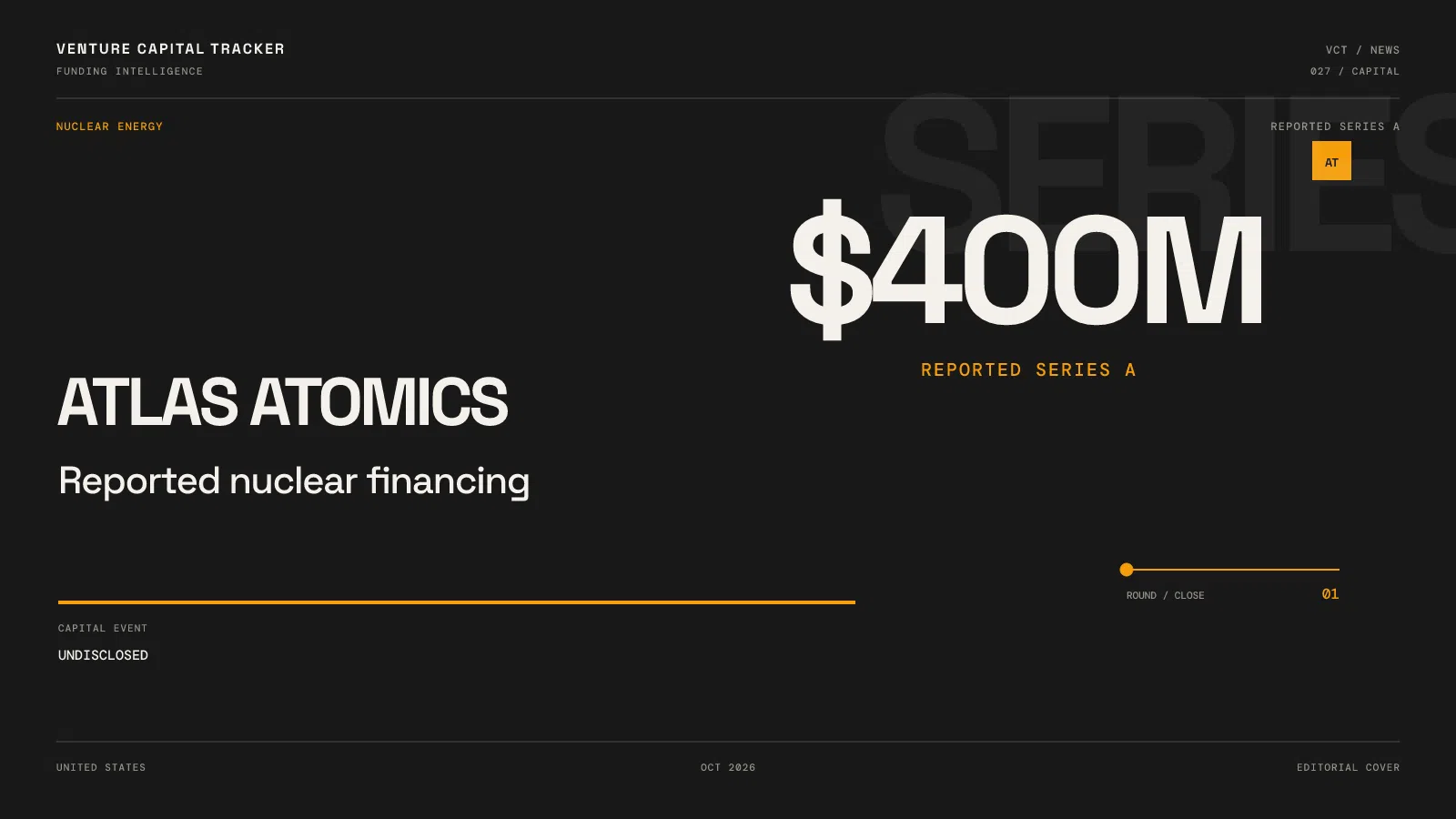
Atlas Atomics has reportedly raised about $400 million in a Series A at a roughly $1.9 billion valuation, an unusually large early-stage bet on advanced nuclear technology.
Bloomberg reported the financing based on people familiar with the matter. General Catalyst is said to be leading, with Andreessen Horowitz participating. Atlas Atomics and both investors declined to comment.
That qualification matters: this is a reported financing, not a company-confirmed close. The amount, valuation and investor lineup should remain attributed until one of the parties announces the transaction or a filing verifies it.
Reported Atlas Atomics financing
| Field | Reported detail |
|---|---|
| Round | Series A |
| Amount | About $400 million |
| Status | Reported; not company-confirmed |
| Lead investor | General Catalyst |
| Participant | Andreessen Horowitz |
| Valuation | About $1.9 billion |
| Original report | Bloomberg, October 8, 2026 |
Public reporting describes Atlas Atomics as a nuclear startup co-founded and backed by Vivek Ramaswamy. It is said to be developing improved heavy-water reactor technology that could operate without enriched uranium while producing electricity, medical and industrial isotopes and supporting fuel recycling.
Why the reactor design matters
Most advanced-reactor developers face a combination of fuel constraints, long licensing schedules and expensive first-of-a-kind construction. A design that avoids enriched uranium could reduce exposure to constrained enrichment capacity and geopolitical supply risks.
But that advantage remains theoretical until Atlas publishes more technical and regulatory evidence. The company has not publicly disclosed a detailed reactor design, licensing milestone, customer agreement or construction timetable.
The reported valuation therefore prices substantial future execution into a company still operating largely in stealth. Investors may be underwriting technical talent and a differentiated fuel strategy, but outsiders cannot yet evaluate the engineering claims with the same detail available for several advanced-reactor peers.
Competitive context
Atlas Atomics would enter a field that includes TerraPower, X-energy, Kairos Power and Oklo. Those companies have spent years working through licensing, demonstration projects, fuel procurement and customer agreements.
The comparison highlights Atlas’s opportunity and its disclosure gap. A large round could let the company hire quickly and fund early regulatory work. It cannot compress every part of nuclear development: safety analysis, component qualification and government approvals still take time.
The political profile of a co-founder may help attract attention and policy access, but it can also create governance and concentration risks. Nuclear projects ultimately depend on durable regulatory support that survives election cycles and changes of administration.
What would confirm the investment thesis
Four disclosures would materially improve the story:
- Confirmation that the financing has closed and whether $1.9 billion is pre- or post-money.
- A named reactor design, power rating and fuel-cycle description.
- A formal Nuclear Regulatory Commission engagement or licensing roadmap.
- Customer, site or demonstration agreements with realistic deployment dates.
Until then, the reported $400 million Series A is best understood as a major financing signal—not evidence that Atlas has solved the commercial and regulatory barriers that define advanced nuclear energy.
Follow Venture Capital Tracker in Google
Add VCT as a preferred source to make our venture-capital coverage easier to find in Google Search.
Editorial note: AI tools assisted with research, structure, or drafting. Venture Capital Tracker retains human editorial responsibility for factual accuracy, relevance, and source quality before publication.