Sabi Raises $50M Seed at Reported $600M Valuation for Brain-AI Cap
Sabi raised a $50M seed led by Khosla Ventures for a non-invasive brain-AI cap. Forbes reported a $600M post-money valuation, which the company did not confirm.
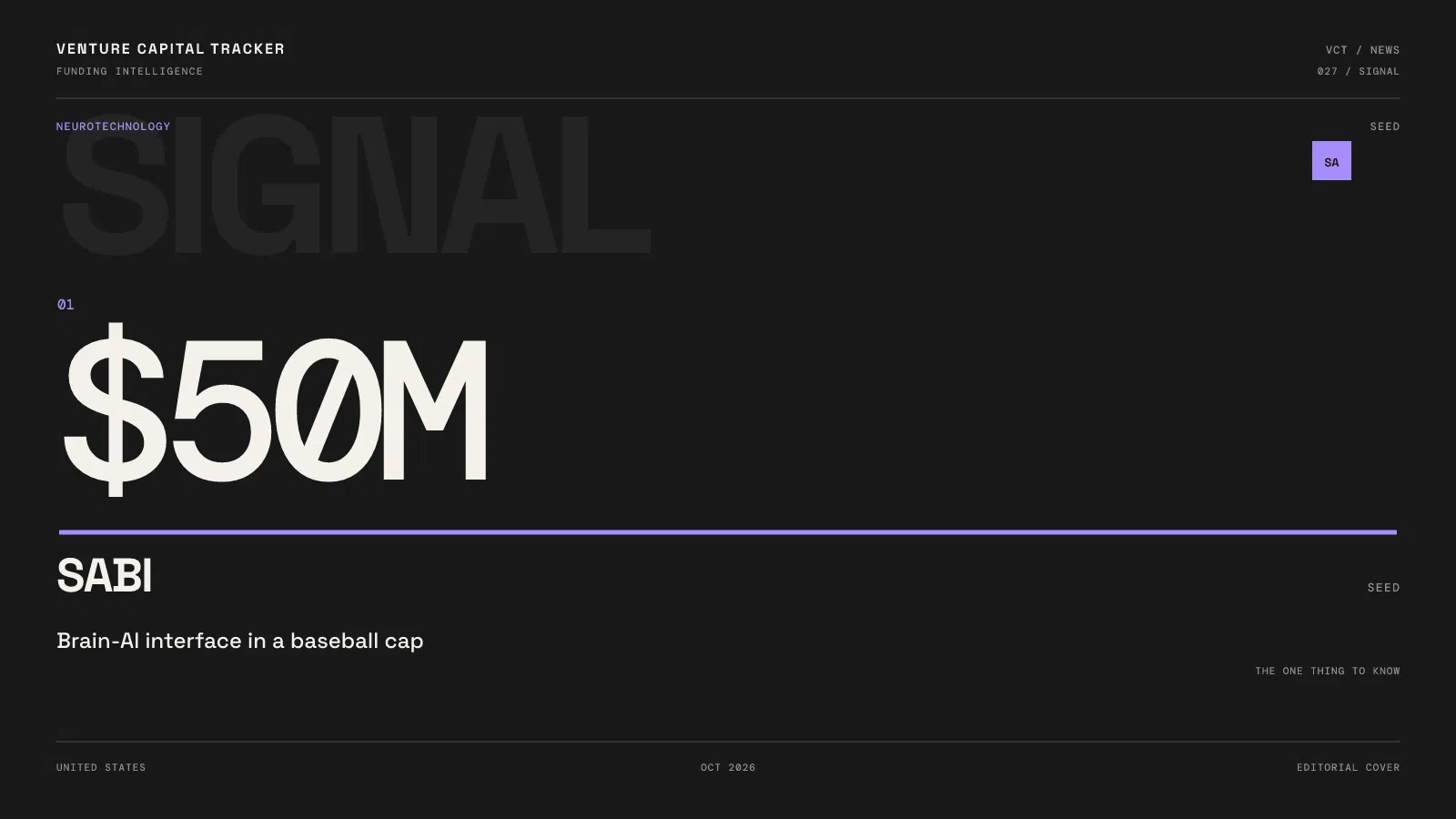
Sabi has raised a $50 million seed round to build a non-invasive brain-computer interface hidden inside an ordinary-looking baseball cap.
Khosla Ventures led the financing. Accel, Initialized Capital, DST Global, Collaborative Fund, Ascend and former OpenAI chief product officer Kevin Weil also participated. Forbes reported a $600 million post-money valuation, although Sabi’s own announcement did not disclose a valuation.
The size of the seed round reflects investor enthusiasm for interfaces that could replace some typing and tapping with neural input. It also sets a demanding bar for a company whose first public prototype is planned for CES 2027.
Sabi funding details
| Field | Detail |
|---|---|
| Round | Seed |
| Amount | $50 million |
| Status | Confirmed close |
| Lead investor | Khosla Ventures |
| Other investors | Accel, Initialized Capital, DST Global, Collaborative Fund, Ascend and Kevin Weil |
| Valuation | Reported $600 million post-money; not company-confirmed |
| Announced | October 9, 2026 |
Sabi says miniature EEG sensors inside the cap can read neural signals through hair without surgery, gel or direct scalp contact. A custom chip processes those signals, while models aim to translate imagined words and trained mental commands into text or AI prompts.
The product claim is bigger than the funding headline
Consumer brain-computer interfaces have historically struggled with signal quality, setup friction and limited vocabularies. A cap that works through hair would remove one important obstacle, but Sabi has not yet published peer-reviewed accuracy, latency or independent benchmark data.
The company says it has accumulated more than 100,000 hours of labelled neural recordings. That dataset could become an advantage if it represents diverse users and reproducible signals. It could also be less defensible than it appears if performance depends on extensive personal calibration.
The planned CES demonstration should be judged on more than a controlled demo. Useful evidence would include error rates, words per minute, setup time, performance across hair types and movement, and how much computation happens locally rather than in the cloud.
Competitive landscape
Sabi enters a rapidly funded neurotechnology market. Neuralink and other invasive developers pursue higher-bandwidth medical applications. Merge Labs and Bridge Neurotech are among the companies exploring non-invasive approaches.
Sabi’s consumer form factor is its differentiator. A familiar cap could be easier to adopt than a clinical headset, but the same design constraint may limit sensor contact and signal resolution.
There is also a product-positioning risk. Voice input already offers hands-free interaction at low cost. Sabi has to demonstrate that silent neural input is sufficiently accurate, private and socially acceptable to justify another wearable.
Privacy and safety are core product requirements
Brain-signal data is unusually sensitive. Even if the device decodes only trained commands, the company will need clear rules for consent, storage, deletion, model training and third-party access.
A system that converts neural signals into actions also needs protections against false positives. Sending a draft sentence is one thing; authorizing a purchase, message or device command is another. High-consequence actions should require explicit confirmation outside the neural channel.
Sabi’s $50 million seed provides enough capital to build custom hardware, collect data and recruit specialized talent. The investment case now depends on whether it can turn a compelling demonstration into a reliable input method—not simply whether it can read a signal in the lab.
Follow Venture Capital Tracker in Google
Add VCT as a preferred source to make our venture-capital coverage easier to find in Google Search.
Last updated:
Editorial note: AI tools assisted with research, structure, or drafting. Venture Capital Tracker retains human editorial responsibility for factual accuracy, relevance, and source quality before publication.