· 5 sources · Updated · Verified
Redalpine Fund VIII Closes $250M: LPs, Cheques and Early Portfolio
Redalpine closed $250M RAC VIII on Nov 10, 2026. See 20-company plan, $1M–$15M first cheques, Aviva's €15M statement, earlier Fund VII and venture risks.

By Venture Capital Tracker Research Desk
Fund close
redalpine
Backed by Aviva Investors , Flexstone Partners +1 more
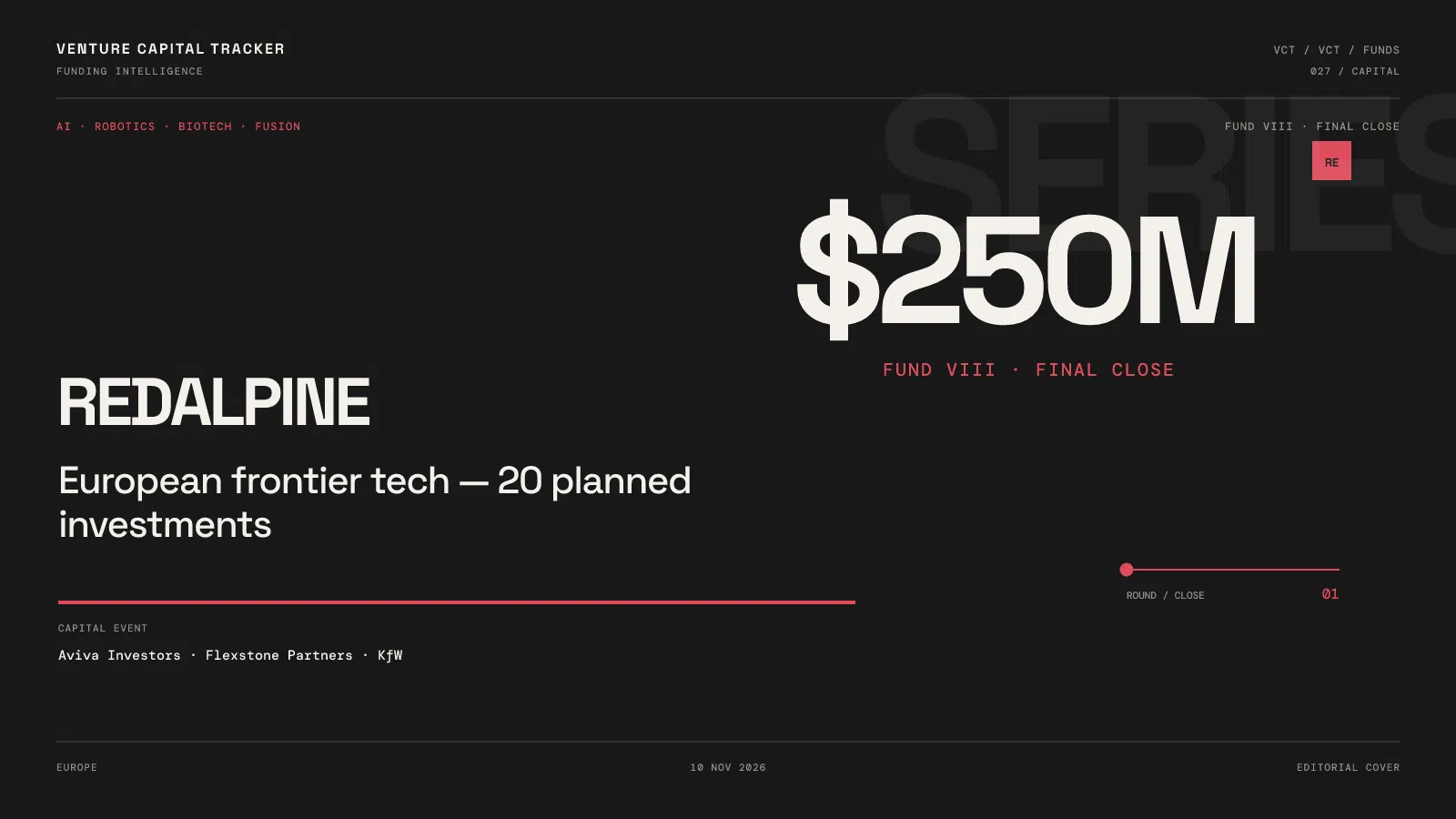
Redalpine announced the $250 million final close of redalpine capital VIII (RAC VIII) on November 10, 2026. The oversubscribed fund plans to back about 20 European companies, primarily leading Seed and Series A rounds with $1 million–$15 million initial investments. Named limited partners include Aviva Investors, Flexstone Partners and KfW. The Swiss-founded manager now reports more than $1.4 billion in assets under management—a firm-wide figure, not the size of Fund VIII.
The decisive distinction is that this is an announced final fund close, not a startup financing round or merely a fundraising target. Redalpine did not disclose a separate legal close day, precise individual LP commitments to RAC VIII, management fees or fund-level realised returns. These facts come from the manager-issued November 10 announcement and its own fund note.
| RAC VIII fact | What is confirmed |
|---|---|
| Final close announced | November 10, 2026 |
| Fund capital | $250M, oversubscribed |
| Main strategy | European frontier technology at the intersection of software and science |
| Stage and role | Primarily leads Seed and Series A |
| First cheque | $1M–$15M, manager-disclosed range |
| Planned companies | Approximately 20 |
| Named institutional LPs | Aviva Investors, Flexstone Partners, KfW; individual Fund VIII allocations undisclosed |
| Initial investments named by manager | Arlequin AI, calliora, Enact Intelligence, telli and Helical |
| Previous early-stage fund | RAC VII, $200M final close in August 2024 |
What changed from redalpine capital VII?
The previous vehicle, RAC VII, closed at $200 million on August 27, 2024, according to redalpine's original release. Fund VIII is therefore $50 million larger, or 25% above its predecessor. That compares the final sizes of two different fund vintages; it does not represent a $50 million top-up to Fund VII.
The 2024 fund was already investing in Proxima Fusion, LegalFly and Expression Edits by its final-close announcement. Redalpine says companies backed by RAC VII subsequently raised more than $1.1 billion in financing. That is money raised by portfolio companies from investors collectively, not $1.1 billion of cash distributed to RAC VII's LPs or realised profit. The manager also reports 11 portfolio-company exits since 2023, without publishing a transaction-by-transaction proceeds schedule in the current announcement. Neither metric alone establishes an LP multiple, DPI or net IRR.
The manager's $1.4 billion-plus AUM covers multiple vehicles, including its separate later-stage investment platform. It should not be added to either fund size.
What does RAC VIII actually invest in?
Rather than underwriting only software subscription businesses, RAC VIII targets technologies where scientific risk and software development interact. Its five early examples illustrate what the mandate means in practice:
| Initial company identified by redalpine | City | Problem being pursued |
|---|---|---|
| Arlequin AI | Paris | Topological neural networks intended to identify patterns and threats in complex relationships |
| calliora | Munich | An AI workflow layer for hospital administration and reimbursement |
| Enact Intelligence | Zurich | Force and tactile sensing for robotic manipulation |
| telli | Berlin | AI agents for customer communication |
| Helical | London | Reproducible biological-model workflows for drug-discovery research |
These are manager-identified investments, not evidence that each business has already reached commercial scale or regulatory validation. The fund announcement supports their inclusion. Claims about a company's eventual product-market fit, hospital savings, clinical outcomes or robotics deployment require separate evidence.
Redalpine says it evaluates more than 5,000 companies a year. The 20-company portfolio target is spread over the fund's investment life—not 20 deals necessarily signed on closing day. Half its investment team is made up of scientists and the other half of operators and entrepreneurs, a composition relevant to diligence on biotech, fusion and robotics where demonstrations may precede industrial deployment by years.
How much capital could a founder realistically receive?
The $1M–$15M initial-cheque range is unusually useful public information: it is stated directly in the manager-issued press release, not inferred from its past portfolio. But the top end is not a promise for every investment.
Dividing $250 million of fund commitments by 20 intended companies yields $12.5 million of gross committed fund capital per planned company. That is only a transparent sizing illustration. It is not the average first cheque: fund fees, operating expenses, reserve capital for follow-ons, portfolio concentration, capital calls and the actual number of investments all matter. Twenty simultaneous $15 million first cheques alone would require $300 million, exceeding the fund size before any reserves.
A deep-tech founder might need successive capital injections after technical validation, pilot production or clinical milestones. Redalpine's larger multi-stage platform may make continued relationships possible, but follow-on participation from RAC VIII or another vehicle is not guaranteed. Its exact reserves and ownership targets were not published.
Founder tour: a practical way to assess fit
The following sequence is illustrative guidance based on redalpine's disclosed mandate, not a claimed observation of its confidential investment committee.
- Check alignment. The company should be building in Europe and have a credible defensible science/software component, not merely relabel a conventional app as frontier AI.
- Match stage and cheque. An early technical team raising a $1M–$15M-led Seed or Series A is closer to the advertised mandate than a late-stage buyout or a small grant application.
- Bring technical evidence. For a hardware or biotech venture, explain reproducibility, third-party benchmarks, regulatory gates, manufacturing constraints and which claims remain hypothetical.
- Explain the commercial route. Identify the eventual purchaser, procurement or approval path, pricing assumptions and why a working prototype can turn into a viable business.
- Discuss milestones and financing risk. Show what the requested equity funds, the next independently verifiable milestone and how much future capital may be required. Ask the investment team about ownership, reserves, board rights, concentration limits and follow-on policy rather than assuming the public cheque range settles those questions.
Redalpine's official website and team/portfolio pages are the starting points for outreach. The current public materials do not document a guaranteed application deadline, response time or standard term sheet.
Who are the LPs—and what did they actually commit?
The issuer names Aviva Investors, Flexstone Partners and KfW among new and returning institutional backers. That mix includes insurance-linked investment management, private-market fund investment and German public development finance. Crucially, the manager's release does not split the $250 million fund by LP.
On November 10, Aviva Investors separately confirmed a €15 million investment with redalpine, calling itself the manager's first UK institutional investor. The Aviva announcement does not explicitly identify RAC VIII as the receiving legal vehicle. It would therefore be too precise to state from these public documents alone that exactly €15 million of Fund VIII's commitments came from Aviva, or that Aviva's announcement is extra money on top of the $250 million close.
For a pension investor, exposure through a venture manager introduces illiquid private-company valuations, multi-year capital calls, concentration and delayed exits. Aviva's own release emphasises valuation, operational, technology and liquidity risk; neither the manager nor Aviva offers guaranteed returns.
How does the fund compare with other European VC vehicles?
Scale by itself does not make one fund a substitute for another. Creandum VIII's $750M early-stage fund is a larger vehicle with a different deployment capacity, while Flashpoint's $116M venture growth fund pursues its own geography and strategy. Redalpine's distinguishing disclosed feature is the combination of a science-heavy team, $1M–$15M first cheques, and deliberately limited portfolio size. None of these figures proves superior returns.
The market case is understandable: European fusion, robotics and biotechnology startups often need institutional investors willing to finance long technical validation cycles. The counterargument is that prolonged R&D, export controls, regulatory approval, capital-intensive manufacturing and a difficult exit environment can consume multiple fund vintages before a meaningful distribution. Larger fund size may improve follow-on flexibility, but it does not resolve those risks.
What remains undisclosed?
A diligent founder or LP should distinguish press-release facts from missing underwriting data. The public announcements do not disclose RAC VIII's exact legal close date, final LP-level allocations, drawn versus committed capital, fund fees and carried interest, expected gross/net returns, realised distributions, formal ownership target, reserve percentage or exact schedule of future investments. Early investments and portfolio-company fundraising do not substitute for fund-level financial performance.
Bottom line: RAC VIII is confirmed $250 million in final committed fund size, aimed at roughly 20 early-stage European companies. Its meaningful signals are a 25% increase on RAC VII, named institutional LP backing, an explicit $1M–$15M entry-cheque range and five identifiable early holdings—not a claim that Redalpine or its LPs have already realised a return from this vintage.
Last updated:
Editorial note: AI tools assisted with research, structure, or drafting. Venture Capital Tracker retains human editorial responsibility for factual accuracy, relevance, and source quality before publication.