· Venture Capital · 20 sources · Updated · Verified
Megaport–Latitude.sh: US$150M Deal, A$2.3B AI Contracts
Megaport bought Latitude.sh for US$150M upfront plus a contingent earnout. By September 2026, Compute ARR was up 227%. The contracts, market, competitors and real risks.

By Venture Capital Tracker
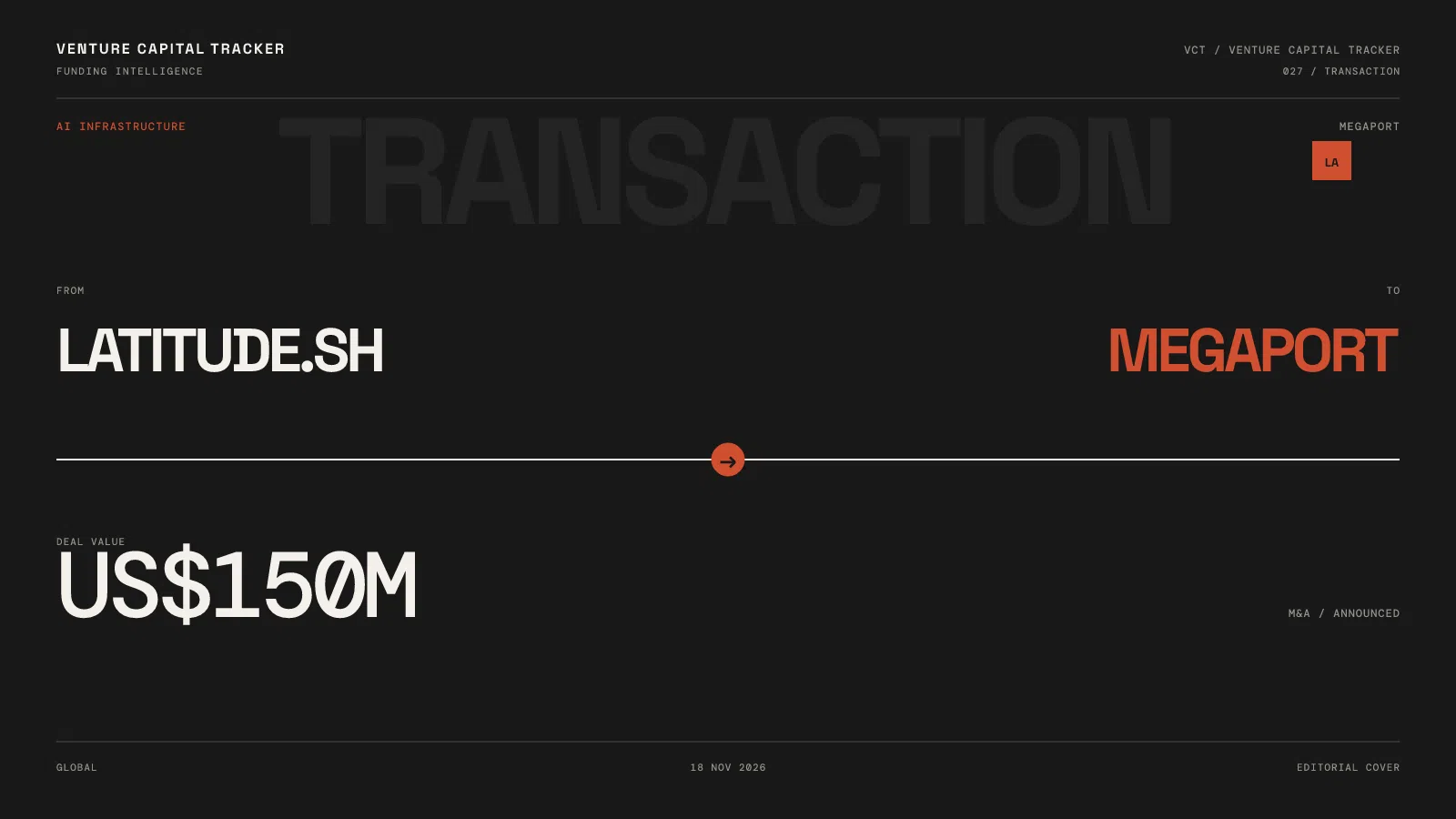
A year ago, Megaport was best known for the private network connections businesses use to move data between clouds and data centers. Its purchase of Latitude.sh, a provider of dedicated servers, put it into the business of supplying computing power too. By September 2026, Megaport had disclosed roughly A$2.3 billion in cumulative AI infrastructure contract value. The critical distinction: that figure is not revenue already earned.
Deal details & investors
Acquisition
Latitude.sh
This is the story of a company trying to turn network reach into an advantage in the expensive new market for AI computing. The opportunity is real. So are the bills for GPUs, power, financing and customer delivery.
Megaport and Latitude.sh: the essential numbers
| Metric | Reported figure | What it actually measures |
|---|---|---|
| Latitude.sh acquisition | US$150M upfront, plus up to US$150M contingent | Purchase consideration, not VC funding or US$300M paid at closing |
| Latitude.sh compute ARR baseline | US$43.1M at September 2025 | Annualized run rate before the acquisition |
| Megaport Compute ARR | US$141.0M at September 22, 2026 | Annualized run rate, up 227% from the baseline; not annual revenue |
| Three new AI contracts | A$978.6M announced September 29, 2026 | Total value over multiple years, not one-quarter sales |
| All announced strategic contracts since April | About A$2.3B by September 29 | Cumulative total contract value (TCV) |
| Customer prepayments on the three new deals | A$322.6M | Cash commitments that help finance hardware, not an equity round |
| Group ARR already billing | More than A$500M at September 2026 update | Annualized recurring revenue from active, billed services |
| Group pro forma ARR | About A$1.1B | Includes contracted services not yet billing; depends on deployment |
| FY27 group revenue guidance | A$720M–A$810M | Management forecast, not booked FY27 results |
| FY27 capital spending guidance | A$1.78B–A$1.88B | Expected infrastructure investment, not operating profit or loss |
Currency matters: A$ means Australian dollars; US$ means US dollars. The September figures come from Megaport's ASX filing, while the acquisition terms are in its November 2025 transaction presentation. Mixing those currencies or treating contract value as revenue creates a misleading story.
What do these two companies actually sell?
Imagine a business that wants to run an AI model near its customers, feed it private data from a different cloud, and avoid sending every sensitive connection across the public internet.
Megaport supplied the private routes. Founded in Brisbane in 2013 by entrepreneur Bevan Slattery and listed on the Australian Securities Exchange as MP1, it built a software-defined network connecting data centers, public cloud providers and enterprises. By June 2026 it reported more than 1,200 enabled data centers across 31 countries and more than 4,000 customer organizations. These are Megaport network figures, not the number of AI data centers it owns.
Latitude.sh supplied the machines. The business developed from a Brazilian hosting operation into API-driven bare-metal infrastructure: dedicated CPUs, NVIDIA GPU servers, storage and automated provisioning. In the November 2025 announcement, Megaport reported that Latitude.sh had served more than 1,150 customers and deployed more than 7,700 servers across 20 markets in 10 countries. Those were figures disclosed around the deal, not independently verified November 2026 totals.
The combined proposition is straightforward: provision compute, connect it privately to data and other clouds, and manage more of the infrastructure through software. That could make Megaport more useful to customers than selling either network circuits or standalone GPU rentals. Whether it produces superior prices, margins or retention remains to be demonstrated.
How much did Megaport pay for Latitude.sh?
The often-repeated US$300 million price is the maximum possible consideration, not the upfront cash price.
| Component | Amount | Condition |
|---|---|---|
| Initial cash and cash-redeemable units | US$70M | Upfront, including US$2M for the Brazilian entity |
| Upfront share-linked units | US$80M | Redeemable into Megaport shares after the first anniversary, subject to terms |
| 2026 revenue milestone | Up to US$50M | Calendar-2026 qualifying revenue targets |
| 2027 revenue milestone | Up to US$50M | Calendar-2027 qualifying revenue targets |
| Integration success milestone | Up to US$50M | New server deployment and integration with Megaport's network by the 2028 deadline |
| Maximum possible consideration | US$300M | Only if all conditions are met |
The original transaction presentation gave precise qualifying-revenue hurdles. For 2026, the base US$25M payment begins at approximately US$51.9M and rises to the US$50M maximum at US$74.2M of relevant revenue. For 2027, the corresponding thresholds are US$80.5M and US$115.0M. The third payment depends on infrastructure and network integration, not simply a revenue target. The terms also include catch-up and capital-expenditure provisions. None of this establishes that the full earnout has been paid.
One important trap: US$141M of annualized Compute ARR at September 2026 is not the qualifying calendar-year revenue used to calculate the sellers' milestone payment. It would be wrong to infer the payout from that ARR number alone.
The deal was announced in November 2025. Megaport's audited half-year accounts date the acquisition of the legal entities to November 26, 2025; its public company blog notes the completed transaction on November 27. Both dates can be accurate because they describe different reporting points.
From the acquisition to the 2026 AI contracts
Megaport's early bet was to combine two businesses customers previously had to assemble separately. Its next bet was much more capital intensive.
November 2025 — Buy the compute platform. Megaport disclosed a US$150M upfront purchase and a proposed A$200M institutional share placement to help fund acquisitions and network expansion. The reported upfront consideration was equivalent to about 3.5 times Latitude.sh's September 2025 ARR. That multiple applies to the upfront price, not the full contingent maximum.
April–May 2026 — Start announcing long-term compute contracts. The company reported growing commitments for compute and connectivity. The significance was not simply deal size; customer contracts increasingly specified committed services instead of relying solely on on-demand GPU use.
June 2026 — Raise capital to build capacity. Megaport announced an A$827.3M equity entitlement offer. Its offer presentation allocated approximately A$369.5M of proceeds to equipment for new contracts, A$350M to an on-demand GPU/server pool, A$19.3M to transaction costs and A$88.5M to balance-sheet capacity. This was a listed-company equity raise, not a Latitude.sh venture financing round.
August 2026 — Report the early financial impact. In the fiscal year ended June 30, 2026, Megaport reported approximately A$312M of group revenue; the compute business contributed about A$44M. Its investor site recorded A$395.2M group ARR at the year-end date.
September 29, 2026 — Make the scale-up visible. Three more AI infrastructure contracts added US$685M (A$978.6M) of cumulative payments over their terms, with A$322.6M in customer prepayments. Across strategic deals announced since April, Megaport reported roughly A$2.3B in aggregate contract value. It raised FY27 guidance and reported that compute ARR had climbed to US$141M.
That sequence explains why it is too simplistic either to dismiss the acquisition as a small hosting-company deal or to portray its entire future contract book as cash in the bank.
The unusual economics: customers are helping buy the GPUs
The September contracts have a particularly important feature: some customers are paying before all the hardware is delivered. Megaport said one new customer committed approximately A$281.5M upfront, covering much of the cash capital spending needed to serve that contract. This can reduce the amount Megaport must borrow or raise from shareholders while its data center hardware is installed.
There is a trade-off. Contracts promise future service, while the provider must deliver equipment, power, connectivity and uptime. Prepayments are not profit. A signed commitment does not eliminate counterparty, execution or hardware-obsolescence risk.
Another useful comparison comes straight from the company's own outlook: FY27 capex guidance of A$1.78B–A$1.88B is roughly 2.2–2.6 times its guided A$720M–A$810M FY27 revenue. That ratio is a VCT calculation using the ends of the disclosed ranges. Capital investment and annual revenue are different accounting categories: the ratio is a measure of the scale of the build-out, not an expected loss margin.
The gap between more than A$500M already billing in annualized group revenue and about A$1.1B pro forma ARR is also important. The latter includes future contracted capacity that still needs to become operational and bill customers. If hardware deliveries or data-center readiness slip, expected sales can move to a later period.
How big is the market Megaport is moving into?
The specialist neocloud market—cloud services built around GPUs and high-performance AI workloads—is growing from a meaningful base. In April 2026, Synergy Research Group estimated that neocloud providers generated more than US$25B of revenue in calendar 2025, including about US$9B in the fourth quarter. It forecast that this category could approach US$400B in annual revenue by 2031, implying about 58% compound annual growth. This is an analyst forecast, not contracted demand or Megaport's addressable share.
For context, Synergy separately estimated US$167.7B in worldwide cloud infrastructure-services spending in Q3 2026. This much broader category includes hyperscalers; it must not be added to the neocloud estimate as though they were independent markets. McKinsey's estimate of roughly US$7T in data-center capital needs through 2030 is yet another measure—cumulative investment required, not annual revenue.
These numbers help explain the rush to secure GPUs and megawatts. They say less about how much profit any individual provider will keep.
Who are the competitors—and which comparisons are fair?
Megaport has two sets of rivals, and treating them as one market leads to poor comparisons.
| Company or group | Primary business | Why it matters for a Megaport/Latitude.sh buyer or investor |
|---|---|---|
| Equinix Fabric, PacketFabric, Console Connect | Programmable private interconnection | Closer comparisons to Megaport's original network business: reach, cloud on-ramps, pricing, reliability |
| Vultr, OVHcloud, Hetzner | Cloud and bare-metal servers | Closer options for straightforward dedicated CPU/server needs, with different regions, support and contracts |
| **CoreWeave** | Large specialist AI GPU cloud | Q3 2026 revenue of US$3.661B, but also a US$709M GAAP net loss and heavy financing commitments |
| **Nebius** | Full-stack AI cloud | Q3 2026 group revenue of US$980.8M, including about US$325M non-recurring asset-light revenue |
| **Crusoe** | AI cloud plus vertically integrated data-center development | Announced an initial closing of a planned US$3.9B Series F in September, at a US$30.9B post-money valuation |
| **Lambda**, **Nscale** | Specialized GPU/AI infrastructure | Alternatives for dedicated capacity and broader AI-infrastructure deployment; financing and services differ |
These scale figures are deliberately labeled. CoreWeave and Nebius numbers are reported quarterly revenue, Crusoe's is funding and valuation, while Megaport's September measure above is annualized compute revenue and contract commitments. It would be misleading to put them in a single revenue league table.
For someone choosing where to run a real workload, the useful checklist is more practical than any funding headline: GPU type actually available, server location, interconnect paths, capacity commitment, all-in egress cost, deployment time, support, and service terms. The right alternative for an isolated dedicated server may be very different from the best home for a large AI training cluster.
For a broader public/private company comparison, see VCT's Neocloud Companies and Stocks 2026 and the AI Infrastructure Funding Market Map.
What has changed since the big September contracts?
The September financial update was not the last news. The companies have continued adding features that help explain how Megaport intends to compete for actual workloads—although product launches do not themselves establish financial returns.
- October 7 — Managed Kubernetes on bare metal. Latitude.sh launched Latitude Kubernetes Service (LKS), with the control plane managed for customers and dedicated worker machines in selected US and UK locations. On October 19, it added support for allocating customers' existing reserved or contracted servers—including GPUs—to Kubernetes node pools. This moves the platform toward infrastructure management, beyond renting individual machines.
- October 12 — Portugal connectivity launch. Megaport expanded its network ecosystem into Portugal, emphasizing Atlantic routes between Europe and Brazil. A network market opening should not be confused with a newly commissioned Latitude.sh GPU data center there.
- October 22 — AWS connectivity preview. Megaport was selected to support AWS Interconnect – last mile. The preview offered private, more automated AWS connections. On November 5, AWS still explicitly described Megaport's Northern Virginia integration as preview, while a different provider's service was generally available. Do not assume every announced feature, service-level commitment or 100 Gbps speed is already GA for Megaport.
- October 28 — Shared storage. Latitude.sh introduced persistent NFS file storage across multiple bare-metal machines at an advertised US$0.08 per GB per month in selected US, UK and Japanese locations. Its November 4 changelog also recorded reliability improvements to virtual-machine provisioning, object-storage tenant lifecycle and network-adapter support.
Why it matters: a buyer comparing bare-metal providers now has more than GPU hourly prices to evaluate. Kubernetes orchestration, private multicloud connectivity, storage fees, network reach and deployment regions determine the real cost and operational effort. These releases offer evidence of a product roadmap, not proof of realized profits or market-share gains. Official Latitude.sh platform changelog, Megaport Portugal announcement and AWS's November 5 preview status provide dated details.
Five risks behind the attractive growth figures
- Capital intensity. Servers and GPUs must be ordered and paid for before they can reliably earn revenue. Better financing does not erase the physical cost.
- Delivery risk. Power, data-center space, cooling, hardware shipments and network commissioning can affect when signed contracts start billing.
- Customer concentration. Megaport has not disclosed the names of all strategic customers. Large committed deals can concentrate both revenue and counterparty risk.
- Technology changes. Hardware may remain on the books longer than it remains competitively priced. Its useful life and resale value are assumptions, not guarantees.
- Earnout and dilution. Additional seller payments can depend on targets and may be settled through cash or shares subject to conditions; financing future capex can also affect existing shareholders.
The balancing evidence is that the legacy network business did not stand still. Megaport reported 116% Network net revenue retention in August 2026 and 29% constant-currency Network ARR growth year over year. Those network metrics are stronger evidence of an existing customer base than any unverified claim that the combined company already dominates AI compute.
The VCT view: a network company becoming a capital allocator
The most interesting part of Megaport's Latitude.sh acquisition is not the US$300M maximum headline. It is the change in what management must execute. A software-defined network business can add connections without purchasing a new fleet of NVIDIA GPUs for every major customer. A GPU infrastructure provider has to manage a balance sheet, supplier commitments, delivery schedules and residual asset value.
Megaport now wants the distribution advantage of the first business and the growth of the second. Customer prepayments and signed contracts provide visibility, but revenue recognized, free cash flow and returns on deployed capital will decide whether the strategy works. That is the follow-up story worth tracking after the excitement of the acquisition fades.
Frequently asked questions
Did Megaport acquire Latitude.sh?
Yes. Megaport took control of the Latitude.sh US and Brazilian businesses in November 2025. Its audited financial statements record a November 26 acquisition date; its public announcement says the deal was completed November 27.
Was the Latitude.sh acquisition worth US$300 million?
Up to US$300M. Agreed upfront consideration was US$150M, split between cash/cash-linked units and share-linked units. Up to another US$150M is contingent on revenue and integration milestones through 2028. It is not accurate to describe US$300M as cash paid at closing.
How much has Latitude.sh grown since the deal?
Megaport reported US$141.0M annualized Compute ARR at September 22, 2026, compared with US$43.1M at the September 2025 baseline: growth of 227%. These are annualized run rates, not full-year revenue figures.
Are Megaport's A$2.3B AI contracts guaranteed revenue today?
No. The figure is the cumulative future value of strategic commitments announced since April 2026. Revenue becomes recognized as contracted services are delivered under the applicable accounting treatment.
Is Megaport a neocloud like CoreWeave?
Not exactly. Megaport began as a private-network connectivity platform and added a CPU/GPU cloud through Latitude.sh. Its model therefore spans network services and specialized compute. CoreWeave and Nebius are much more concentrated in AI infrastructure.
What should be watched next?
The next useful data points are delivery of contracted hardware, billed versus pro forma ARR, the composition of FY27 revenue and capex, use of debt and prepayments, and any formal determination of contingent seller payments.
Last updated:
Editorial note: AI tools assisted with research, structure, or drafting. Venture Capital Tracker retains human editorial responsibility for factual accuracy, relevance, and source quality before publication.