· 13 sources · Verified
Maple raises $5.3M for private AI that works on your desktop
Its documentation separates protected chat content from external services and agent permissions. Current prices and an unfinished audit add practical buying questions.

Editorial team
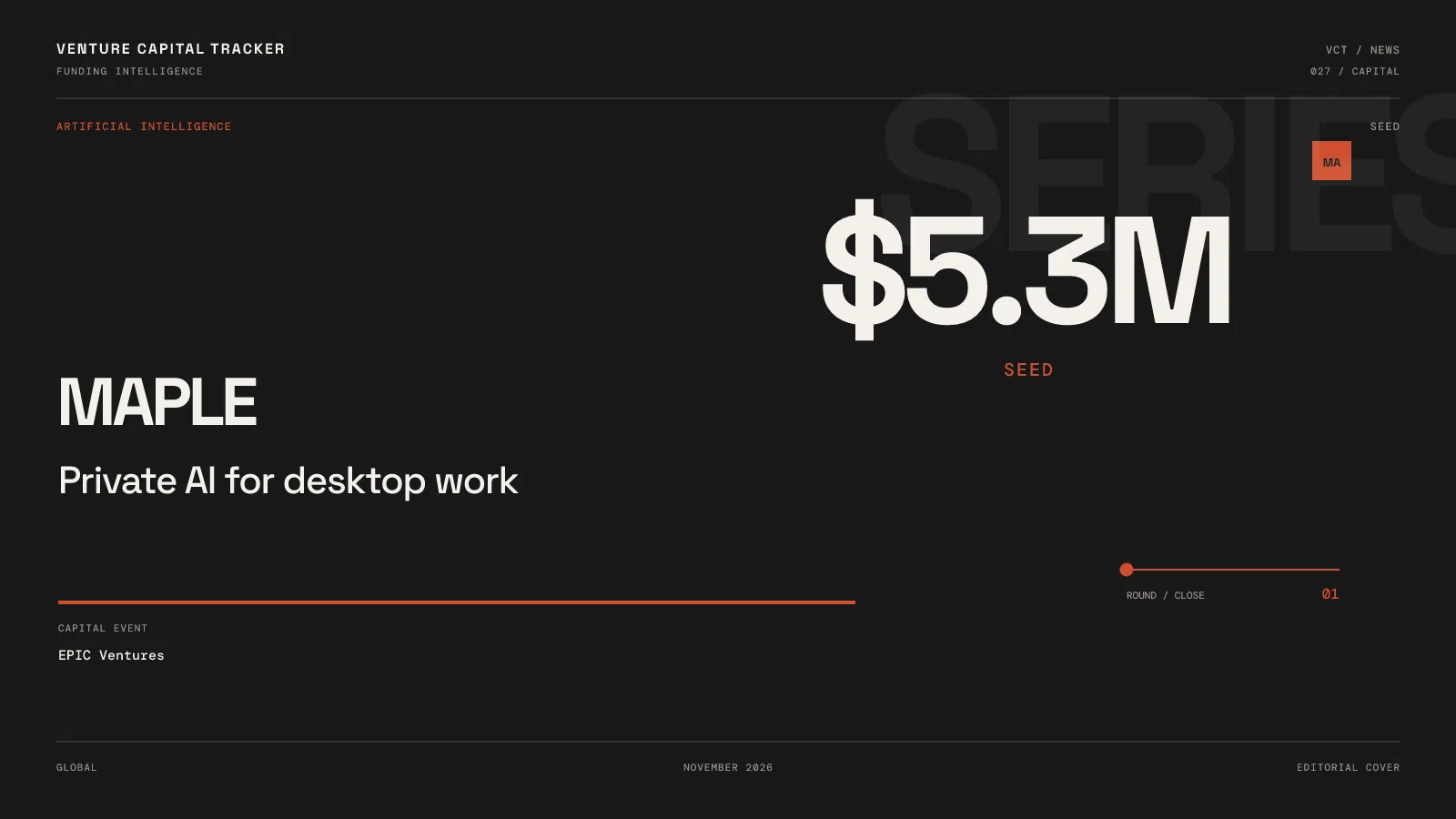
Maple wants a small business to hand an AI assistant a folder of invoices without letting the AI company read them. Its desktop app works through files and connected apps, while hosted models process requests inside protected hardware.
Deal details & investors
Funding event
Maple AI
Led by EPIC Ventures
The Austin company announced its seed round on November 24, led by EPIC Ventures, with Draper Associates, Planetary VC and Epoch VC participating. It did not disclose a valuation, individual allocations, financing-instrument breakdown or legal closing date.
In that announcement, EPIC co-founder and managing partner Nick Efstratis argues that verifiable privacy can unlock enterprise work that businesses hesitate to send to AI. That is an investor's thesis, published by the company, rather than evidence that procurement concerns have been resolved.
Maple says the proceeds will support hiring, model capacity, Work and Teams, and business integrations. Its founders are CEO Mark Suman, a former Apple engineer, and CTO Anthony Ronning, who designed its enclave architecture. The company dates its product launch to January 2025; Work's public launch post is dated November 12, 2026.
What the desktop app actually does
Consider a small business matching invoices against a payment export. This is an illustrative workflow based on Maple's documented folder and app capabilities, not a VCT product test.
The operator chooses a project folder, supplies the relevant exports and asks for unmatched or duplicate entries. Work plans the steps and examines the files. The operator can review requests for actions beyond the selected mode, then inspect the discrepancy list against the original records.
Adding a live payments or accounting connection changes the scope: a summary made from supplied files and an action in a business account are different jobs. Before enabling the latter, the buyer should establish what leaves the protected model path and which actions require approval.
Work also supports pairing computers. Its product page says the task runs on the selected machine and describes long jobs on a Mac that stays on. TechCrunch reported an earlier angel round below $1M and a planned cloud agent. The current desktop task runs on a selected computer that must stay on.
Private processing still involves a cloud
Maple Work runs on a user's computer. When it needs an AI model, information from the task travels to hosted infrastructure for processing. It is not the same as running the model entirely on that computer.
According to Maple's technical explanation, messages are encrypted before leaving the device and decrypted inside a hardware-isolated environment known as an enclave. The client checks a signed description of the software running there before establishing a session.
That protection has dependencies. Maple identifies Amazon's Nitro hardware, published code, its own signing key and a second enclave running the model. The user checks Maple's enclave; Maple's enclave checks the model's. A matching software fingerprint shows an approved release, not by itself that the release was built from the public source. Rebuilding the image is a further verification step.
The same page says Maple has not yet been audited and is working toward a SOC 2 audit. VCT has reviewed the documentation, not performed a security audit or tested these protections.
Chat-content protection also does not mean the service collects no information. Maple's privacy notice, revised October 20, lists account and payment information, device and usage data, and API request metadata. Businesses need to assess those categories separately.
A private model is not a permission system
Maple's Work documentation explicitly puts web search, connected apps, custom servers and hand-offs to external coding agents outside its privacy promise. If a task sends material to another service, that service's handling of it becomes part of the decision.
Work can connect to apps through the Model Context Protocol, a standard for giving AI tools access to external systems. Maple lists services including Notion, Dropbox, Stripe, Jira and Linear. A connection lets the agent do useful work; it also requires choosing which accounts and permissions the task needs.
Separately, users choose how much freedom the agent gets:
| Mode | What Maple documents |
|---|---|
| Read only | Reads, searches, builds and tests; asks before other actions. |
| Auto | Writes files and runs scripts; uses a model to judge when approval is needed. |
| Full access | Acts without asking. |
Maple says Auto is not a sandbox and can judge incorrectly. Encryption addresses access to the contents of a request. It does not establish that an agent's output is right or that its next action is safe.
The subscription is a usage budget
Maple's current pricing, checked November 25, combines subscriptions with metered model usage. Chat, Work and the API spend from one balance.
| Plan | Monthly subscription | Included monthly usage |
|---|---|---|
| Pro | $20 | $20 |
| Max | $100 | $200 |
| Max+ | $200 | $400 |
| Team | $30 per user | Twice Pro's allowance per member, pooled across the team |
Work is included in the paid plans. Maple says additional usage is not billed automatically: customers choose whether to add credits or change plans. The included figures are service credits, not unlimited tasks. The model chosen and the amount of processing affect how quickly they are used.
Other ways to draw the privacy boundary
Running a model locally removes the hosted inference provider from that part of the workflow, provided the task actually stays local. Ollama's documentation distinguishes its local server from its cloud service; the latter processes requests remotely under a zero-retention policy. Installing a local app does not, on its own, prove that every request stays on the device. Local operation also puts hardware and configuration choices on the user.
Proton's Lumo provides another hosted alternative. Its privacy documentation describes no server-side chat logs and encrypted saved history. Its policy separately allows a simplified request to go to search partners when web search is enabled. These are specific commitments to compare, rather than interchangeable meanings of “private.”
A buyer can compare these setups with the same files, required integrations and spending limit, then check the output, credit consumption and actions that needed approval.
Follow Venture Capital Tracker on Google
Add VCT as a preferred source to see more of our venture-capital reporting in Google Search.
Editorial note: AI tools assisted with research, structure, or drafting. Venture Capital Tracker retains human editorial responsibility for factual accuracy, relevance, and source quality before publication.