· 11 sources · Verified
Embo raises $110M to train robot brains in imagination
The Dreamer researchers are combining video pretraining with robot experience. Their earlier papers help define the evidence—and the tests needed before a workplace deployment.

Editorial team
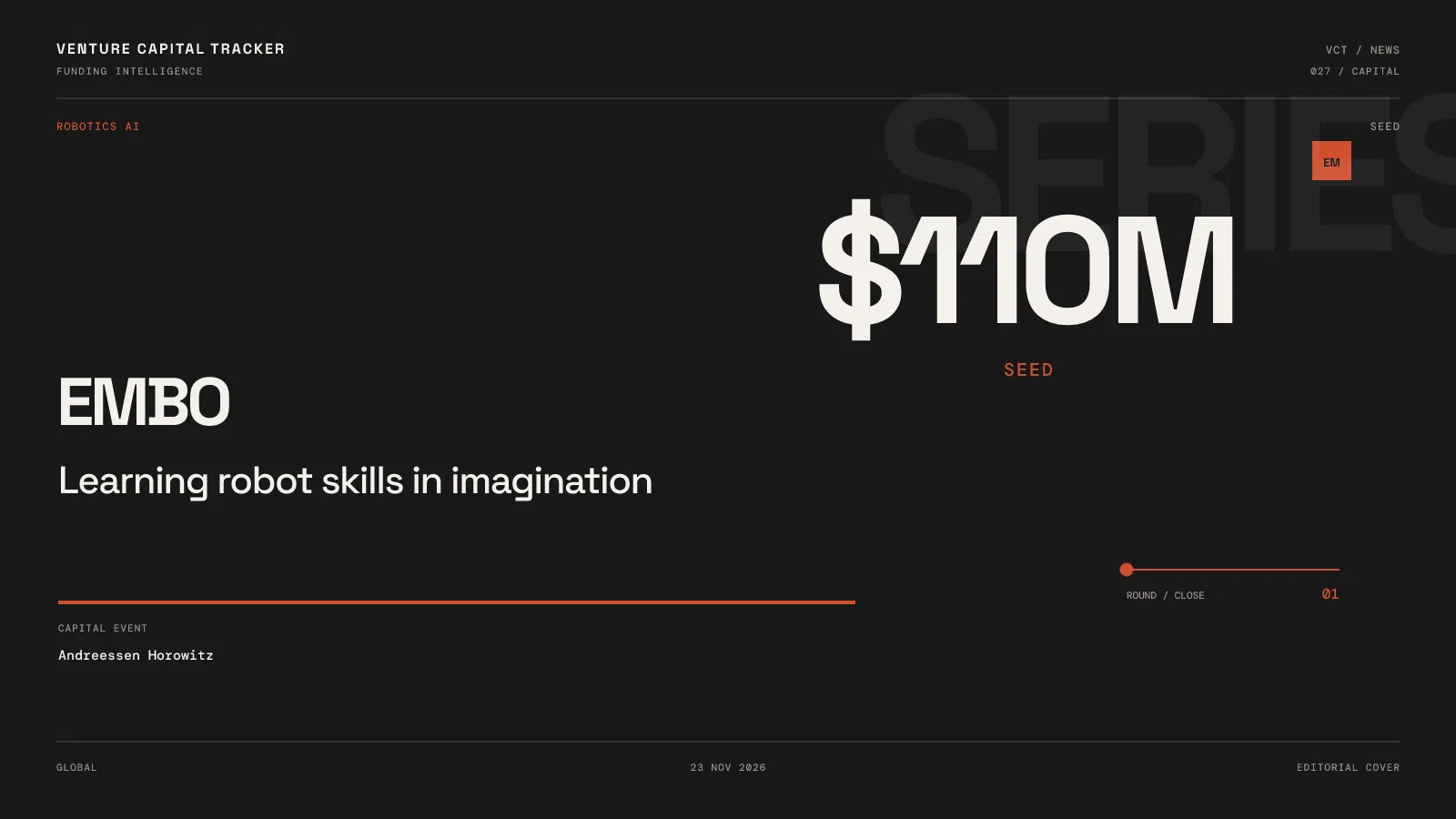
Embo wants to teach robots by letting them practise inside a model of the world. The company, led by researchers Danijar Hafner and Wilson Yan, is betting that video can supply broad knowledge of physical events, while imagined trial and error helps turn that knowledge into useful actions.
Deal details & investors
Funding event
Embo
Led by Andreessen Horowitz
Its November 23 announcement names Andreessen Horowitz as lead investor, with Khosla Ventures, DST Global, NVIDIA and other strategic investors participating.
For investors, the attraction is a way to expand robot training without collecting every lesson on an expensive physical machine. For a prospective customer, the question is whether the resulting skills survive a new room, a different object or a failed grasp.
How imagined practice is supposed to help
A world model learns to predict what happens next. For a robot, the useful prediction is how the scene changes after an action: whether a push moves an object, for example, or whether a grasp succeeds.
Embo’s public description starts with learning broad patterns from video and text, then adapting the model to experience from its humanoid fleet. Reinforcement learning—using feedback about the results of actions—is a further training step.
The learned model supplies a place to rehearse possible actions before trying them physically. Real robot experience remains part of the training plan.
The lead investor’s thesis stresses two objectives: carrying a learned skill into unfamiliar settings, and recovering when something goes wrong. Its examples include an object slipping or a drawer sticking. These describe the capability being sought, rather than a published measure of Embo’s success at delivering it.
The company page identifies Hafner as chief executive and Yan as chief technology officer. Their prior work includes Dreamer and VideoGPT. Embo also cites experience building infrastructure for training across 70,000 GPUs. That statement concerns the team’s previous work; it does not disclose the size of Embo’s current compute cluster.
Two research results, two different tests
The scientific record offers more detail than the phrase “robot brain” suggests.
In the September 2025 Dreamer 4 preprint, Hafner, Yan and Timothy Lillicrap report an agent that learned to obtain diamonds in Minecraft using previously collected data. Its behaviour was improved inside a learned world model, without interacting with the game to collect further training experience.
The Minecraft experiment used about 2,541 hours of recorded gameplay paired with mouse and keyboard actions. Its evaluation measured item-acquisition success over 1,000 game episodes, each lasting up to an hour. The recorded actions helped connect visual predictions with control; this was not learning from passive video alone. That is a defined test of learning and sequential action in a game. It does not establish a humanoid’s grasp reliability, safe contact with people or uptime on a production line.
There is also earlier physical-robot evidence. The DayDreamer paper, first submitted in 2022, studied four robots performing different tasks. In one experiment, a quadruped learned to roll over, stand and walk after an hour of real-world training. The researchers describe that walking result as a single training run. This was learning from physical interaction, with imagined experience helping train the behaviour—not a demonstration that internet video alone produced a general robot worker.
| Evidence | What it supports | What it leaves open |
|---|---|---|
| Dreamer 4’s offline Minecraft experiment | A learned world model can support improved behaviour from a fixed dataset in that benchmark | Transfer to physical hardware and unfamiliar workplaces |
| DayDreamer’s physical-robot experiments | Earlier world-model methods learned specific real-world tasks | Broad humanoid capability and repeatable commercial performance |
| Embo’s launch description | A funded plan combining video, robot experience and reinforcement learning | Product availability, customer results and operating economics |
The papers provide evidence for particular learning methods. Neither validates a released Embo product.
Other routes to robot learning
Embo is entering a field with several approaches to transferring broad knowledge into physical action.
Physical Intelligence’s published π0 research describes a vision-language-action model: a system that combines visual and language knowledge with robot-control outputs. It uses diverse robot data and can be adapted to particular tasks. That offers a different reference point from learning a predictive world in which to practise. It does not establish which approach is better on a shared customer task.
NVIDIA’s current Cosmos platform spans world simulation, data generation and models that can be specialized for robot actions. That breadth matters: “world model” describes a family of capabilities, not one interchangeable product. A developer building on available models takes on integration and evaluation work; choosing a new supplier brings questions about access, support, hardware compatibility and delivery.
The approaches can overlap. Comparing them requires the same robot, task, operating conditions and allowance for human assistance. Game scores, generated-video quality and factory throughput answer different questions.
VCT’s coprod analysis covers another part of that integration problem: coordinating motors, sensors and power. A capable model still needs a physical system that can execute its commands predictably.
What a buyer would need to verify
For an illustrative evaluation, consider a manufacturer assessing a robot for one repetitive handling task. This is a proposed diligence process, not a report of an Embo customer trial.
The first gate would be access: which robot and sensors are supported, where computation runs, how quickly commands arrive, and what happens if the model or connection fails.
The second would be performance on unfamiliar objects and layouts, with completion rates, cycle times and human interventions recorded across repeated trials. Recovery tests would deliberately introduce a missed grasp or displaced object, within an appropriately controlled test setup.
The commercial gate would then combine usable output with the costs of hardware, computing, integration, maintenance and supervision. A stronger simulation result matters only if it improves that complete operating system.
The financing terms also have limits: no disclosed valuation, individual allocations, instrument breakdown or separate legal closing date. The Information reported fundraising talks in March; those discussions do not establish a second completed round.
The launch materials reviewed do not disclose pricing, a customer-access programme, deployment results or a delivery timetable. They also do not quantify the current fleet or its training data. VCT’s Genesis AI analysis examines the same shift from a demonstration to a working shift. For Embo, the next useful disclosure would be a repeatable physical test: what the robot did, under which conditions, how often people intervened and what changed when the environment did.
Follow Venture Capital Tracker on Google
Add VCT as a preferred source to see more of our venture-capital reporting in Google Search.
Editorial note: AI tools assisted with research, structure, or drafting. Venture Capital Tracker retains human editorial responsibility for factual accuracy, relevance, and source quality before publication.