· 14 sources · Verified
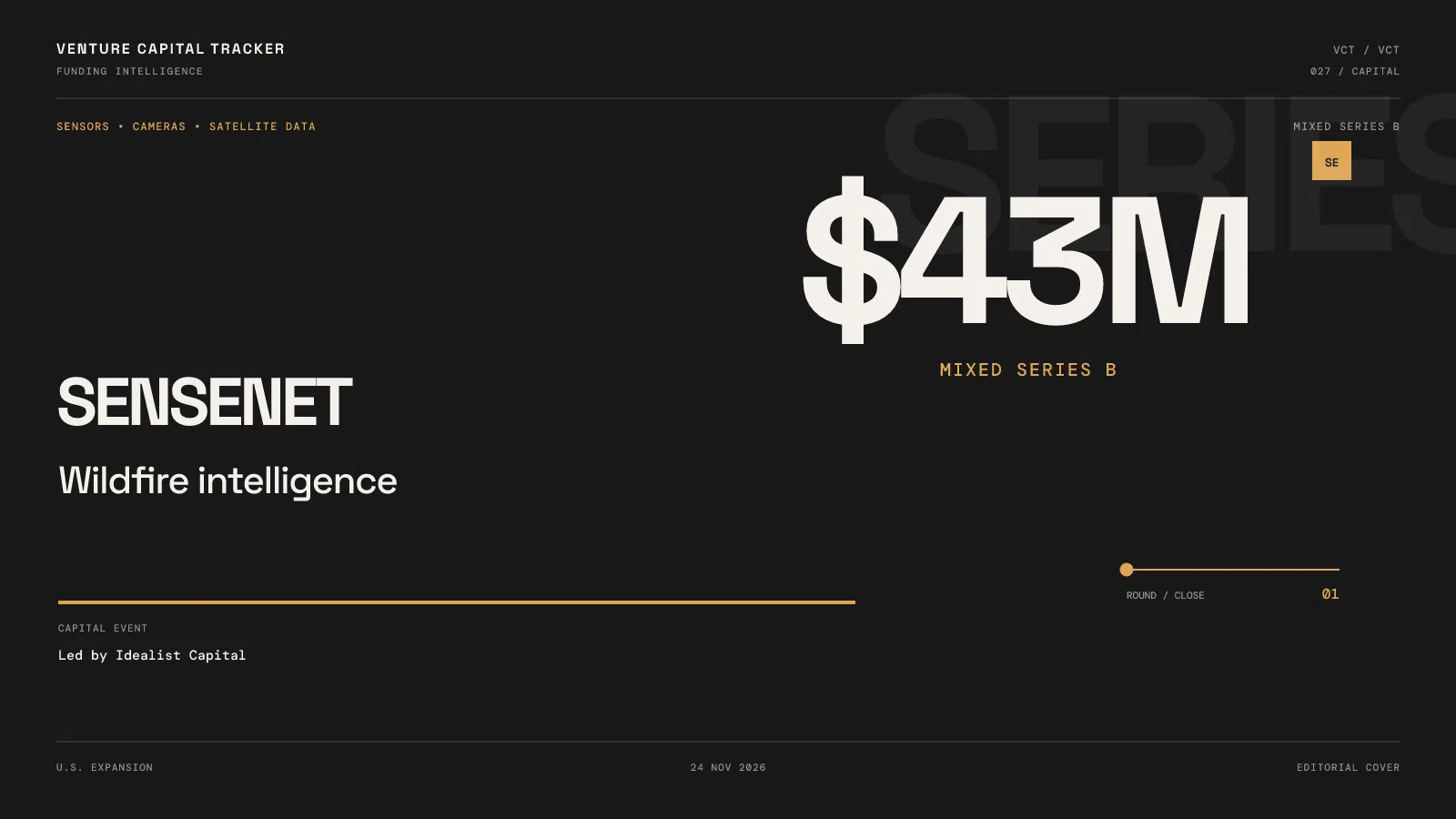
SenseNet secures $43M for U.S. wildfire detection expansion
City records explain how warnings reach firefighters, what a monitoring service can cost and which questions the company’s acreage claims leave open.

Editorial team
SenseNet is expanding a wildfire-warning business in the United States. The North Vancouver company combines sensors, cameras and satellite data to help public agencies and infrastructure operators locate fires and assess what may happen next.
Deal details & investors
Funding event
SenseNet
Led by Idealist Capital
Municipal records show what buying that service involves: installation, annual monitoring fees, camera privacy and agreement on which authority responds when an alert arrives.
Its November 24 financing announcement names Idealist Capital as lead, alongside Fusion Fund, Stormbreaker Ventures, Thin Line Capital, National Bank of Canada and the Sitka Foundation. The stated goal is U.S. and international expansion, including larger commercial teams.
The Series B combines newly issued shares, secondary share sales and debt. The split is undisclosed. As GeekWire explains, primary shares put money into the company; secondary sales pay existing shareholders. The headline total therefore does not establish how much new equity cash SenseNet received. No valuation or separate legal closing date was disclosed.
From a signal to a fire crew
SenseNet’s product description combines gas sensors intended to identify early combustion, cameras looking for smoke, local weather measurements and models of fire risk and spread. Satellite and drone feeds add other views. Its interface brings those signals together for emergency teams and infrastructure operators. GeekWire reports that Hamed Noori and Shahab Bahrami founded the company in 2019.
A documented deployment makes that easier to understand. In a July 2024 update, the City of Vernon, British Columbia, described sensors, gateways and cameras in four wildland-interface areas. Data was analysed by AI and warnings reached firefighters by text or email. Cameras could also help triangulate a reported fire’s position.
The city explicitly described this as a complement to existing fire-notification methods. Its research partnership had started in July 2022; installed hardware was due to come under city care and control when the research phase ended on August 1, 2024, while SenseNet continued support and upgrades. The fire chief reported that it had helped crews identify incidents earlier. That is useful customer testimony, rather than a controlled comparison of detection speed.
For an illustrative municipal deployment, the practical journey would start with identifying the assets and terrain to monitor, then choosing sensor and camera sites and establishing communications. An alert would carry evidence and a location to a designated responder, who would verify the incident and decide what to dispatch. This is a way to assess the service, not a report of a new customer trial.
SenseNet’s current contact and product information says it supports API integrations with existing monitoring systems and emergency operations centres. A buyer still needs to establish which integration is included, who watches the alerts and how a loss of power or connectivity is handled.
The purchase price is only part of the budget
A May 21, 2024 Harrison Hot Springs council report, in its May 27 meeting packet, assigned installation, operation and maintenance to proposed service provider Rogers Communications. SenseNet would supply equipment and software.
| Proposed package | Budget including installation, estimated euros |
|---|---|
| 65 sensors, four gateways, three cameras | Up to €101,000 |
| 100 sensors, five gateways, three cameras | Up to €139,000 |
| 100 sensors, five gateways, five cameras | Up to €159,000 |
Staff budgeted about €34,000 annually for subscription, operation and maintenance. Equipment replacements were included; future subscription increases were unknown. The report also raised camera-privacy obligations and distinguished local firefighters’ support role from provincial responsibility on Crown land.
These are historical proposed budgets, not current quotes or proof of installation. VCT converted the Canadian-dollar figures at the ECB’s May 21, 2024 rate, 1.4797 Canadian dollars per euro, rounding to €1,000.
For a buyer, these details turn a technology demonstration into a service decision: who installs and maintains it, what the annual charge covers, and which team is authorised and equipped to act. A fast notification cannot by itself supply a crew, a road into difficult terrain or an evacuation plan.
What the monitoring footprint tells investors
SenseNet says its footprint has grown from 130 million to more than 450 million acres over the past year, with more than 5,300 sensors and cameras across 12 countries. Those are company-reported figures, not an independent measurement of uniform detection coverage.
The distinction matters because its product combines different types of observation. A local gas sensor, a camera’s view and satellite data do not provide interchangeable measurements. A buyer would need a site map showing where each layer works, what obstructs it and what response time is expected under specified conditions. Dividing the acreage by the device count would not establish a sensor’s effective range.
The company announced its Series A on October 22, 2025, led by Stormbreaker. That earlier financing is distinct from the current Series B.
Growth has also included an acquisition. In an August 31 announcement, SenseNet said it acquired N5 Sensors’ wildfire business, bringing its specialist technology, employees and more than 30 federal and enterprise customer relationships. N5 retained its defense and national-security business. Financial terms were not disclosed.
That history makes it useful to ask how much expansion came from new deployments and how much from acquired relationships. The financing announcement does not allocate the latest footprint growth between the two.
Idealist co-managing partner Steeve Robitaille’s stated rationale is the combination of detection, monitoring and risk prediction for infrastructure operators, natural-resource companies and governments. The firm’s own investment criteria emphasise commercially proven solutions and a route to scale and profitability. Those criteria make renewals, service costs and customer outcomes relevant alongside acres monitored.
Other ways to buy an earlier warning
SenseNet competes in a market where the hardware and the operating service can differ substantially.
Pano AI describes cameras on high vantage points, software that identifies smoke and analysts in its intelligence centre who review detections before confirmed incidents are sent to response partners. That gives buyers a concrete comparison for the staffing and verification included in a service.
Dryad’s Silvanet documentation describes a forest sensor network connected through mesh and border gateways to cloud software, with applications for planning deployments and checking communications. It provides a reference point for evaluating local sensor placement and network operation.
OroraTech’s Wildfire Solution combines satellite observations with alerts, fire monitoring and spread analysis, available through its platform and API. It offers a different starting point for buyers prioritising information across a large region.
These are product descriptions, not results from a common performance test. The appropriate comparison is the same terrain, incident types and operating requirements. A gas-sensor network’s local detection task and a satellite service’s regional view can be complementary.
The materials reviewed do not provide a shared benchmark for false alarms, missed ignitions, verification time or total operating cost. An illustrative procurement trial would measure those outcomes on the intended site, including nuisance smoke and communications failures, and record the time from first signal to verified alert and response. That would test what a headline footprint cannot: whether the warning reaches the right people early enough to change their next decision.
Follow Venture Capital Tracker on Google
Add VCT as a preferred source to see more of our venture-capital reporting in Google Search.
Editorial note: AI tools assisted with research, structure, or drafting. Venture Capital Tracker retains human editorial responsibility for factual accuracy, relevance, and source quality before publication.