· Venture Capital · 48 sources · Updated · Verified
Linq Raises $90M at $1B Valuation in a16z-Led Series B
Linq’s $90M a16z-led Series B values it at $1B. Compare messaging and voice rivals, revenue, growth, a16z’s related bets and public-market returns.

By Venture Capital Tracker
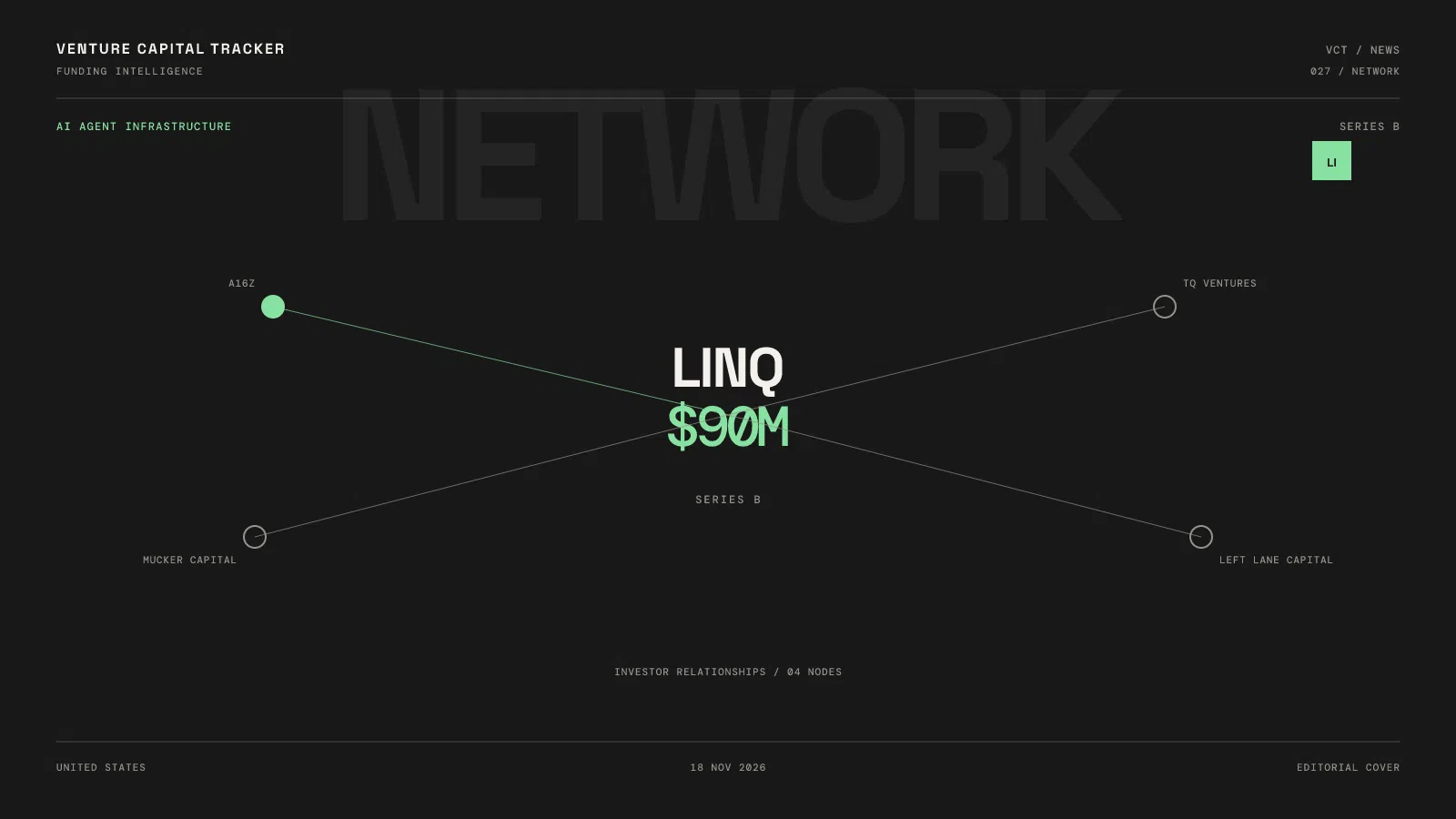
Linq has raised $90 million in a Series B led by Andreessen Horowitz, and its own funding announcement puts the company’s valuation at $1 billion. Ben Horowitz is joining the board.
Deal details & investors
Funding event
Linq
Led by Andreessen Horowitz
Reported valuation $1B
The deal, announced on November 18, backs a practical idea: an AI assistant becomes more useful when it can reach people and operate the tools they already use. Linq supplies messaging, phone connectivity and computing infrastructure to developers building those assistants.
Its clearest example is DoorDash. Customers can describe what they want in a message, review a suggested cart and confirm an order inside the conversation.
Linq’s $90M funding: the investors and valuation
| Detail | What has been disclosed |
|---|---|
| New round | $90 million Series B |
| Lead investor | Andreessen Horowitz |
| Returning investors | TQ Ventures, Mucker Capital and Abstract |
| New participants | Anthos and Left Lane Capital |
| Valuation | $1 billion, according to Linq’s company blog |
| Total funding | More than $120 million, according to Linq |
| Board appointment | Ben Horowitz |
The company announcement discloses the valuation, but does not specify whether it is pre-money or post-money.
The company previously raised a separate $20 million Series A led by TQ Ventures in February 2026. The new financing will support messaging, additional software and hardware infrastructure, and partnerships.
What does Linq actually do?
Linq sells infrastructure for developers building AI agents: software that can carry out tasks for a user. It supplies ways for those agents to communicate and act, while developers choose the intelligence and application logic behind them.
Consider an appointment assistant. Messaging lets it ask when you are available. Phone connectivity lets it reach a business. Computer access lets it work through a booking website. Payment tools can support an authorized transaction. This is an illustrative workflow; each step still needs integration, permissions and error handling.
| Product | What it provides | A useful distinction |
|---|---|---|
| Messaging | APIs for channels including Apple Messages for Business, iMessage, RCS, SMS and WhatsApp | Channel capabilities and onboarding differ |
| HD Calling | Phone connectivity for a developer’s own voice agent | The customer brings the voice system; Linq handles connectivity |
| Compute | Dedicated Apple Silicon Mac minis for browser, desktop and macOS workloads | Developers run their own software on managed physical machines |
| Payments | Payment requests and single-use virtual cards for agent purchases | Collecting money and spending on someone’s behalf are separate flows |
The compute product is more concrete than the phrase “computer use” suggests: Linq racks and manages dedicated Macs, with administrative access over SSH. Browser automation, desktop tasks and Apple-platform testing are among its advertised uses.
Linq’s payments documentation distinguishes checkout links, which settle funds to a merchant’s Stripe account, from Agentcard, which lets an agent pay another merchant using a single-use card.
Why a16z invested
In its investment announcement, a16z argues that agents will become a common way for customers to interact with companies. Its bet is that developers will need a dependable communications layer beneath those experiences.
The founders reached that opportunity through several changes of direction. Elliott Potter, Patrick Sullivan and Jared Mattsson built Linq in Birmingham, Alabama, initially around digital business cards. The business evolved into sales software and AI sales agents before customers asked to use its underlying messaging infrastructure for their own products.
Linq developed infrastructure for its own application, then found other businesses wanted to buy the infrastructure itself.
The strategic question is whether it can make that service sufficiently dependable and convenient that customers keep expanding their usage.
DoorDash provides a real deployment example
DoorDash’s own September 30 product announcement describes ordering by text: customers request food, receive suggestions and confirm checkout in the thread. Linq and a16z identify Linq as the messaging infrastructure behind the Apple Messages for Business experience.
Linq also reports that its customers have processed more than one billion messages. This measures cumulative activity. The announcements do not provide enough information to calculate revenue per message, customer retention or the share of messages that produce a completed purchase.
The distinction matters because an assistant can generate substantial conversation without generating a profitable transaction.
Apple Messages for Business and iMessage are different offerings
Linq and a16z describe the company as an official Apple Messages for Business Messaging Service Provider. That status concerns Apple’s business messaging service; buyers should confirm which channel and commercial arrangement their application will use.
Apple’s guidance explains that users can start business conversations from places such as Maps, Search, websites and apps. Its security documentation says businesses receive a relationship-specific identifier rather than the user’s phone number or Apple Account details.
Linq separately documents an iMessage API. Developers comparing providers should establish whether they need Apple Messages for Business, phone-number-based iMessage, RCS, SMS or WhatsApp. A product described simply as “Apple messaging” does not answer that question.
How much does Linq cost?
Linq’s public pricing page, checked November 19, 2026, lists the following plans in US dollars.
| Plan | Listed price | Selected inclusions |
|---|---|---|
| Hobby | Free | Up to 20 contacts, API access, message-status webhooks, RCS and SMS fallback |
| Business | $260 a month | Dedicated line, payments, group messaging, managed load balancing and dedicated support |
| Enterprise | Custom quote | Contractual service-level agreements, SSO and engineering support |
Twelve months of the listed Business subscription equals $3,120, before any additional charges. This is simple monthly-price arithmetic; it does not imply an annual contract or discount. The page labels voice and WhatsApp as add-ons and does not establish an all-inclusive cost for every agent workflow.
There is also an important product-stage detail. The voice documentation lists inbound calling as live and outbound calling as early access, requiring activation. It uses “Pro and Enterprise” plan names, while the pricing page uses “Business and Enterprise.” Buyers should confirm eligibility and charges with Linq.
The same documentation says HD audio depends on compatible connections throughout the call. The product name does not guarantee wideband quality for every conversation.
Why is this market moving now?
Three developments are converging.
First, agents can do more than generate a reply. DoorDash’s ordering flow shows a conversation reaching a transaction. Browser and desktop tools extend the range of tasks developers can attempt, especially where a business has no suitable API.
Second, voice infrastructure is improving. On November 17, 2026, Twilio announced voice-agent upgrades including smarter turn detection, HD audio and speech-provider failover, with several features scheduled for general availability that month. Those are practical attempts to fix interruptions, unnatural pauses and dropped conversations.
Third, developers want to reach users through existing channels. LiveKit’s September launch of Connectors links its agents to Twilio calls and WhatsApp Business Calling. The market is moving toward connected services that can share a conversation and complete work.
VCT’s analysis: Linq’s timing benefits from this convergence. The same developments also let established providers and specialist startups expand into neighboring parts of its business.
Who competes with Linq, and what are they doing?
Linq sits across several markets: communications APIs, agent platforms and managed computing. The closest rival depends on which part of a customer’s system is being purchased.
| Company or group | Overlap with Linq | Current approach |
|---|---|---|
| Sendblue | Direct messaging alternative | iMessage infrastructure, SDKs, delivery callbacks and fallback channels; its advertised AI Agent plan is $100 per dedicated line per month and is inbound-first |
| Blooio | Direct messaging alternative | Business messaging across Apple Messages for Business and other channels; its pricing page offers shared, dedicated and reply-only lines |
| Twilio | Messaging and voice infrastructure | Combining its global communications network with Conversation Relay, agent integrations and conversation analysis |
| Sinch and Bandwidth | Large communications providers | Extending network reach and adding AI integrations; Bandwidth emphasizes its owner-operated network and Maestro orchestration |
| LiveKit and Agora | Real-time voice and agent infrastructure | Frameworks, media transport and tools for live agent conversations; LiveKit also connects to existing telephony and WhatsApp |
| Vapi and Retell AI | Voice-agent platforms | Tools to build, test, deploy and monitor agents, including workflows and human handoffs |
| ElevenLabs | Voice technology and an expanding agent platform | Combining speech models, ElevenAgents and enterprise deployment across multiple communication channels |
| Browserbase | Browser execution | Managed browsers, Stagehand automation, search, web data and tools to inspect agent sessions |
The messaging specialists compete on a much narrower purchase than an entire agent platform. Sendblue’s $100 plan has inbound-contact limits; outbound Enterprise deployments use custom pricing. Blooio’s pricing includes a $98/month reply-only Inbound plan and a $289/month Commercial Dedicated plan. These prices do not establish equivalent capacity, channel permissions or an all-inclusive substitute for Linq’s $260 Business subscription.
Some companies can also work together. A voice-agent platform may use another company’s communications network, while a messaging provider connects to a separately chosen AI system. LiveKit’s Twilio connector is a documented example.
What is different about Linq?
Linq’s proposed advantage is the combination of messaging, phone connectivity, payments and dedicated Mac infrastructure under one supplier. A developer can keep control of the application and AI models while buying several operational components together.
It does not have exclusive access to conversational interfaces. Sendblue also targets agent developers, Blooio markets business messaging, and Twilio and Sinch already operate broad communications businesses.
VCT’s assessment: the defensible advantage would come from dependable delivery, channel relationships, integration depth, support and attractive costs across those products. The current announcements do not establish that Linq beats every specialist on performance or price. Bundling creates value only if it saves customers meaningful work without compromising the result.
Which competitors are bigger, and how fast are they growing?
The clearest operating comparisons come from public financial reports.
| Company | Period and revenue | Disclosed growth |
|---|---|---|
| Twilio | Q3 2026: $1.56 billion | 20% reported year over year; 16% organic |
| Sinch | Q3 2026: SEK 7.085 billion net sales | 5% organic |
| Bandwidth | Q3 2026: $234 million | 22% reported year over year |
| Agora | Q3 2026: $42.1 million | 19% reported year over year |
Sources: Twilio, Sinch, Bandwidth and Agora. Figures cover each company’s business, rather than a standalone segment equivalent to Linq. Original currencies and each growth measure are retained.
There are also substantial private platforms:
- ElevenLabs reported more than $500 million ARR in May 2026, up from $350 million at the end of 2025. Its September employee tender valued the company at $22 billion. ARR is an annualized recurring-revenue measure, not booked annual revenue.
- Retell AI reported a $100 million annualized revenue run rate on November 12, with $4.6 million raised. A usage-driven run rate is not automatically contracted ARR or audited full-year sales.
- LiveKit announced a $100 million Series C at a $1 billion valuation in January 2026.
- Browserbase disclosed a $300 million valuation around its June 2025 Series B. That historical valuation is lower than Linq’s disclosed figure; it does not establish which company has more revenue.
Linq’s disclosed $1 billion valuation belongs alongside those financing figures, but its announcements do not supply a current absolute revenue number for a direct operating comparison. Neither funding totals nor valuations establish a reliable revenue ranking against Sendblue or Blooio.
Margins also matter. Twilio reported a roughly 49% GAAP gross margin for Q3; Sinch reported 34.6%. Communications services include network and delivery costs. Linq’s expansion into managed hardware adds another cost base to examine before assuming software-like economics.
What else has a16z backed in this domain?
a16z has invested across several layers of conversational AI.
| Company | Verified investment | Relationship to Linq’s niche |
|---|---|---|
| 11x | a16z announced its Series B lead in November 2024; 11x identifies the round as $50 million | Sales applications and digital workers, including voice agents |
| ElevenLabs | Co-led its $180 million Series C in January 2025; participated in the $500 million Series D announced February 2026 | Voice models and an expanding enterprise agent platform |
| Decagon | Co-led a $131 million Series C in June 2025; a16z also says it led the seed | Enterprise customer-service agents |
| Town | Led a $55 million Series A in June 2026; participated in the October $108 million Series B | Work-assistant application; also named by Linq as a customer |
Decagon subsequently announced a $4.5 billion valuation in January 2026. Town’s October financing valued it at $1 billion. Those later valuations do not reveal a16z’s cash returns or the economics of its individual holdings.
The pattern suggests an investment thesis spanning voice technology, agent applications and the infrastructure connecting them. That is VCT’s interpretation of the disclosed investments, rather than a claim that every company directly competes with Linq.
Have similar companies gone public, and what returns did they produce?
The relevant public benchmarks are older listings: Twilio in June 2016, Bandwidth in November 2017 and Agora in June 2020. A recent IPO was not verified among the AI-native private peers discussed above.
The table shows price changes from the IPO offer price to the November 18, 2026 regular-session closing price.
| Company | IPO offer price | Nov. 18 close | Cumulative price return | Annualized price return |
|---|---|---|---|---|
| Twilio | $15 | $195.93 | +1,206% | About 28.0% over 10.4 years |
| Bandwidth | $20 | $40.37 | +102% | About 8.1% over 9.0 years |
| Agora | $20 per ADS | $3.28 per ADS | −83.6% | About −24.6% over 6.4 years |
IPO prices come from the companies’ offering disclosures: Twilio, Bandwidth and Agora. Closing quotes are from Yahoo Finance: TWLO, BAND and API. Calculations use closing price divided by offer price, and annualization uses elapsed time. They assume an IPO allocation at the offer price and exclude fees, taxes, currency effects and dividends. Buying when public trading opened could produce a different result. Agora’s unit is an American depositary share.
This small, selected sample is not a “typical ROI” for the sector. It excludes private failures and other outcomes, spans different holding periods and cannot establish what a Linq investor will earn. It does demonstrate that exposure to a growing communications market can produce very different shareholder returns.
What could a $1B entry valuation mean for a private investor?
An illustrative calculation helps explain how company growth translates into investor returns. Assume an investor enters at a $1 billion post-money equity valuation, later retains 70% of the original proportional ownership, and receives a simple pro-rata distribution at exit.
| Exit equity value | Gross money multiple after that dilution |
|---|---|
| $500 million | 0.35× |
| $1 billion | 0.70× |
| $3 billion | 2.10× |
| $10 billion | 7.00× |
Under those assumptions, a 3× gross return requires an exit equity value of about $4.29 billion. These are scenarios, not forecasts or Linq’s disclosed terms: its valuation basis, investor check sizes and full preference structure were not provided. Actual proceeds can also depend on preferences, fees and timing.
What should customers and investors watch next?
For customers, a useful pilot should measure the percentage of tasks completed correctly, the cost per completed task and how often a person must intervene. Tests should include delayed messages, failed calls, unavailable appointments and declined payments.
Privacy also needs to be assessed across the whole application. Linq advertises zero data retention, but its documentation describes delivery queues, failure-handling exceptions and retained metadata. Developers must also account for the data their own systems and model providers receive.
For investors, the unanswered questions are commercial: recurring revenue, gross margins after communications and hardware costs, customer concentration and retention. The funding announcements do not disclose enough to calculate a revenue multiple for the $1 billion valuation.
The next meaningful evidence will be whether customers can complete more useful work at a sustainable cost. DoorDash supplies a tangible starting point; Linq’s expansion into calls and computers broadens what it must prove.
Last updated:
Editorial note: AI tools assisted with research, structure, or drafting. Venture Capital Tracker retains human editorial responsibility for factual accuracy, relevance, and source quality before publication.