· 19 sources · Updated · Verified
Socket Security: $1B Valuation, Investors, Pricing and Rivals
Socket reached a $1B valuation as AI coding raised the stakes for dependency security. A sourced look at its backers, pricing, acquisitions and increasingly overlapping rivals.

By Venture Capital Tracker
An AI coding assistant can add a package, run its installer and execute third-party code before a developer has read the change. That creates an opening for attackers—and a business opportunity for the companies trying to close it.
Deal details & investors
Funding event
Socket
Led by Thrive Capital
Reported valuation $1B
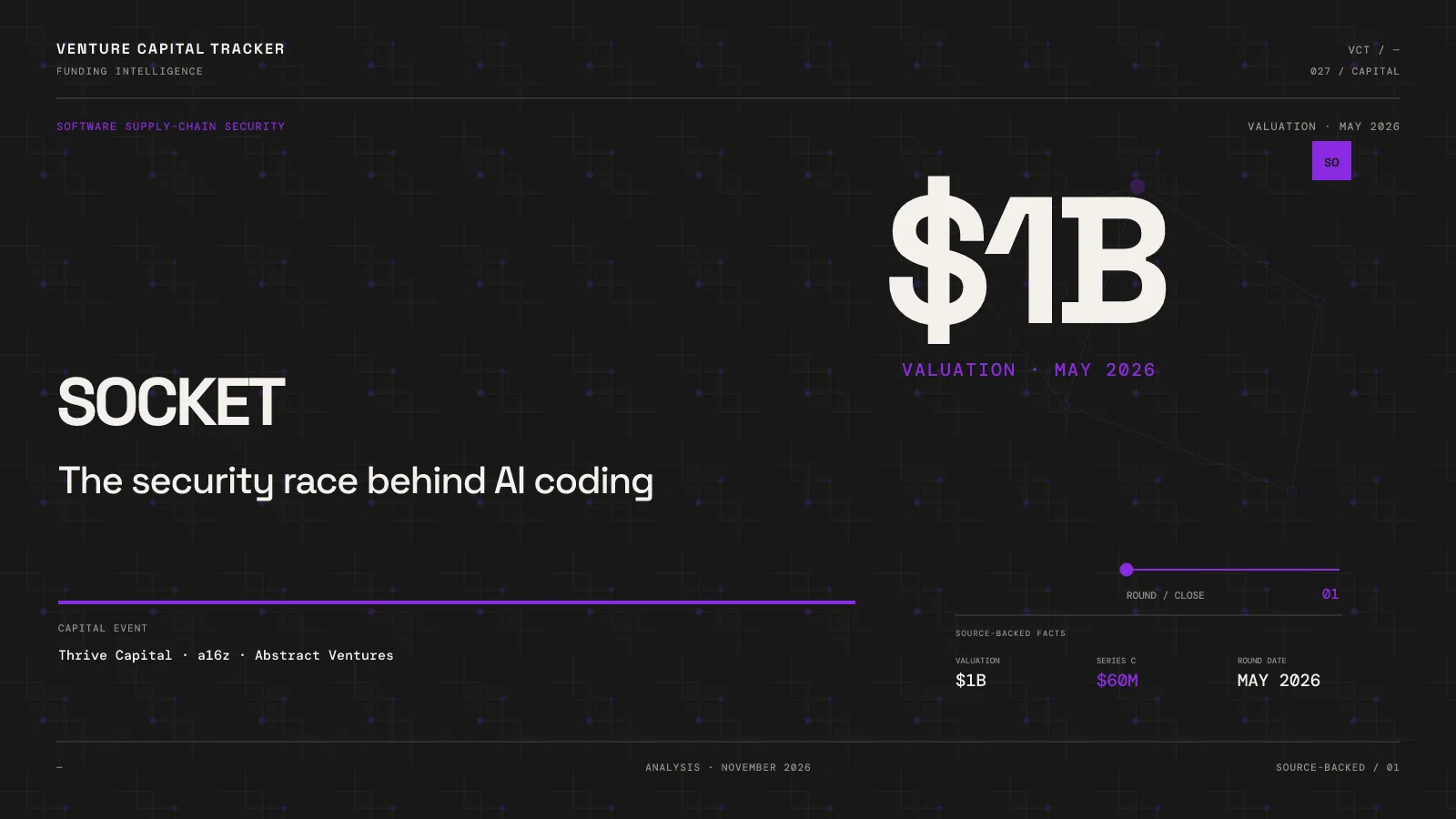
Socket reached a $1 billion valuation in a $60 million Series C announced on 20 May 2026. Its backers include major venture firms and founders associated with Stripe, Figma, Vercel and other technology companies. The more revealing story is how its original focus on malicious dependencies is expanding into a crowded application-security market.
This analysis examines Socket security products, investors, pricing and alternatives using primary sources checked on 19 November 2026. The $1 billion figure is the May financing valuation, not a live market price.
What does Socket security protect?
Socket examines the open-source packages developers bring into software projects. Its dependency analysis looks for behavior such as unexpected network access, installation scripts, obfuscated code and other risk signals, alongside known vulnerabilities and license issues.
A vulnerability is a weakness in software, often introduced by mistake. A malicious package may be deliberately designed to steal credentials or execute commands. A scanner that recognizes a disclosed vulnerability and a system that evaluates a newly published package are answering different questions.
Socket’s products include pull-request checks, a command-line interface and Socket Firewall, which blocks malicious packages during installation. Capabilities vary by ecosystem and plan; its language-support documentation separates general availability, beta features and planned support.
This is the security company at socket.dev. It is separate from the Socket.IO communications library and similarly named crypto businesses.
Socket funding: four rounds and a $1 billion valuation
The four announced rounds total $124.6 million. Socket reports the rounded total as $125 million. That is capital raised, not revenue or the value of the company.
| Announcement | Round | Amount | Lead or selected institutional backers |
|---|---|---|---|
| 11 May 2022 | Seed | $4.6M | Unusual Ventures, Village Global and South Park Commons participated, alongside angels |
| 1 August 2023 | Series A | $20M | Andreessen Horowitz led; Abstract Ventures and WndrCo joined |
| 22 October 2024 | Series B | $40M | Abstract Ventures led; a16z, Elad Gil and other backers participated |
| 20 May 2026 | Series C | $60M | Thrive Capital led; a16z, Abstract Ventures and Capital One Ventures participated |
Sources: Socket’s original seed, Series A, Series B and Series C announcements. Transaction adviser Cooley independently confirms the latest round and valuation.
For the institutional investors’ wider portfolios, see VCT’s profiles of Thrive Capital, Andreessen Horowitz, Abstract Ventures and Capital One Ventures.
The financing valuation does not establish what shareholders could receive in an exit. Revenue, ownership, dilution and financing terms would be needed to assess investment returns.
Who are the founders and operators who invested?
The widely circulated graphic of 17 recognizable backers draws on investments across different rounds. Socket’s original announcements provide a clearer way to attribute them.
| Announcement in which the named backers appear | Investors represented in the graphic |
|---|---|
| Seed, May 2022 | Patrick Collison, John Collison, Dylan Field, Guillermo Rauch, Charlie Cheever, Julia Hartz, Nat Friedman, Haroon Meer, Fred Ehrsam, Todd McKinnon and Frederic “Freddy” Kerrest |
| Series A, August 2023 | Aaron Levie and Arash Ferdowsi |
| Series B, October 2024 | Bret Taylor, Tobias Lütke, Phil Venables and Jeff Lawson |
These are named individuals, not evidence that Stripe, OpenAI, Shopify or the other companies associated with them made corporate investments. Nor is this a complete investor list. The seed, A and B announcements identify additional backers.
Their participation provides connections and credibility. It does not replace evidence about detection quality, customer retention or commercial performance.
Why AI coding makes this market more urgent
The risk predates AI. Open-source packages can depend on other packages, so one installation can introduce code from maintainers the developer never selected directly. An attacker may compromise a trusted maintainer or publish a deceptive package name.
AI adds another route: a coding agent can recommend a nonexistent dependency. If an attacker registers that name, a later installation can fetch malicious code. This is often called slopsquatting. Endor Labs describes that scenario in its agentic development security guide.
Consider a hypothetical deployment script that adds a utility package. A conventional review might assess the script’s functionality while missing an installer that reads cloud credentials. A package check before execution addresses a different point of exposure from a vulnerability report generated later.
That explains the appeal of install-time controls. It also explains why a package firewall should sit alongside restricted credentials, isolated build environments and review of sensitive changes. No single scanner secures an entire development process.
What traction is disclosed—and what remains unknown?
Socket’s Series C page, checked in November, reports more than 27,000 organizations, 1.5 million repositories and 11.6 million commits secured monthly. It names Anthropic, Cursor, Replit, Vercel and Figma among its customers. These are company-reported operating measures, not independently audited figures. The live page may have been updated since the May announcement.
They show adoption across developer workflows. They do not reveal how many organizations pay, the average contract value or how much revenue the company retains.
The sources reviewed do not establish Socket’s ARR, profitability, net revenue retention or revenue growth rate. That prevents a reliable calculation of its revenue multiple or investor returns. Repository and scan volumes also cannot be used to rank its revenue against competitors.
From dependency scanning to a broader security platform
Two acquisitions help explain Socket’s direction.
On 23 April 2025, it announced the acquisition of Coana, adding reachability analysis. This evaluates whether an application can reach vulnerable code, helping teams prioritize findings. It complements malware prevention: code executed during installation needs attention even when it is absent from the deployed application’s normal call paths.
On 28 April 2026, Socket announced the acquisition of Secure Annex, founded by John Tuckner. The deal extended its ambitions into browser and editor extensions, MCP servers and AI tools. The announcement distinguished continuing customer coverage from capabilities being integrated into Socket.
Its expansion also includes Socket Basics, a suite for static code analysis, secrets detection and container scanning. The product announcement describes a foundation built on open-source tools, while the current pricing page places these capabilities in Enterprise.
Socket therefore overlaps with broader security platforms. Describing it only as an npm malware detector misses part of the current product.
Socket vs Snyk, Endor Labs, Semgrep and Dependabot
Where does protection run? What does it detect? Can the buyer use it today? A preview feature and a generally available product should not receive the same label.
| Product | Relevant capabilities documented by its vendor | Availability or scope to check |
|---|---|---|
| Socket | Behavioral dependency analysis, install-time Firewall, vulnerability prioritization and patches; broader scanning through Basics | Ecosystem support and advanced controls vary by plan |
| Snyk | Open-source, code, container and infrastructure-as-code security; Evo adds install-time dependency blocking | Its Evo Dependency Firewall launch describes an experimental preview for selected customers |
| Endor Labs | Reachability-based dependency analysis, Package Firewall, code security and remediation | Confirm language coverage, deployment requirements and contracted modules |
| Semgrep | Code and secrets scanning, dependency vulnerabilities and malware detection/response | Its September 2026 announcement labels the malware firewall private beta |
| GitHub Dependabot | Alerts for known vulnerable or malicious dependencies; dependency review can enforce checks in pull requests | Malware alerts depend on reviewed GitHub advisories; they are not a universal pre-install inspection system |
Sources: Socket documentation, Snyk’s Evo launch, Endor Labs’ current product explanation, Semgrep’s September announcement, and GitHub’s malware-alert and dependency-review documentation.
For a team already using Snyk or Semgrep, the buying decision may be whether an additional dependency control closes a material gap—or duplicates protection it already has. For a team overwhelmed by vulnerability alerts, prioritization and remediation may matter as much as detecting the next malicious release.
This is a comparison of documented capabilities, not an independent detection benchmark. None of these sources proves a universal winner.
How much does Socket cost?
Socket’s public pricing page, checked on 19 November 2026, displays the following seat prices and minimums.
| Plan | Displayed price per developer/month | Minimum seats | Monthly seat-cost calculation |
|---|---|---|---|
| Free | $0 | One developer | $0 |
| Team | $25 | Five | $125 at the displayed rate |
| Business | $50 | Twenty | $1,000 at the displayed rate |
| Enterprise | Custom | Custom | Quote required |
For budgeting, twelve months at those displayed minimum seat rates equals $1,500 for Team or $12,000 for Business, before applying a billing-cycle discount. These are calculations, not annual contract quotes. Socket advertises savings of up to 20% for annual payment.
Team includes reachability analysis; Business adds features such as SSO/SAML and SBOM support. Enterprise includes advanced deployment controls and full-application function-level reachability. Socket defines a developer using commits to scanned repositories during the previous 90 days. Buyers should check the live billing selection and seat count before comparing offers.
The free entry point makes adoption easier; the commercial question is which organizations convert to paid controls and larger deployments. Public pricing alone does not answer that question.
How much capital is competing for the opportunity?
Selected financing announcements illustrate the range of businesses addressing overlapping problems.
| Company | Selected disclosed financing | What the comparison tells us |
|---|---|---|
| Socket | $60M Series C at $1B valuation, May 2026 | A dependency-security specialist financing a wider platform |
| Endor Labs | $93M Series B, April 2025, led by DFJ Growth | Another venture-backed platform investing in secure AI development |
| Semgrep | $100M Series D, February 2025, led by Menlo Ventures | Code-analysis tooling expanding automation and supply-chain protection |
| Snyk | $196.5M Series G at $7.4B valuation, announced December 2022 | A much later financing stage; an old valuation is not a current market price |
Sources: Endor Labs’ company-issued release, Semgrep’s funding announcement and amount confirmation, and Snyk’s original release.
These rounds occurred at different times and cover businesses with different scopes. They are not a market-share ranking or a reliable way to infer relative revenue.
The competitive direction is clearer than any single market-size forecast: vendors are combining package intake controls, code analysis, prioritization and fixes. Socket’s challenge is to preserve a useful advantage as those capabilities converge.
What buyers—and investors—should watch next
A useful product evaluation starts with a representative repository and its actual package managers. Measure how much installation and build time the tool adds, which findings require investigation, whether policy covers developer laptops as well as CI, and how exceptions are handled. Test the deployment mode and plan being offered, rather than a capability listed elsewhere on the vendor’s site.
For investors, the more revealing measures would be paid-customer conversion, retention, expansion revenue and the cost of maintaining detection coverage. Famous backers and repository counts do not answer those questions.
Socket has raised enough capital to broaden its product and has documented adoption among prominent software companies. Its next test is turning dependency protection into a durable business while rivals build similar controls.
For financing updates, return to the Socket startup profile. For a different part of the supply chain—the third-party scripts running inside a visitor’s browser—see VCT’s client-side security vendor comparison.
Last updated:
Editorial note: AI tools assisted with research, structure, or drafting. Venture Capital Tracker retains human editorial responsibility for factual accuracy, relevance, and source quality before publication.