· 12 sources · Verified
Palo Alto’s $4.5B Applied Compute Deal Moves Security Into Model Training
The proposed acquisition joins AI infrastructure to a security platform. Its deal terms, product workflow and spending plans show what buyers and investors still need to test.

By Venture Capital Tracker
A business teaching an AI model to review contracts needs more than cheaper answers. It needs supporting citations, control over sensitive documents and a way to catch mistakes before the next version reaches users.
Deal details & investors
Acquisition
Applied Compute
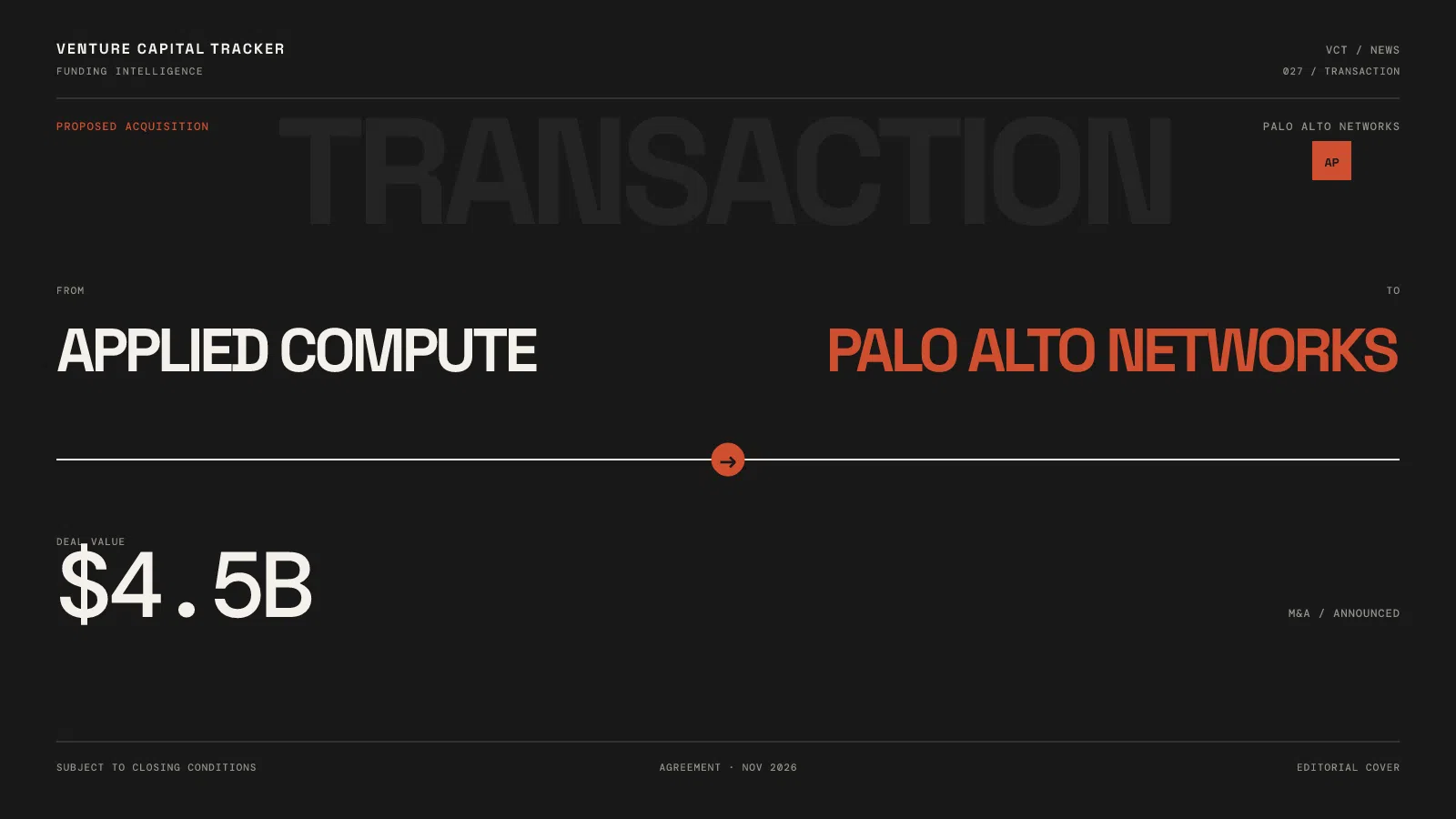
Palo Alto Networks' agreement to buy Applied Compute would bring that model-building work inside a major cybersecurity supplier. The purchase would expand its role from protecting enterprise systems into infrastructure for adapting and operating AI models.
Palo Alto announced the agreement on November 18. Its issuer statement says the transaction remains subject to regulatory clearance and other closing conditions. Applied Compute chief executive Yash Patil would become Palo Alto's co-chief AI officer after completion.
What Applied Compute actually sells
Open-weight models make their trained parameters available, allowing organizations to adapt and run them. They still need infrastructure and expertise. Applied Compute's platform description combines training, inference—the process of generating an answer—and improvement using feedback from production.
Its AC2 product is designed for teams building models around a particular job, rather than choosing one general model for every request. The August 25 launch documentation, which described AC2 as a private beta at that time, explains a console for comparing training runs, inspecting the model's attempts and examining the grading rules used to judge them.
An illustrative workflow, based on that documentation, looks like this:
- A team chooses a base model and defines the task and scoring rules.
- It runs training experiments and checks where the model fails.
- A successful version moves onto dedicated serving capacity.
- Real usage supplies traces and feedback for the next training cycle.
This describes the vendor's workflow, not a VCT product test. Each release still needs evidence that it improves the intended task without creating unacceptable failures elsewhere.
A concrete example: checking legal documents
A case study co-authored by Harvey and Applied Compute describes models trained for Harvey's Review Table, which extracts answers from document collections. The task requires an answer in the expected format and citations supporting it. The authors describe evaluating correctness and citation quality alongside cost.
That is a more specific business problem than making a model better at everything. A legal team cannot use a cheaper answer if the supporting reference is wrong. The case study reports improvements on its own evaluation set; it does not establish that the same results transfer to another firm's documents or review requirements.
Routing is another approach. Applied Compute's Clay case study describes choosing different models for different research requests instead of sending every query to the same model. It reports up to 47% lower inference cost with limited impact on answer quality. Those are supplier and customer claims for that workload, not a general savings forecast.
The deal price and the funding round describe different things
Applied Compute's November 2 announcement disclosed $350 million of new funding at a $3.25 billion valuation. Elad Gil led, with Kleiner Perkins among the participating investors. The company also reported reaching a $100 million annualized revenue run rate. Annualizing a current pace does not establish revenue earned over a completed year.
November 2 is the funding announcement date, not a separately verified legal closing date. The acquisition should not be added to that fundraising total.
| Figure | What the source establishes |
|---|---|
| $350m funding | New capital disclosed in the November 2 issuer announcement |
| $3.25bn valuation | Financing valuation; its pre- or post-money basis was not specified |
| $4.5bn acquisition consideration | Proposed payment in Palo Alto shares, subject to adjustments |
| About $500m cash and prepaid compute commitments | Combined amount included in the buyer's transaction presentation |
The SEC filing says the agreement covers Applied Compute's outstanding stock, warrants and other equity rights. It uses $337.16 as the reference price for calculating buyer shares and says the final number of shares was not yet known.
The presentation does not separate the approximately $500 million between cash and prepaid commitments. That combined figure is not additional purchase consideration. Different securities, preferences and adjustments can affect distributions. A comparison between the financing valuation and purchase consideration cannot establish what any particular investor will receive.
What Palo Alto plans to build
The buyer's earnings presentation supplies details beyond the announcement. It describes approximately 70 US-based employees and targets $1 billion of additional next-generation security annual recurring revenue by fiscal 2029.
The same presentation anticipates less than $3 billion of cumulative capital spending from fiscal 2027 through fiscal 2030. Assuming the expected close, management projects operating-margin reductions of up to one percentage point in fiscal 2027 and two points in fiscal 2028. These are management projections, not achieved results.
The buyer expects closing in its fiscal third quarter of 2027. Its statement says Applied Compute would continue serving existing customer groups while Palo Alto brings the platform to its customer base. The August private-beta announcement does not establish present-day availability for every customer. Product integration, pricing and delivery commitments still need to be established for individual buyers.
Reuters' same-day reporting places the purchase within Palo Alto's broader move into enterprise AI and security-platform consolidation. VCT's earlier Console acquisition coverage examines a different part of that expansion: agents for IT work.
What buyers can compare today
A company can use a hosted general-purpose model, rent infrastructure for customized open models or operate its own stack. Using a hosted model reduces infrastructure work. A customized model offers more ways to adapt the system but adds training and testing work; running the stack internally also puts operation of that infrastructure on the buyer. Those are purchasing tradeoffs, not performance rankings.
Together AI is an example of another managed infrastructure provider. Its dedicated inference documentation describes hosting customized models and testing updates with shadow traffic or A/B comparisons. Its pricing support page separates training charges from ongoing dedicated hosting costs.
That makes a per-token comparison insufficient. Buyers should price the training cycle, serving capacity, engineering work and testing needed for their expected usage. The reviewed Applied Compute announcements do not supply a comparable customer price quote.
Before committing, a buyer should ask for contractual answers about where data and model versions run, retention, access controls, model portability and support if an update fails. It should then test a representative task against its present system, including difficult cases and a rollback to the previous version.
The unresolved commercial test is whether bringing model infrastructure and security together makes those tasks easier for customers. The signed agreement establishes the purchase terms; it does not yet establish the combined product's performance.
Follow Venture Capital Tracker on Google
Add VCT as a preferred source to see more of our venture-capital reporting in Google Search.
Editorial note: AI tools assisted with research, structure, or drafting. Venture Capital Tracker retains human editorial responsibility for factual accuracy, relevance, and source quality before publication.