· Venture Capital · 5 sources · Verified
Harbor Raises $10M Seed for AI-Agent Risk and Insurance
Harbor’s $10M seed round links agent monitoring with insurance distribution. The key questions are risk evidence, carrier capacity and enterprise adoption.

By Venture Capital Tracker
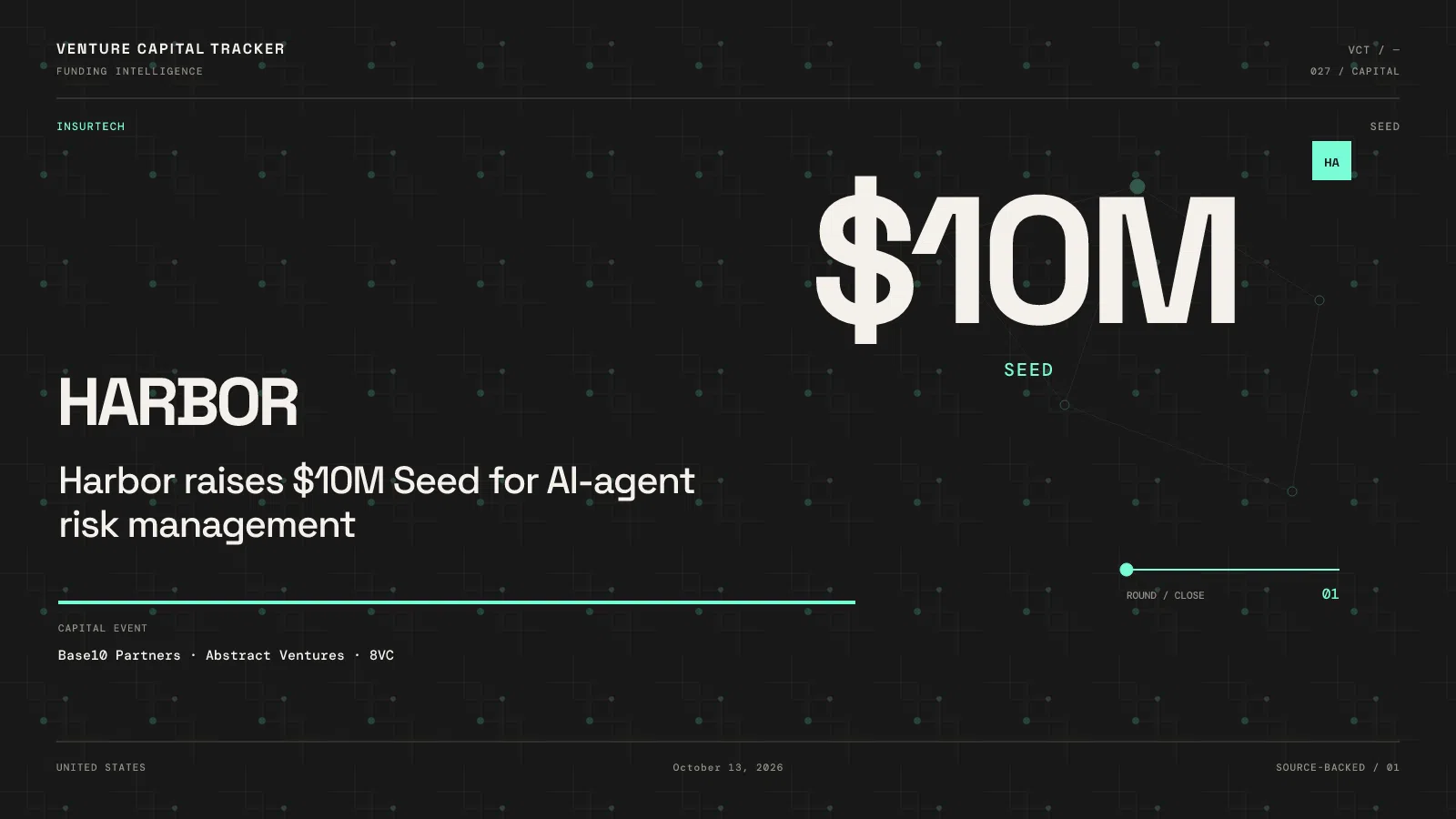
Harbor announced $10M in seed financing on October 13, 2026, co-led by Base10 Partners, Abstract Ventures and 8VC. The San Francisco company is building risk-management software and insurance distribution around enterprise AI agents.
The opportunity is a shift from observing an agent’s behavior to putting a price on the financial exposure it creates. But the funding round is company capital—not a disclosed pool of insurance claims capacity.
Harbor’s seed round: the disclosed terms
| Item | Detail |
|---|---|
| Financing | $10M seed |
| Announcement | October 13, 2026 |
| Co-leads | Base10 Partners, Abstract Ventures, 8VC |
| Other named investors | Restive Ventures, NFX, Innovation Endeavors, Kibo Ventures, Masia, MVP Ventures |
| Valuation | Not disclosed |
The company announcement and press page identify the financing and investor group. They do not specify investor allocations, the financing instrument or an exact legal closing date. No separate debt facility, grant or acquisition is disclosed in that announcement.
From agent telemetry to an insurance proposition
Harbor’s product combines activity monitoring, runtime policy enforcement, source-level analysis and adversarial testing. The company presents these capabilities as inputs to measuring risk, rather than relying on a one-time assessment before deployment.
That distinction matters for systems whose models, tools and permissions can change independently. A harmless text assistant and an agent authorized to execute payments create different exposures, even if both use the same underlying model.
Investor Restive Ventures’ investment thesis emphasizes this connection between agent permissions, production behavior and potential financial loss. It is an investor’s rationale, not independent proof that the underwriting model works.
Insurance distribution is not the same as carrying every loss
Harbor’s legal disclosures identify Miralta Q, Inc., doing business as Harbor, as a distribution and marketing agent for insurance carriers. They state that the described policies are issued by surplus-lines carriers, with coverage dependent on jurisdiction and actual policy terms.
That is more specific than the shorthand claim that a startup “insures AI.” It does not establish that Harbor itself bears every covered loss on its balance sheet. Nor does visiting a website or installing monitoring software automatically bind coverage.
The reviewed announcement does not disclose carrier-specific capacity, premium volume, policy limits, exclusions, claims experience or the allocation of underwriting risk.
What investors should watch next
Our analytical view is that Harbor must prove two connected products: software that customers rely on and insurance distribution supported by credible risk evidence.
First, telemetry needs to explain exposure, not simply produce more alerts. False positives can interrupt valuable workflows, while missed events can undermine both customer trust and the usefulness of the risk assessment.
Second, agent failures may be correlated. Many customers can depend on the same model provider, tool integration or software update. More monitored activity does not automatically mean more independent observations of loss.
Third, enterprise adoption must survive procurement. Buyers need to understand access to sensitive traces, deployment boundaries and the performance cost of checking actions. Those requirements affect implementation effort and margins.
The strongest follow-up evidence would be paid deployments, renewal behavior, carrier relationships and claims-informed risk calibration. Until then, the $10M round finances a promising approach to AI-agent risk—not demonstrated insurance profitability.
Source note: Financing facts are company-disclosed. Product and insurance descriptions come from Harbor’s own materials; Restive provides an investor perspective. Commercial and risk-economics discussion is VCT analysis.
Follow Venture Capital Tracker in Google
Add VCT as a preferred source to make our venture-capital coverage easier to find in Google Search.
Editorial note: AI tools assisted with research, structure, or drafting. Venture Capital Tracker retains human editorial responsibility for factual accuracy, relevance, and source quality before publication.