· Venture Capital Tracker · venture-capital
Workday Agrees to Acquire C1.ai for Agent Identity Governance
Workday signed a definitive agreement to acquire C1.ai, adding identity governance for employees, machines and AI agents. Financial terms were not disclosed.
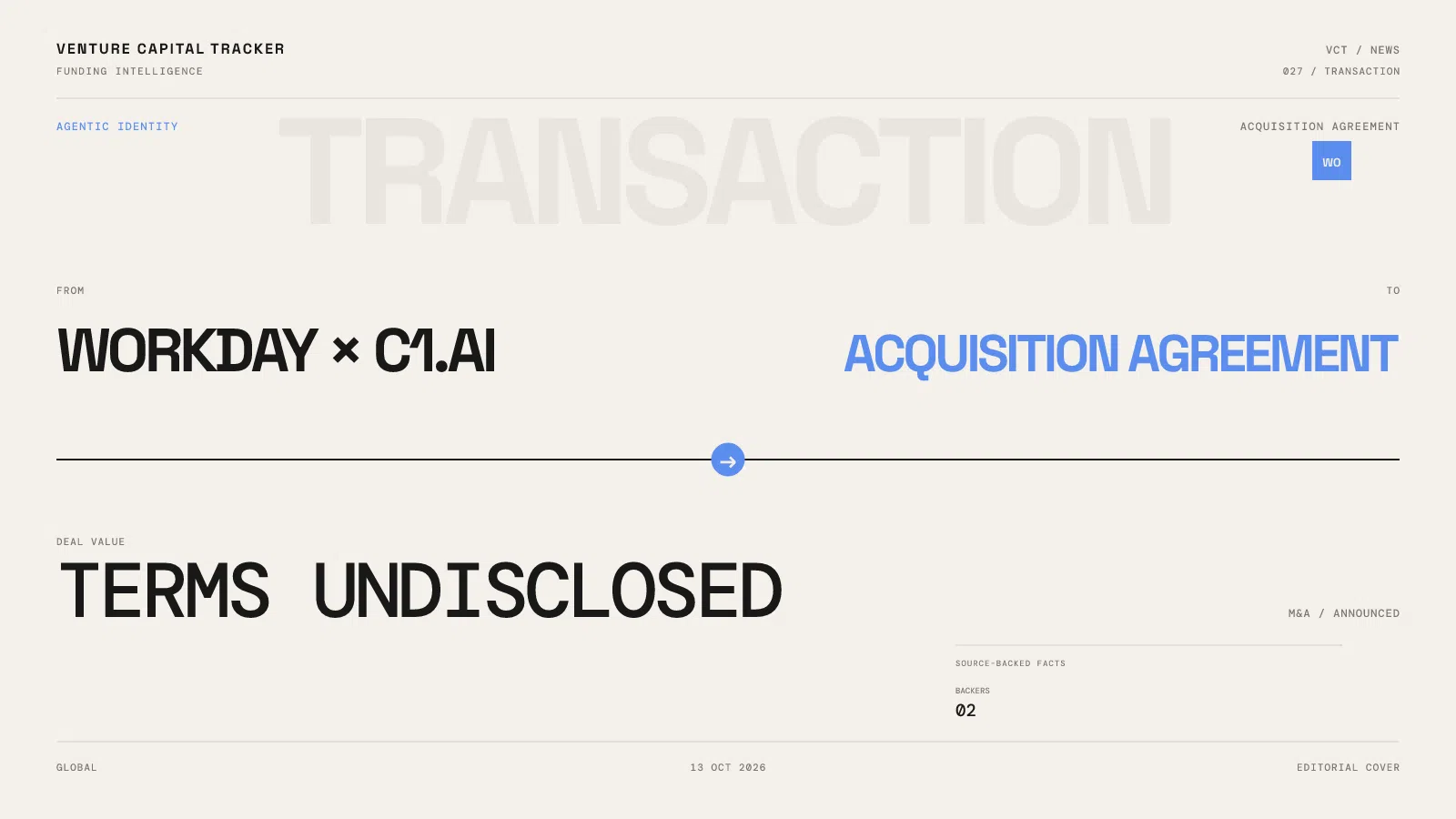
Workday has signed a definitive agreement to acquire C1.ai, the identity-security company formerly known as ConductorOne, as it tries to govern access for AI agents as well as employees.
Financial terms were not disclosed. The transaction is expected to close in Workday’s fiscal fourth quarter ending January 31, 2027, subject to customary closing conditions. It is an announced acquisition, not a completed deal.
Transaction details
| Item | Detail |
|---|---|
| Acquirer | Workday |
| Target | C1.ai / ConductorOne |
| Consideration | Undisclosed |
| Status | Definitive agreement |
| Expected close | Workday fiscal Q4, ending January 31, 2027 |
| Product category | Identity governance and access management |
C1.ai connects to enterprise systems including email, CRM, code repositories, finance applications and cloud infrastructure. Its platform grants, reviews and revokes access for human users, service accounts and AI agents.
Why identity is becoming part of Workday’s AI strategy
Workday already sits at the system of record for employees, organizational roles and financial approvals. That data can determine what a person should be allowed to access from hiring through departure.
AI agents complicate the model. An autonomous agent may need temporary permissions across multiple applications, act on behalf of different employees and create actions that are difficult to trace through traditional identity-governance reviews.
C1.ai gives Workday a policy and workflow layer for those non-human identities. The strategic opportunity is to combine Workday’s authoritative HR and finance data with C1.ai’s access controls so permissions change automatically when roles, employment status or assigned tasks change.
This is more specific than a generic “agentic AI” acquisition. It targets a real operational bottleneck: companies cannot safely deploy autonomous software if they cannot identify each agent, constrain its permissions and remove access when the work ends.
C1.ai brings venture-backed security infrastructure
C1.ai was founded by Alex Bovee and Paul Querna, both of whom previously worked in identity and security. The company raised a $79 million Series B in 2025 led by Greycroft, with participation from CrowdStrike Falcon Fund and existing investors including Accel and Felicis Ventures.
The company subsequently rebranded from ConductorOne to C1.ai as it expanded from identity-governance automation into a broader control plane for human, machine and agent identities.
Workday has not disclosed C1.ai’s revenue, customer retention, growth rate or acquisition multiple. That prevents a financial assessment of the purchase. The strategic fit is clearer than the price discipline.
The integration challenge
Identity products depend on broad connector coverage, reliable policy enforcement and customer trust. Workday must integrate C1.ai without narrowing its usefulness to Workday-only environments. Large enterprises run heterogeneous application stacks, and a governance layer loses value if it cannot remain vendor-neutral.
The companies also cite C1.ai research suggesting 95% of large U.S. companies already run autonomous agents and Deloitte research finding only 21% have mature governance. Those figures illustrate the perceived gap, but they come from surveys and should not be treated as audited deployment data.
What to watch after closing
The acquisition will be successful if Workday can turn organizational data into timely access decisions across third-party systems. Useful evidence would include:
- native integration between Workday role changes and C1.ai access policies;
- governance for agent credentials, delegation and approval boundaries;
- continued support for non-Workday identity and security infrastructure; and
- customer adoption beyond pilot deployments.
Bottom line
Workday is buying a security control plane for the agentic enterprise rather than another general-purpose AI assistant. The logic is strong: agents need identities and least-privilege access just as employees do. The unanswered questions are financial—the purchase price is undisclosed—and operational, because C1.ai must remain broad enough to govern access across the full enterprise stack.
Follow Venture Capital Tracker in Google
Add VCT as a preferred source to make our venture-capital coverage easier to find in Google Search.
Editorial note: AI tools assisted with research, structure, or drafting. Venture Capital Tracker retains human editorial responsibility for factual accuracy, relevance, and source quality before publication.