· Venture Capital Tracker · venture-capital
Stand Raises $70M Series C at $1B for Resilient Home Insurance
Saga Ventures leads Stand’s $70M Series C at a $1B valuation. The investment case depends on mitigation and underwriting—not insured property value alone.
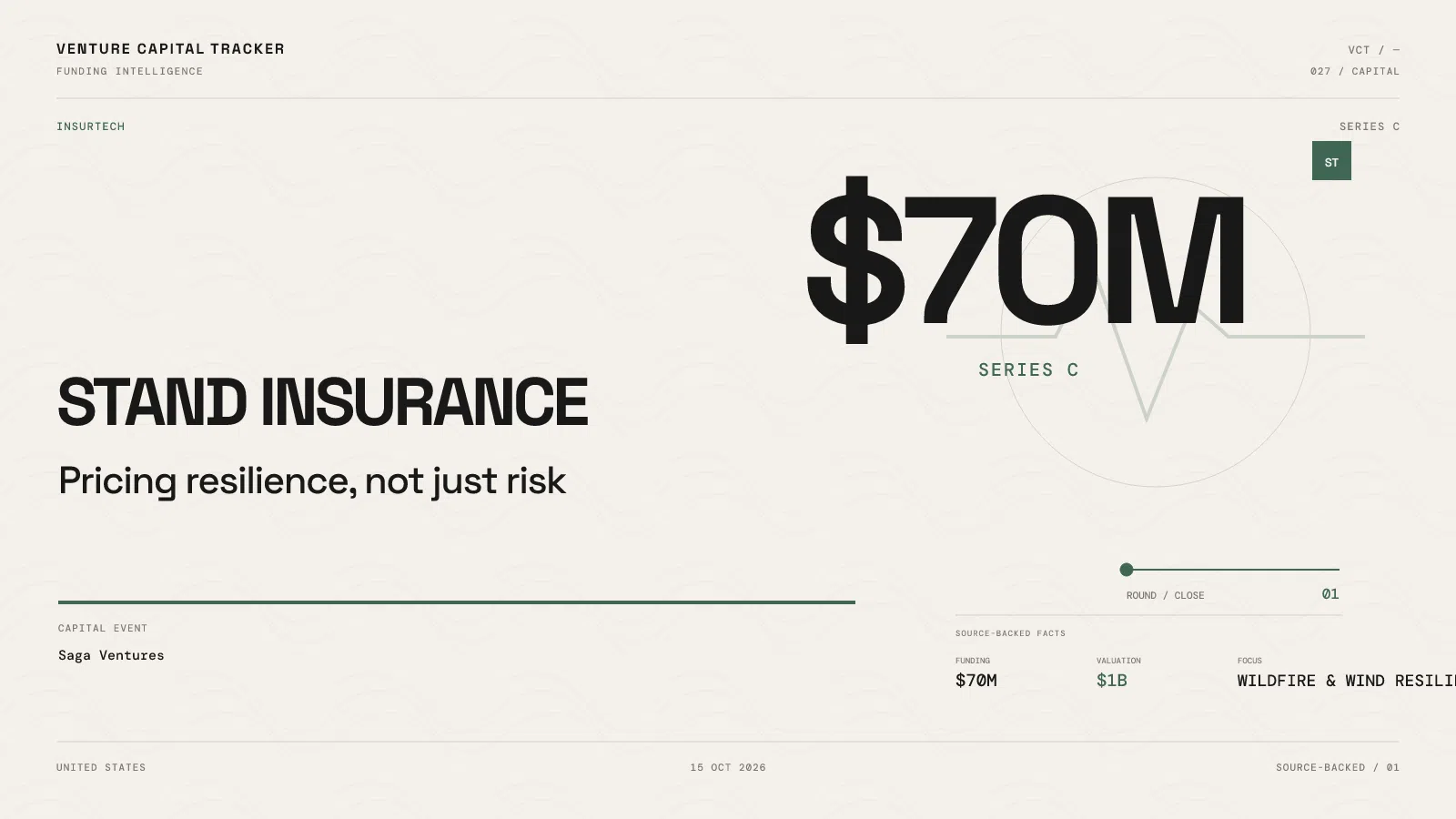
Stand Insurance announced a $70 million Series C at a $1 billion valuation on October 15, 2026, led by Saga Ventures. Lowercarbon, Eclipse, Equal Ventures, Inspired Capital, Neotribe and Jackson Square Ventures also participated, alongside other investors. The company puts total funding at $130 million.
The financing backs a business that combines home insurance with physical improvements intended to reduce catastrophe damage. That makes the investment question unusually concrete: can better knowledge of an individual building, followed by verified mitigation work, produce lower losses and sustainable insurance economics?
Stand Series C: investors and disclosed terms
The company’s financing announcement describes money raised, rather than fundraising talks or a proposed facility. It does not specify the exact closing date or whether the $1 billion valuation is pre-money or post-money. Those omissions prevent a reliable calculation of new-investor ownership from the headline alone.
Stand also reports more than $10 billion in insured property value, compared with $1 billion a year earlier. This measures the value of properties covered. It is not annual revenue, premium income, assets managed or capital available to pay claims. The tenfold increase demonstrates a larger exposure base; it does not establish underwriting profitability.
The product changes the property as well as its price
Stand describes a process that starts with simulations of a home’s response to hazards such as wildfire and wind. It then recommends protective improvements, helps owners arrange the work and verifies completion.
The business rests on a clear hypothesis: strengthening a building can reduce risk enough to support better insurance terms. The hypothesis is stronger than a promise to make an existing administrative process faster, but it also requires more evidence: the model must identify interventions that work, owners must complete them, and the resulting portfolio must perform.
A credible assessment would compare otherwise similar properties, account for their locations and hazard exposure, and follow claims over time. A model can predict lower losses. Claims data must show whether that prediction holds.
Underwriting capacity remains a separate constraint
The release says Stand underwrites and services policies issued through Concert Specialty Insurance Company in California and Stand Insurance Exchange in Florida, with reinsurance support. This structure matters because raising company equity is different from securing insurance capacity.
In our analysis, growth depends on coordinating several resources: distribution, property assessments, mitigation services, issuing arrangements and reinsurance. More customer demand alone cannot establish that each resource remains available at an attractive cost.
Capital providers will want to understand geographic concentration, the cost of acquiring and servicing customers, and portfolio performance after major weather events. Those questions do not imply a problem at Stand; they identify what a financing headline cannot resolve.
Why the next disclosures matter
The important follow-up metrics are earned premiums, retention, loss experience, expenses and the economics of reinsurance. Evidence that completed improvements translate into better outcomes would make the resilience thesis more persuasive than insured-value growth alone.
The Series C gives Stand resources to expand. The durable advantage, if it emerges, will come from repeatedly selecting, improving and insuring properties at economics that work for homeowners and the capital behind their policies.
Explore the Stand Insurance profile. For different insurance models, compare Ledgebrook’s $200M financing and Meanwhile’s Bitcoin life-insurance round.
Follow Venture Capital Tracker in Google
Add VCT as a preferred source to make our venture-capital coverage easier to find in Google Search.
Editorial note: AI tools assisted with research, structure, or drafting. Venture Capital Tracker retains human editorial responsibility for factual accuracy, relevance, and source quality before publication.