· 13 sources · Verified
Genesis AI raises $500M. Its next test is the factory shift
Eno pairs human-like hands with models trained on workers’ movements. Industrial trials will have to establish repeatability, maintenance costs and safe integration.

By Venture Capital Tracker
Genesis AI is building a robot that can handle tools and objects made for human hands. For a factory buyer, the next question is how much acceptable work it can complete across a shift—and what it costs to keep it working.
Deal details & investors
Funding event
Genesis AI (robotics)
Led by Premji Invest , Khosla Ventures +1 more
Reported valuation $3.5B
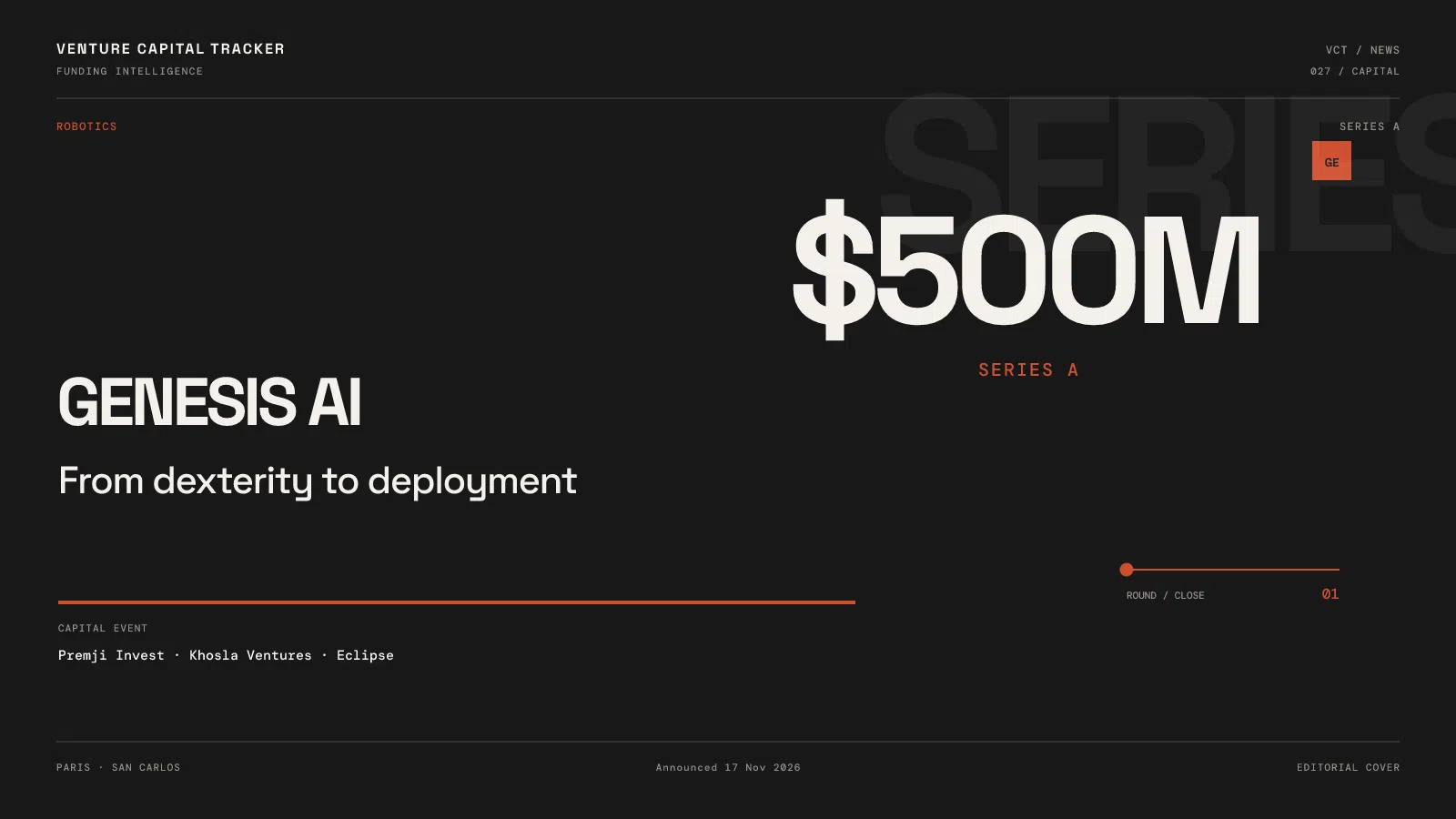
Co-founded by Zhou Xian and Théophile Gervet, the robotics company has operations in Paris and San Carlos, California. It announced its Series A on November 17. The $500 million round values it at $3.5 billion after the investment. Premji Invest, Khosla Ventures and Eclipse co-led it.
Genesis is initially pursuing manufacturing, logistics and laboratory work. Its proposition is a robot that can learn varied physical tasks, rather than requiring a new machine for every job. The appeal is flexibility for workplaces where objects and processes change. The economics of each installation still need to be established.
A robot built around its hands
Eno is a wheeled machine with an articulated body and arms fitted with human-like robotic hands. In its June 16 introduction, Genesis described a design intended to handle tools and environments made for people. The company plans industrial deployments first, with other sectors following later.
Eclipse's account of the system describes GENE, the software that directs actions, custom hardware and a training process built around human work. Sensor gloves and cameras collect examples of people handling objects. Genesis World supplies simulated environments for training and evaluation. The goal is to make learning transfer into useful movement on the physical machine.
Owning those pieces together is central to the investment case. In that November 17 thesis, Eclipse argues that problems emerge where software, hardware and manufacturing meet. Controlling those interfaces can help a company change the whole system when one component limits the rest. Eclipse is an investor in Genesis; that argument is a rationale for backing the company, not independent validation of its reliability.
TechCrunch reported 30–40 Eno robots built, undisclosed pilots and hands needing replacement after weeks of regular work; its demonstration used separate arms.
What an industrial trial would need to prove
Genesis already has a documented route into industrial evaluation. Its June 16 partnership announcement with LG CNS describes a sequence: identify suitable manufacturing and logistics uses, develop a rollout plan, then run a pilot covering workflow documentation, data collection, additional training and validation. The intended settings include LG operations and LG CNS customers, initially in the United States.
That is an integration programme. The announcement does not supply completed pilot results, a signed order value or an independently measured productivity gain.
A useful trial starts with a narrowly defined job. For illustration, an operator evaluating a robot for small-parts assembly could agree which connectors, orientations and tolerances it must handle, then test what happens when parts move or a step fails. This is a VCT evaluation framework, not an account of an Eno customer deployment.
NIST's assembly testing work provides a useful starting point. It uses task-based tests involving insertions and fastening, considers factors such as obstruction and mechanical resistance, and stresses repetition to make comparisons meaningful.
| Buyer question | Evidence to request |
|---|---|
| Does it finish the job? | Completed, acceptable outputs across repeated trials, including failures. |
| How often does someone intervene? | Intervention and recovery logs, with the time spent restarting work. |
| Does performance survive variation? | Results with changed part positions, obstructions and the customer's actual materials. |
| What wears out? | Maintenance intervals, replacement prices and time unavailable for work. |
| Can it operate safely here? | A documented assessment of the complete installation and how people interact with it. |
The safety question extends beyond the hand. OSHA's industrial robot guidance treats the robot, tools, controls and surroundings as a system. It calls for risk assessment through design, integration, operation and maintenance. A capable manipulation model does not replace that work.
The alternatives use different architectures
Genesis is pursuing an integrated robot product. Two published research examples show how approaches can differ. Figure's Helix combines visual and language understanding with control of a humanoid's upper body, including its fingers. Physical Intelligence's π0 research explores a generalist policy trained across different robot configurations.
These are different bodies, datasets and demonstrations. The published descriptions do not provide a shared customer-site test that would establish which approach performs best. A buyer still needs to compare the same task, acceptable output and operating conditions. A conventional task-specific installation or a staffed station also belongs in that economic comparison.
Genesis's own investors acknowledge the adoption problem. In a Premji Invest interview, its founders explain why ownership of hardware and simulation lets them adjust training and execution together. They also describe adapting to a customer's environment. Those are proposed ways to reduce deployment effort; the interview does not disclose a standard installation price or independently verified payback period.
The financing and the bill
The new round follows a separate $105 million seed announcement on July 1, 2025. Adding the two disclosed rounds gives $605 million, a VCT calculation across those announcements. That is cumulative fundraising, not the amount newly raised in November. The Series A valuation is explicitly post-money; individual investor commitments and any split between newly issued shares and sales by existing holders were not disclosed.
The issuer also names Durable Capital Partners, accounts advised by T. Rowe Price Associates, Bpifrance, HSG, NVIDIA, AMD Ventures, Zoom, Samsung Next and Ericsson, plus individual backers. Its stated uses include more data and training, deployment and hiring.
Commercial terms are still taking shape. In Crunchbase News's interview, CEO Zhou Xian said Genesis was exploring renting robots and software together. He declined to disclose revenue and did not provide a paying customer count. A rental model can change when a customer pays, but the contract still has to assign responsibility for repairs, downtime, integration and acceptable output.
For an operator considering a trial, those terms are the next documents to request alongside the demonstration: what work the robot must complete, who restores it when it stops, and what the customer pays during the interruption.
Follow Venture Capital Tracker on Google
Add VCT as a preferred source to see more of our venture-capital reporting in Google Search.
Editorial note: AI tools assisted with research, structure, or drafting. Venture Capital Tracker retains human editorial responsibility for factual accuracy, relevance, and source quality before publication.