· 9 sources · Verified
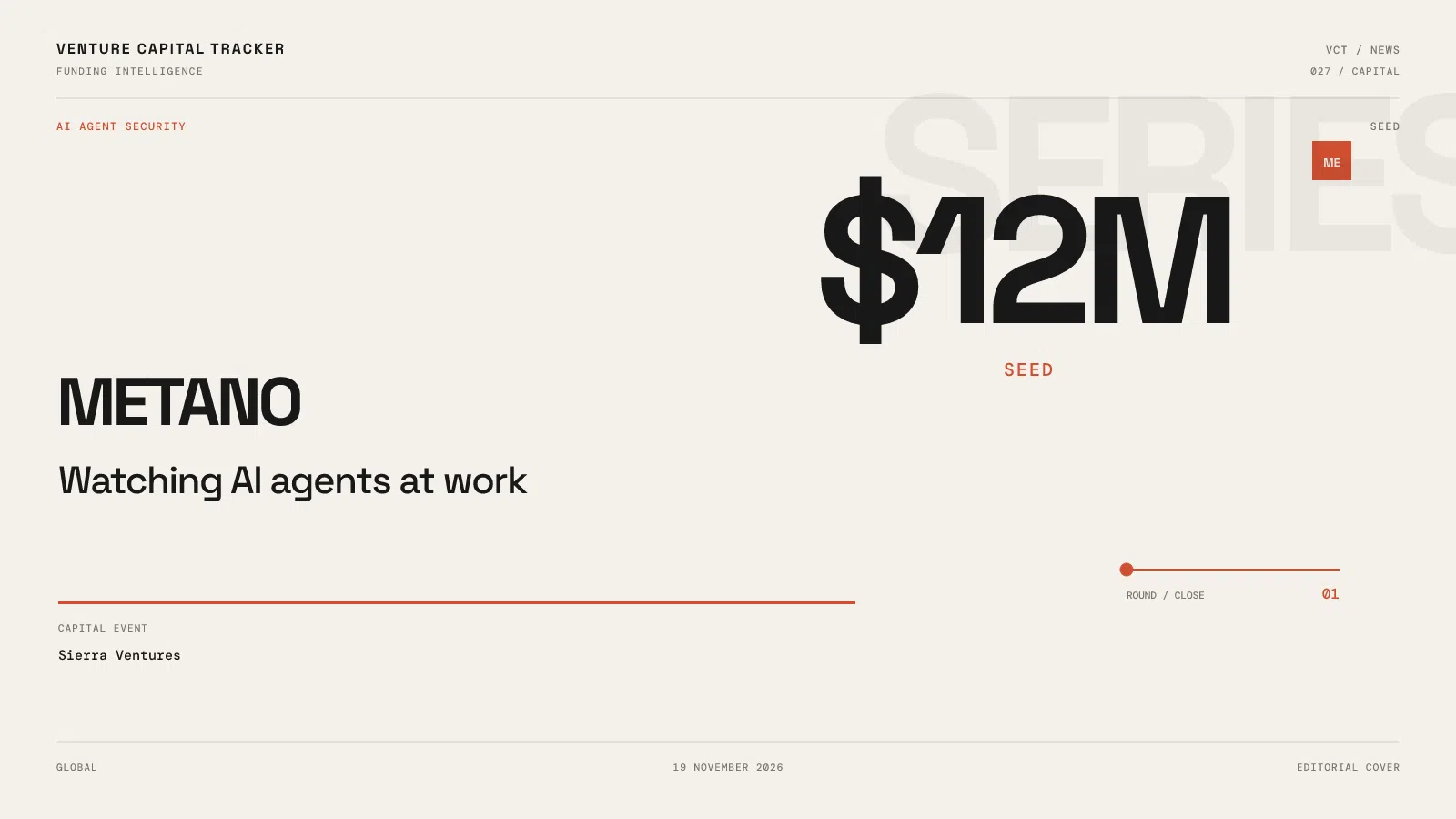
Metano Raises $12M to Watch AI Agents at Work
The security startup wants to connect an agent's identity, tools and actions. Its deployment details expose the practical hurdles for enterprise buyers.

By VCT Editorial
An AI agent—a software assistant able to use tools and carry out tasks—can have permission to enter a company's files and applications yet still do something its owner never intended. Metano's new financing backs a security business built around that gap: watching agents at work, connecting their actions and applying controls while they run.
Deal details & investors
Funding event
Metano
Led by Sierra Ventures
The company announced its seed financing on November 19, led by Sierra Ventures, with Correlation Ventures, High Alpha and 360 ONE participating. Co-founders Neelima Rustagi, the chief executive, and Ratnesh Pandey, the chief technology officer, are selling a platform for discovering agents, monitoring their behavior and enforcing policies across endpoints, cloud services and business software.
Metano says the platform is generally available. The announcement does not disclose a valuation, investor allocations, financing instrument or a separate legal closing date. The Metano company record and linked investment event keep those unknowns alongside the disclosed seed amount.
What happens after access is granted
Metano calls its intelligence layer Hive. According to the company, it connects an agent's task, identity, tools and access to data across a session. The intended benefit is context: a sequence of individually ordinary actions may tell a different story when examined together.
Was an assistant asked to read a document, update a customer record or send information outside the company? Each has different consequences. A claim to understand the agent's intent needs testing against the job its owner authorized.
Sierra Ventures managing partner Mark Fernandes frames agents as a potential new security control point in the issuer's announcement. That is an investor's thesis, not an independent test of the product. Sierra's own investment description spans inception through Series A, including AI infrastructure and vertical applications.
Quick discovery, slower tuning
Metano's implementation description adds useful qualifications to its fast-onboarding pitch. The company says initial discovery and approve, restrict or block decisions can begin with the first pass. Behavior-based guardrails fitted to the customer's usage follow roughly a week of observation.
| Step | What the company describes | What a buyer should establish |
|---|---|---|
| Initial deployment | Sensors deployed through device management; fast onboarding | Which devices and workloads are actually included |
| Observation and tuning | About a week of behavior baselining | Who reviews proposed policies and false alarms |
| Inline enforcement | Developer integration for full enforcement on homegrown agents | Which actions can be stopped before execution |
The documentation distinguishes code-free discovery, detection and monitoring from full inline enforcement on custom agents, which requires its software development kit. Audit mode precedes individual controls. Metano says analysis defaults to its cloud, with a customer-environment option for Hive. VCT has not installed or benchmarked it.
What the evaluation can tell a buyer
The Evaluation Edition starts with a workstation scan and a dashboard showing agents and the resources they can reach. The company offers 30 days of evaluation; live alerts require installing its sensor. Its page describes a subsequent free tier retaining seven days of history and the latest report, with real-time alerts paused.
A scan can be a useful starting inventory. It does not, by itself, show that an enterprise's cloud and software agents are all covered or that every unsafe action will be blocked. Metano does not publish a numeric enterprise subscription price on the pages reviewed. Buyers still need a quote, supported-environment list and agreement covering data handling.
For an illustrative procurement exercise, a company could select a low-risk document-assistance workflow, state which files the assistant may read and require human approval for outbound messages. It could then compare three outcomes: permitted work completed, unauthorized work blocked and legitimate work interrupted. This is a proposed evaluation, not a customer deployment or a VCT product test.
The practical question is whether a control prevents the unwanted action, explains the decision and leaves staff able to finish the authorized task. A dashboard full of alerts answers only part of it.
The alternatives begin with permissions
A buyer is not choosing between a new monitoring product and no controls. Microsoft's Entra Agent ID authorization documentation describes permission scopes and restrictions on highly privileged agent access. It also separates permission to call downstream services from permission to invoke an agent itself.
Those are important boundaries even if a business adds a specialist security product. These approaches address different parts of the problem; they are not interchangeable purchases.
| Approach | Question it addresses | Assessment required |
|---|---|---|
| Identity and permission controls, including Entra Agent ID | What may this agent access? | Correct scopes, consent and ownership |
| Protocol-level authorization | Is this request authorized for this service? | Correct implementation and credential handling |
| Metano's runtime layer, as described by the company | Does this sequence fit the agent's assigned work? | Detection quality, enforcement coverage and operating cost |
The Model Context Protocol's authorization security guidance requires servers to validate that access tokens were issued for their use. It also warns that stolen tokens can produce requests that appear legitimate. That is a reason to retain strong access controls, rather than treating behavioral monitoring as a replacement.
What the seed round has yet to prove
Metano's launch release includes a customer endorsement from Sigmoid and statements about a SOC 2 examination and ISO certification. Those are issuer-presented claims; VCT has not inspected a certification report or independently tested customer outcomes. The materials reviewed provide no controlled comparison of detection accuracy, false-positive rates or end-to-end performance against competing products.
Its integration page says it works alongside existing endpoint, network and data-protection tools, and describes connections to platforms and business applications. Logos and broad compatibility statements still need to become a deployment-specific list of supported controls.
For buyers, evidence from their own authorized workflow will matter more than a broad coverage slogan. For investors, the commercial question is whether a startup can turn that evaluation into paid deployment without creating too much integration work or another alert queue. Metano's evaluation gives buyers a starting point; the integration effort and effectiveness of the resulting controls remain to be established in their own environment.
Follow Venture Capital Tracker on Google
Add VCT as a preferred source to see more of our venture-capital reporting in Google Search.
Editorial note: AI tools assisted with research, structure, or drafting. Venture Capital Tracker retains human editorial responsibility for factual accuracy, relevance, and source quality before publication.