· 12 sources · Verified
Model ML raises $250M as AI agents move into deal work
The London company wants to turn deal data into editable financial models and presentations. Its product documents reveal what buyers can check—and what the funding announcement leaves unanswered.

By Venture Capital Tracker
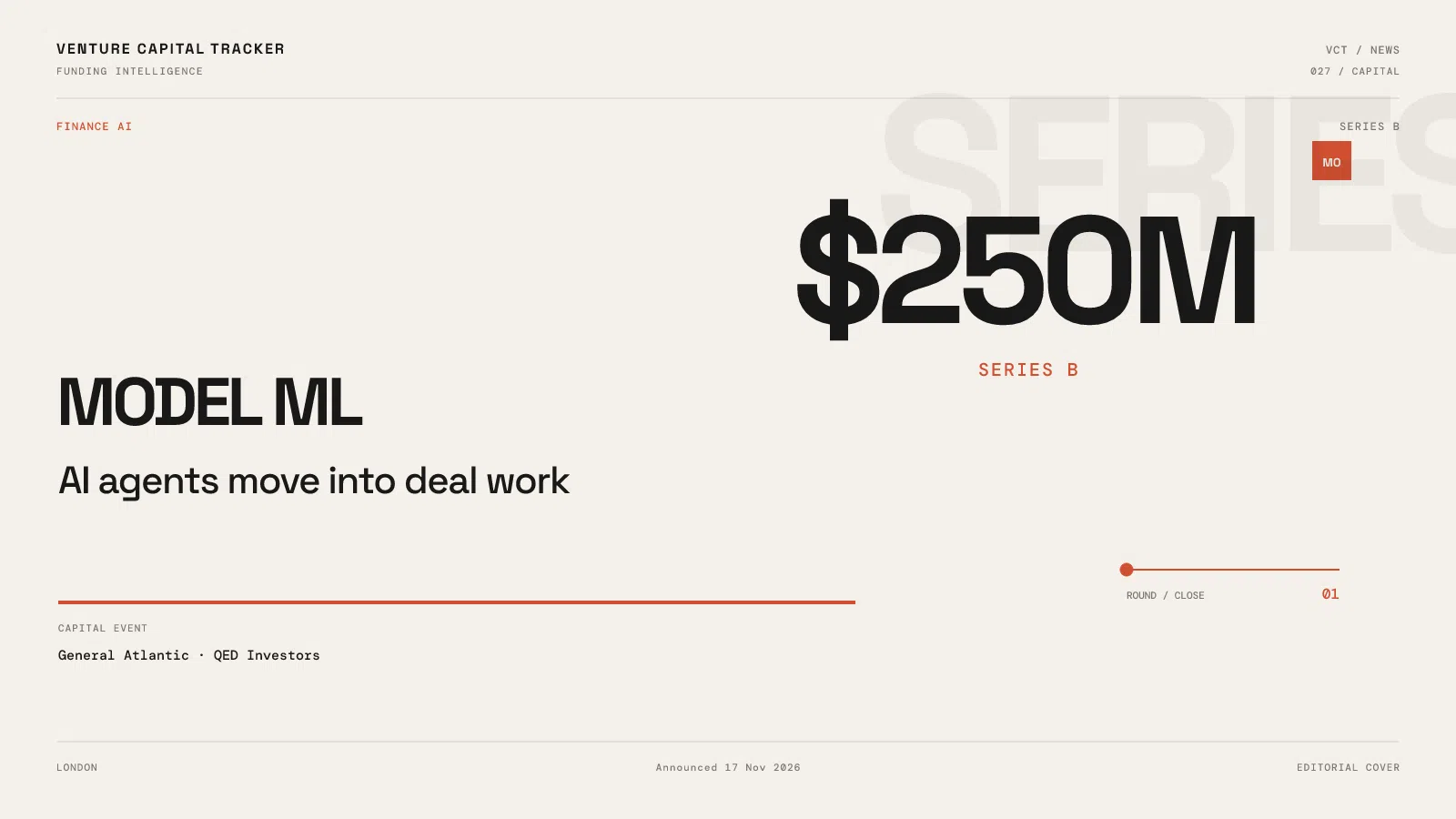
Model ML wants to turn a change in a deal's source data into an updated spreadsheet and presentation. General Atlantic and QED Investors are backing that ambition in the London company's Series B, announced on November 17, 2026.
Deal details & investors
Funding event
Model ML
Led by General Atlantic , QED Investors
Reported valuation $1.5B
Consider the job: a revised financial schedule arrives in a deal's document room. The spreadsheet needs changing, and the presentation must agree with it before the next meeting. Model ML is selling software to help carry that work across a team's existing tools. The test is whether the banker can trace and check the result.
The Series B announcement reports a $1.5 billion valuation. Other participating investors were Evolution Equity Partners, Airtree, Forestay Capital, Y Combinator, FT Partners, Latitude, Inception Fund and 13Books Capital. The release does not specify whether the valuation is pre- or post-money, individual investor contributions, or any primary-versus-secondary split.
From deal files to a working spreadsheet
Founded by brothers Chaz and Arnie Englander, Model ML develops agents for bankers, consultants and investors. Its product documents emphasize editable work that a financial team can inspect and revise.
Its March 30, 2026 Operator documentation describes agents building Excel models with live formulas, linked assumptions and sensitivity tables, as well as editable PowerPoint presentations and Word documents. Those tables show how a valuation changes when assumptions such as a sale price or borrowing level change.
The connection to source material matters just as much. Model ML's June 17, 2026 Intralinks integration announcement says customers with active deals on Intralinks DealCentre AI can connect approved data-room content to its workspace and Office plug-ins. The company says this preserves existing Intralinks controls and lets work reflect changes to deal files.
An illustrative use of those documented capabilities would run like this:
- A deal team connects its approved document room and selects the material for analysis.
- An analyst asks for a valuation model using the team's assumptions and format.
- The agent builds an editable workbook and supporting presentation.
- A reviewer checks the source figures, dates, formulas and assumptions before circulating them.
That is an illustration based on the company's documentation, not a VCT product test. In particular, a formula that recalculates can still start with the wrong figure or use the wrong definition. A useful pilot should include a revised source file and a deliberately changed assumption, then examine how the outputs change.
What the cost claim measures
Model ML is not committed to one AI provider. Its funding announcement says it routes tasks between models and increasingly uses its own adapted versions of open-source AI models. On the workloads those models handle, the company claims costs of 2% of frontier models—the leading general-purpose AI systems—and, in most cases, five times the speed.
The release limits those vendor comparisons to workloads handled by its own fine-tuned models. They are not a disclosed subscription price or evidence that a customer's entire banking workflow becomes 98% cheaper.
The company's July 29, 2026 Composite benchmark methodology helps explain the distinction. It records model calls, tool calls and repeated context inside its own agent system, then applies published input, output and cached-token prices. It assesses spreadsheets, slides, financial analysis, multi-step workflows and document retrieval. This is a company-run evaluation; VCT has not independently reproduced it.
For buyers, the price remains a sales conversation: Model ML's pricing FAQ says pricing is scoped to each engagement through a sales process. A prospective customer therefore needs a quote and a representative trial to assess software, implementation and review costs.
An increasingly crowded finance desktop
Model ML competes with other specialists working on similar institutional problems. Rogo's platform describes finance-specific agents, deal-room projects and governance over models, spending and permissions. It says answers cite underlying filings, models or documents.
Hebbia describes Matrix as analysis across documents or companies with traceable findings, while its Max agent produces spreadsheets, slides and reports. That means the promise of a finished spreadsheet or deck is already shared by several vendors.
The practical comparison is a firm's own task: use the same authorized files, definitions and output format, then compare source traceability, spreadsheet logic, permission handling and the time a reviewer needs. These product descriptions do not establish a head-to-head accuracy winner.
There is also a distinction within finance software. Payhawk's recently announced financing supports agents around expenses, invoices and approvals. Model ML is aimed at the analysis and documents used by financial and professional-services firms. The buyer and workflow matter more than the common “AI agent” label.
What the financing reveals—and leaves open
Model ML says annual recurring revenue grew twelvefold year on year in the third quarter of 2026, while daily active users rose twenty-sixfold. It has not disclosed the absolute figures in the announcement, so those multiples cannot establish revenue scale or a valuation-to-revenue ratio.
The company reports $350 million in cumulative funding. Its new round follows a separate Series A announced on November 24, 2025, when FT Partners led a $75 million financing. The lifetime total is not additional capital raised this November.
General Atlantic's Paul Stamas framed the investment around financial institutions moving from AI experiments to everyday work. The announced use of proceeds is to expand research and engineering in London and New York and support wider deployments.
For customers, deployment and review remain separate questions. Model ML's security page says it offers deployment in customer infrastructure, supports enterprise authentication and does not train models on customer data. These are company statements, not a substitute for reviewing the proposed environment and contract. Before handing over a live deal, a buyer still needs to establish which users and models can access it, which source version an output used, and who signs off the finished work.
Follow Venture Capital Tracker on Google
Add VCT as a preferred source to see more of our venture-capital reporting in Google Search.
Editorial note: AI tools assisted with research, structure, or drafting. Venture Capital Tracker retains human editorial responsibility for factual accuracy, relevance, and source quality before publication.