· 8 sources · Verified
Agile Robots Raises $500M Series F at $8.5B Valuation
Its 20,000 installed industrial robotic solutions are not 20,000 humanoids sold. An Audi logistics trial shows the challenge ahead: converting factory capacity, robot software and technical demonstrations into repeatable, paid production work.

By Venture Capital Tracker Research Desk
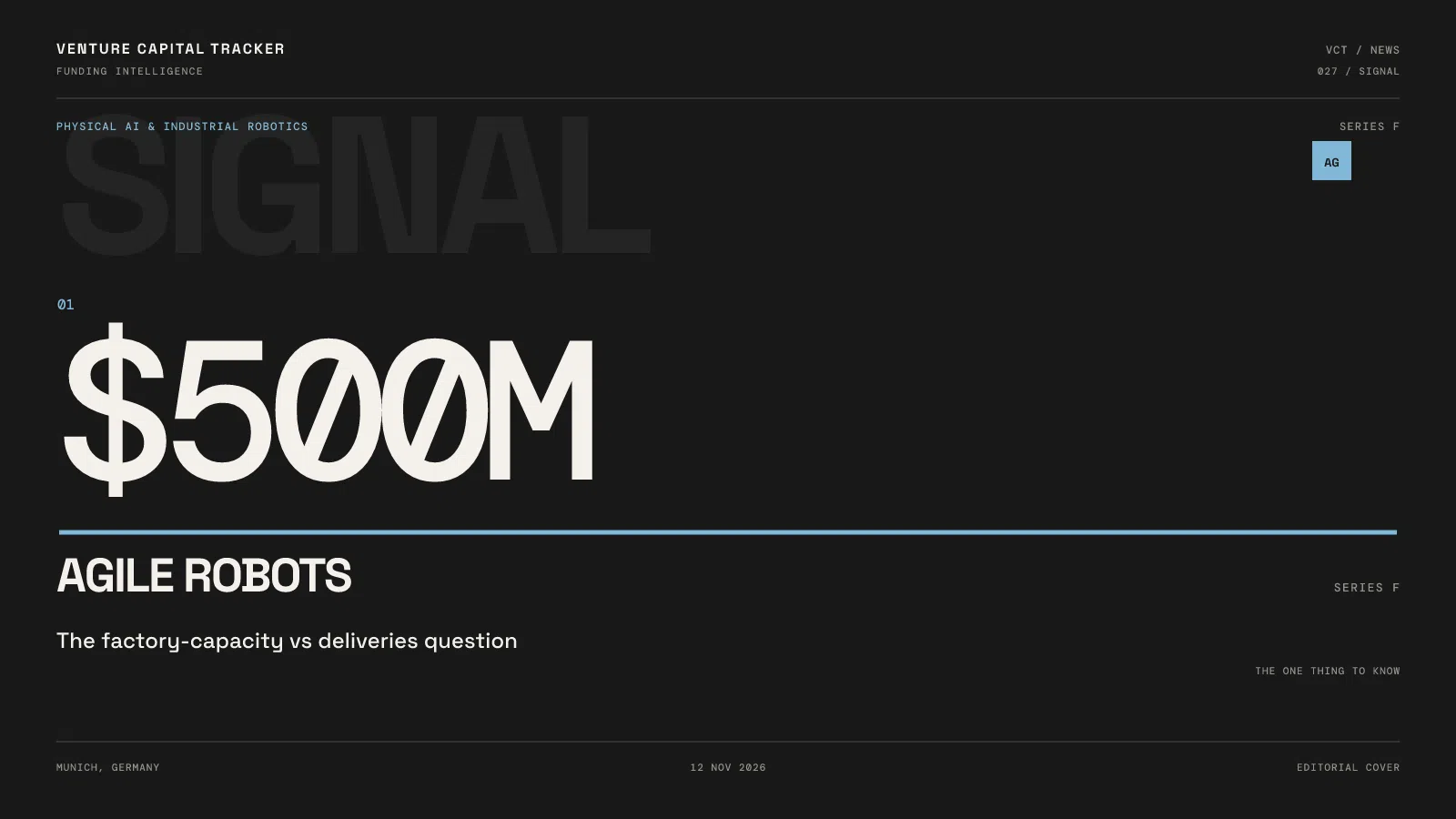
Agile Robots builds the machinery already working in modern factories: robotic arms, mobile systems, hands and the software that coordinates them. The Munich company’s next wager is that this industrial footprint will make it easier to sell humanoids that adapt to changing tasks, rather than machines that repeat a fixed movement.
Deal details & investors
Funding event
Agile Robots
Led by SoftBank Group
Reported valuation $8.5B
The company’s November 12, 2026 financing announcement says the money will support U.S. expansion and additional manufacturing in Germany. But two numbers in its own account describe different milestones: 20,000-plus installed robotic solutions, across its older products and subsidiaries, and a new factory rated to make up to 10,000 humanoids annually. Neither number establishes the quantity of paid humanoid deliveries.
A concrete test is happening at Audi—not a stage demonstration, but the difficult, repetitive task of sorting car parts into the order needed for final assembly.
From an Audi parts bin to a usable factory robot
Audi, Agile Robots, Dassault Systèmes and NVIDIA announced a proof of concept on October 21. It focuses on parts sequencing at Audi's Ingolstadt plant, where components may arrive in mixed containers and unfamiliar positions. The company says roughly one million parts picks occur each day across Audi's operation. That is an existing logistics-scale figure, not throughput achieved by the experimental robots.
The disclosed project can be understood as a five-step buyer workflow:
- Define the task. Audi's logistics experts specify the parts, required sequence and operating constraints that a mobile humanoid needs to handle.
- Simulate the workplace. Dassault Systèmes' DELMIA/3DEXPERIENCE and NVIDIA Omniverse tools help engineers model the work cell, routes, safety, ergonomics and task timing.
- Pick and arrange. Agile's dual-armed mobile humanoid is intended to identify mixed parts, grasp them and place them in the right assembly order.
- Test exceptions. Engineers must validate errors, flexible parts, human proximity, recovery and reliable cycle times, rather than a single successful demonstration.
- Make a buying decision. A scalable production rollout would require repeatable uptime, accepted deliveries, site integration, safety approval and a credible payback period.
This is a source-grounded explanation of the companies' stated project, not VCT's hands-on test. Audi calls the work a proof of concept. No independent production-line error rate, robot throughput, plant-wide deployment contract or customer cost saving was disclosed. An exacting customer test is useful evidence of demand to explore the technology, but not yet evidence of mass commercial adoption.
What Agile Robots actually sells
The product range serves different buyers. Factory operators and equipment integrators can use arms, end effectors, autonomous mobile robots and full-size Agile ONE humanoids. Research teams can use Agile ONE SN, introduced in October as a compact humanoid platform integrated with NVIDIA's Isaac GR00T research workflow. The research model measures 1.4 metres, weighs 43 kilograms, and has a 3-kilogram payload per arm. Its software helps labs capture demonstrations, simulate, train, evaluate and physically test robot skills. A research prototype is not proof that industrial-scale humanoid safety and reliability have been achieved.
The software layer matters as much as the robot's shape. AgileCore lets an integrator coordinate robots, cameras, grippers, autonomous mobile robots and programmable logic controllers—even hardware from multiple vendors. It exposes dashboards for task progress, cycle time, throughput, overall equipment effectiveness and quality; developers can add custom skills through an SDK.
Agile's AgileAI assistant can translate a natural-language instruction, such as loading a machine with a metal block, into a configurable robot task. The operator retains manual adjustment. That is a vendor-described capability, not independent evidence of reliable unsupervised natural-language control. A real factory must still solve gripping, safety interlocks, fixture design, operator training, recovery procedures and service support.
What does a buyer pay? Public list prices for a complete industrial humanoid, AgileCore licensing, service agreements, integration and the Audi project are not disclosed. Nor is an independently established payback period. A buyer cannot compare full ownership costs from the latest funding release.
Who invested and what the financing does—or doesn't—prove
The official funding statement names SoftBank Group as lead investor and NVIDIA, Hitachi Group (Hitachi and Hitachi Ventures), T.Capital among participants. Agile says its lifetime funding now totals $2 billion. That is a cumulative historical amount, not new money added on top of this round.
SoftBank Investment Advisers' Dennis Chang cites industrial execution and robotics expertise as its rationale. That is the investor's thesis, not an audit of plant throughput. SoftBank also led a reported $220 million Series C in 2021, according to independent coverage. The precise pre-money versus post-money basis of the newly stated valuation is not specified, so an ownership or dilution calculation would be guesswork.
Hitachi's role goes beyond writing a cheque. On September 29, Agile and Hitachi announced a manufacturing co-development and commercialization agreement. They plan to combine Agile's hardware and AgileCore with Hitachi's industrial integration, edge computing and HMAX Industry sales channel. That could shorten the route from a technical pilot to a customer's existing plant—but the partners have not disclosed orders or revenue from that channel.
NVIDIA also contributes the compute and training ecosystem used by Agile ONE SN. That integration can reduce the setup burden for researchers; an economic advantage in an operating factory still requires measured proof.
Three metrics that must not be counted as humanoid sales
| Publicly disclosed measure | Valid interpretation | Not established |
|---|---|---|
| 20,000+ installed robotic solutions | Existing industrial customer and subsidiary equipment footprint | Humanoids delivered or generating revenue |
| Up to 10,000 humanoids/year | Stated capacity at the Fürstenfeldbruck facility | Utilization, actual production, accepted deliveries or margins |
| Audi proof of concept | Realistic parts-sequencing trial under industrial constraints | Paid production scale, measured uptime or contract value |
The investment question is whether a highly capable factory can convert rated capacity into units successfully commissioned for customers. That requires data on production yield, field failures, service costs and repeat orders—none of which the company provided.
Agile's origins as a 2018 spinout of the German Aerospace Center, together with the group’s industrial subsidiaries including Franka Robotics, distinguish it from pure humanoid startups. VCT's industrial AI landscape maps the wider buying market; NEURA Robotics offers another European robotics reference point. Those links are market context, not a claim that either company has proven superior unit economics.
What may win instead of a humanoid
A plant with predictable part positions might obtain a better return from a conventional fixed robotic arm. Moving carts between stations may be more economical with a non-humanoid autonomous mobile robot. The humanoid case is strongest where the same workspace presents variable shapes, multiple manipulation tasks and existing human-scale infrastructure. However, a broad range of movement can bring more failure modes and safety challenges.
There is also execution risk at the shareholder level. In a November 6 notice, SoftBank said Chinese authorities had prohibited the proposed purchase of ABB's robotics operations in China, while talks with ABB on the wider transaction continued. Some summaries have described the entire global purchase as cancelled; SoftBank's primary release establishes a narrower regulatory setback, not a final worldwide termination. It is separate from Agile's financing but illustrates obstacles in cross-border industrial robotics.
What would change the investment case
The next informative disclosures would be actual humanoids shipped, accepted and operating at paying customer sites, factory utilization, intervention rates, safety certifications, Audi's production-versus-lab milestones, customer pricing and gross margins. Revenue estimates published by third parties are not audited company figures.
Agile has credible existing industrial assets, a strategic route into manufacturing customers and specific testing work in automotive logistics. What it has not yet shown publicly is that the ambitious humanoid capacity translates into durable paid deployments at attractive economics. That—not the scale of the new factory on its own—is the test for the next financing chapter.
Follow Venture Capital Tracker on Google
Add VCT as a preferred source to see more of our venture-capital reporting in Google Search.
Editorial note: AI tools assisted with research, structure, or drafting. Venture Capital Tracker retains human editorial responsibility for factual accuracy, relevance, and source quality before publication.