· 8 sources · Verified
Databento Raises $100M Series C at $1.1B: API Pricing, AI Labs and Data Economics
A market-data infrastructure company is moving beyond quant trading desks into AI development. The test is whether standardized exchange feeds can scale without licensing, connectivity and historical-data costs overwhelming the economics—and which growth claims are independently verifiable.

Editorial team
Databento is selling a piece of finance that most people never see: the continuously changing stream of trades, bids, offers and order-book updates behind trading systems. A quant developer can request a specific exchange's historical events or subscribe to a live feed through a documented API, rather than assemble a separate capture, licensing and normalization pipeline for every venue.
Deal details & investors
Funding event
Databento
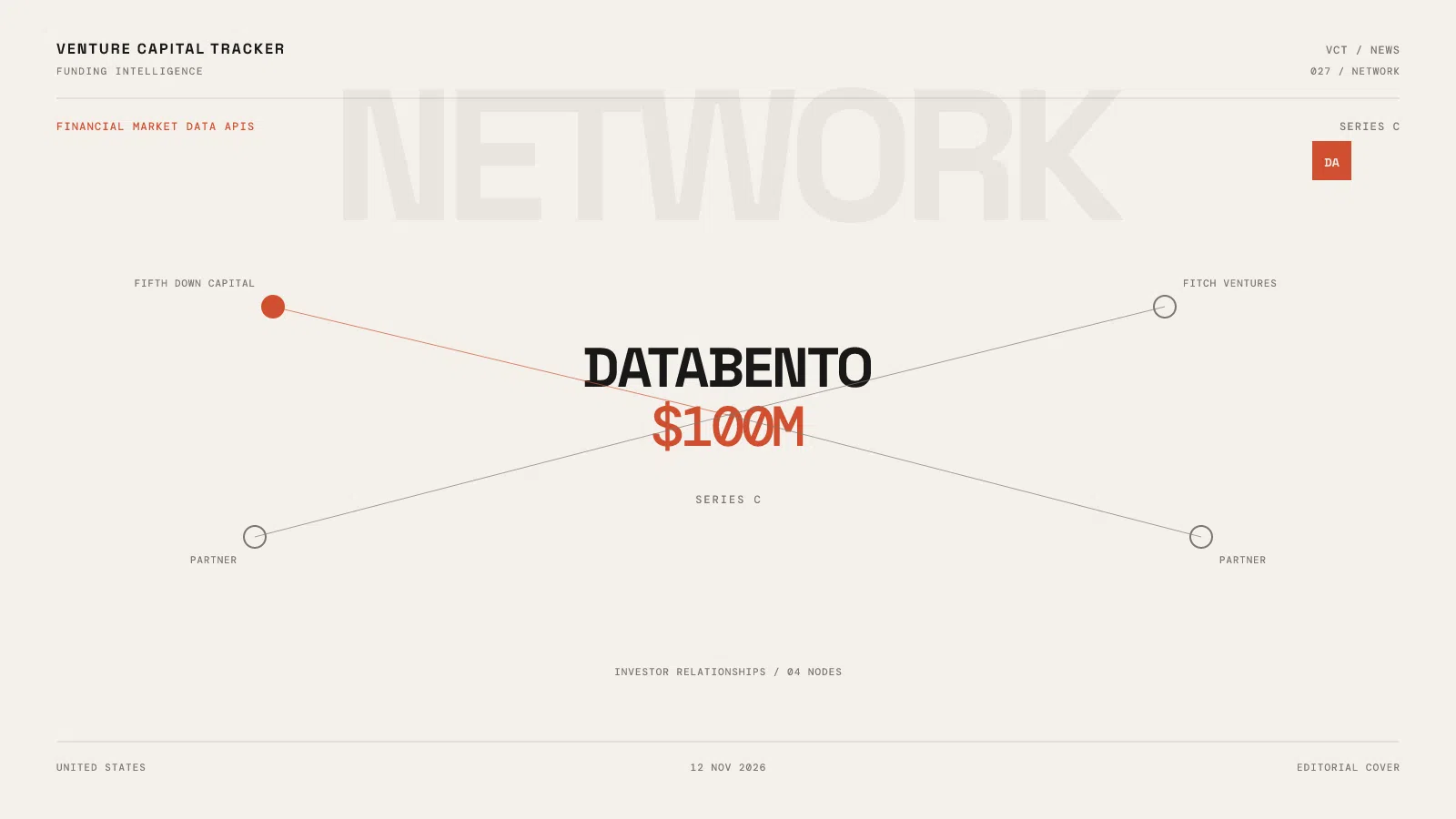
Led by Fifth Down Capital
Reported valuation $1.1B
That matters for two very different buyers. A trading firm needs reproducible high-resolution data to test strategies and monitor execution. An AI research team may need accurately timestamped, machine-readable financial data to build models or agents. Databento says it has enterprise contracts with five of the six largest frontier AI labs, but it has not named those labs, disclosed contract values or shown how much revenue comes from AI users. This is a company claim, not independently verified customer evidence.
The important comparison is therefore not just another data startup's headline valuation. It is the cost and difficulty of buying, normalizing, distributing and maintaining exchange data—and whether Databento can make that work for customers without losing economics to venue licenses and infrastructure.
What a Databento customer actually does
Consider an illustrative systematic futures researcher preparing a backtest. Databento's published quickstart makes the technical steps concrete:
- Choose a venue and instruments. The developer selects an available dataset such as CME Globex
GLBX.MDP3, particular futures symbols and a historical period. - Choose the level of detail. One-second price bars (open, high, low, close and traded volume, or
ohlcv-1s) suit some statistical tests; individual trades or messages describing each individual order are more detailed, consume different volumes and serve different analysis questions. - Authenticate and request. The researcher creates an API key, installs the Python client or uses the HTTP API, and calls
timeseries.get_rangewith the dataset, symbols, schema and start/end timestamps. - Run and verify the model. The returned records are normalized into a consistent format, but the customer still has to check symbol mapping, timestamps, missing sessions, corporate actions where relevant and backtest assumptions.
- Move into production, if appropriate. A trading operation can evaluate Databento's separate live streaming service, exchange permissions, recovery and latency requirements before committing its production strategy to the feed.
These are documented capabilities translated into a representative workflow, not a claim that VCT operated a live trading system. Databento also supplies Python, C++ and Rust client libraries, order-book formats, batch downloads and dedicated connectivity. The output is data for the customer's software—not an automated trading decision, investment research report or Bloomberg-style desktop terminal.
What does the API cost—and what isn't in a headline price?
Databento's public pricing schedule, checked November 12, distinguishes small research use from commercial market-data distribution. It advertises $125 of introductory historical-data credit and usage-based historical downloads, priced by uncompressed binary data volume. The menu also lists a $199/month Standard subscription, while Plus lists $1,750/month in license fees and Unlimited $4,500/month in license fees, with annual contracts on the latter two tiers.
That is not a promise that a trading firm's all-in bill is one of those three numbers. Dataset choice, depth of book, historical volume, venue permissions, professional versus personal use, redistribution, connectivity and contractual terms can change the effective cost. The vendor's usage guide explains why historical data is metered by bytes rather than by how many CSV or JSON files a customer downloads. The public price estimator is the better tool for a specific workload.
For example, a researcher downloading daily bars for a few instruments faces a very different data requirement from a high-frequency team retaining full order-book updates across many contracts. Even at the same advertised monthly access tier, the latter has far greater bandwidth, storage, cleaning and backtesting demands. This difference is the real economics of the product; a flat per-seat comparison hides it.
Why Fifth Down led this round—and what changed after July
Fifth Down Capital has known the company since before it generated revenue. Founder Andrew Spellman says Databento's ability to serve institutional customers while growing profitably strengthened his original investment thesis. That is Fifth Down's stated conviction, not proof of audited profits or a disclosed valuation multiple. Fitch Ventures joined as a strategic investor; its parent is a financial information business, but the company has not announced a guaranteed distribution agreement or revenue commitment tied to that investment.
The funding history has an unusually short interval between major disclosures:
| Announcement | Capital newly announced | Lead and significance |
|---|---|---|
| July 9, 2026 — Series B | $97M | New Enterprise Associates led; the issuer reported over $300M of demand, which was interest in the round, not money raised |
| November 12, 2026 — Series C | $100M | Fifth Down led; Fitch Ventures joined strategically; the company disclosed its $1.1B valuation |
The July and November rounds are two separate financings, not two reports about the same capital. Their combined disclosed new proceeds are $197M, but that number is not Databento's lifetime total funding, because earlier capital is outside this two-round comparison. A company valuation is also not cash raised: the newly stated $1.1B figure has no disclosed pre-money versus post-money basis, so VCT cannot reliably infer dilution or how much the investors now own.
Databento's existing VCT startup profile and the original July Series B coverage provide the separate historical record.
What the growth numbers establish—and what they don't
Databento says revenue has more than doubled since its July Series B, that it is profitable, and that it had 39 employees at the Series C close. Those claims are material: market data is normally expensive to capture, store and redistribute, and an expanding service with few employees is an unusually lean operating model.
Still, the issuer did not disclose absolute revenue, net income, gross margins, churn, deal size, contracted annual recurring revenue, customer concentration or audited statements. Doubling a small baseline and doubling a large baseline are very different stories. Nor does a $1.1B equity valuation divided by 39 employees measure actual productivity or free cash flow. The employee figure describes a moment in time, not a replacement for financial statements.
There is also an important distinction between infrastructure nearly ready and infrastructure delivering service. Databento says it has nearly completed buildouts at nine data centers over the preceding four months, including sites associated with Australian, Japanese, European and U.S. markets. It is pursuing a very large historical archive and wider asset-class coverage. Neither the planned archive scale nor the nine buildouts independently proves that all venues have launched, all data rights are secured, or paying customers are using each site today.
What competes with Databento?
The right alternative depends on what the buyer must build. Massive (formerly Polygon.io) is a genuine developer-oriented competitor offering real-time and historical APIs, flat files and broad equities/options data; an engineering team should compare specific exchanges, schemas, depth, retention and rights, not slogans. dxFeed is another institutional market-data feed provider with a different integration and service model. Nasdaq Data Link serves historical and alternative-data use cases but is not automatically interchangeable with a deeply timestamped live limit-order-book feed. Bloomberg and LSEG sell broader institutional data, analytics and workflows; terminal seats are an imperfect price comparison to raw API packets.
Databento's case is strongest when a customer needs reproducible event-level data, familiar APIs and less bespoke exchange plumbing. A vendor with existing licenses or a proprietary low-latency data plant may find less incremental value. Buyers must still diligence coverage by venue, rights to redistribute, resilience after disconnects, timestamp fidelity, cloud egress and the engineering cost of switching data schemas.
The most revealing future disclosures would be actual annual revenue, the share attributable to AI labs versus quantitative finance, recurring gross margins after venue costs, paying usage of the new exchange sites and independently documented production reliability. Those figures would show whether the company's efficient API delivery model is defensible at global institutional scale—not merely attractive to new investors.
Follow Venture Capital Tracker on Google
Add VCT as a preferred source to see more of our venture-capital reporting in Google Search.
Editorial note: AI tools assisted with research, structure, or drafting. Venture Capital Tracker retains human editorial responsibility for factual accuracy, relevance, and source quality before publication.