· Venture Capital Tracker Editorial · venture-capital
Volantis Raises $88M Series A to Put Photonics Between AI Compute and Memory
Volantis raised an $88 million Series A to build A-1, a photonic AI inference system targeting the memory-bandwidth bottleneck, with first deliveries planned for 2027.
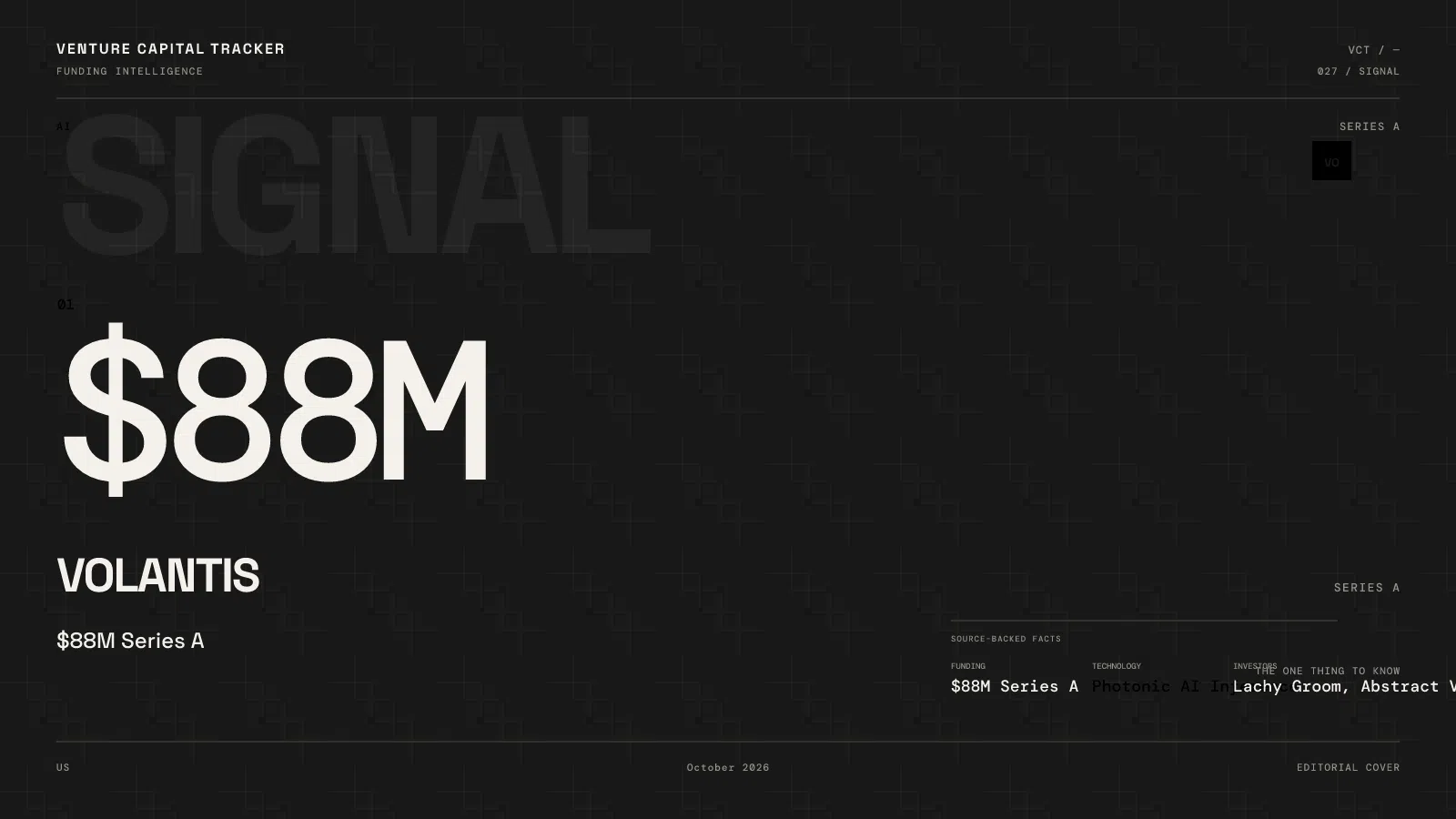
Volantis has raised an $88 million Series A to develop and commercialize A-1, an AI inference system that uses photonics to connect compute with a much larger memory pool.
Lachy Groom and Abstract Ventures co-led the round. John Doerr, VXI Capital, Triatomic Capital and Susa Ventures participated, alongside angel investors Dwarkesh Patel, Naveen Rao and Sholto Douglas. The financing brings Volantis's disclosed funding to $97 million.
The size of the round is notable, but the more consequential claim is architectural: Volantis argues that the next inference bottleneck is not raw arithmetic alone. It is the speed and energy cost of moving model weights and context between processors and memory.
Financing snapshot
| Item | Detail |
|---|---|
| Company | Volantis |
| Financing | $88 million Series A |
| Co-leads | Lachy Groom and Abstract Ventures |
| Other investors | John Doerr, VXI Capital, Triatomic Capital, Susa Ventures, Dwarkesh Patel, Naveen Rao and Sholto Douglas |
| Total disclosed funding | $97 million |
| Product | A-1 photonic AI inference system |
| First integrated deliveries | Targeted for 2027 |
| Valuation | Not disclosed |
| Announced | October 1, 2026 |
Why AI inference is running into a memory wall
Large models must repeatedly move enormous quantities of weights and intermediate data into compute engines. On-chip SRAM is fast but limited in capacity. High-bandwidth memory offers more capacity, but packages can hold only a limited number of stacks close enough to the processor, and data movement consumes meaningful power.
The result is a familiar trade-off: more memory makes larger models and context windows possible, while bandwidth and latency determine how quickly those models can answer. Expanding one dimension does not automatically solve the other.
Volantis proposes replacing short electrical links between compute and memory with optical connections. The company says optical reach is roughly 100 times longer, allowing many more memory devices to sit in one uniform-latency pool while bandwidth rises as capacity is added.
That is the central investment thesis. If the architecture works at production scale, photonics could move from connecting racks and chips to becoming part of the memory fabric inside an inference system.
What A-1 is supposed to deliver
Volantis describes A-1 as a 15U appliance that fits into existing data-center racks. The published target specifications include:
- 10 TB of memory capacity;
- 240 TB/s of memory bandwidth;
- 10 TB/s of off-wafer input/output bandwidth;
- a 20 kW power envelope;
- support for models above 20 trillion parameters;
- as much as 10,000 tokens per second per user.
The company also claims 15 times better tokens per dollar than Nvidia Rubin and six times better tokens per watt for certain large mixture-of-experts workloads.
Those are company targets, not independently validated results from a generally available production system. Volantis says first integrated inference engines are scheduled for customer delivery in 2027. Until then, the critical evidence will be silicon, packaging yield, system stability, software compatibility and repeatable application benchmarks.
Why micro-VCSELs matter
The optical design uses custom micro-VCSELs—vertical-cavity surface-emitting lasers—rather than external lasers. VCSELs already have a large manufacturing base in consumer sensing and data communications. Volantis says using gallium arsenide devices gives it a more established supply chain than approaches dependent on indium phosphide.
The company is trying to optimize photonics for an unusually short but extremely dense connection: compute to memory. That workload differs from long-haul optical networking because it requires thousands of lanes, very low latency and energy consumption low enough to compete with electrical links inside a server.
Volantis says its links consume less than one picojoule per bit, operate above 95 degrees Celsius and reach a wafer-scale bit-error rate below 1e-12. Again, those figures should be treated as company-reported engineering results until customers or independent labs verify them.
A system company, not only a photonics component supplier
Volantis is not positioning itself merely as an optical-chip vendor. A-1 combines licensed, silicon-proven compute-engine intellectual property with the startup's proprietary interconnect and packaging.
That choice could shorten the path to a complete product. It also expands execution risk. The company must integrate compute, memory, optics, packaging, cooling, firmware, networking and developer software into a system that data-center operators can deploy and support.
The founding team is built around that integration challenge. Chief executive Tapa Ghosh and chief technology officer Roy Meade are joined by semiconductor and photonics veterans whose prior work includes Micron's HBM program, early CoWoS packaging and co-packaged optics.
The competitive field
Volantis is entering a heavily financed photonics market.
- Ayar Labs develops optical input/output chiplets for high-bandwidth chip-to-chip connections.
- Lightmatter is building photonic interconnect and compute infrastructure for AI data centers.
- Celestial AI is developing a photonic fabric that connects compute and memory across systems.
- Quintessent focuses on scalable lasers and optical connectivity.
Volantis's differentiation is the memory-side architecture and the decision to sell an integrated inference appliance. Its competitors may have broader customer relationships, more mature silicon or more flexible component strategies.
The eventual winner may not be determined by peak bandwidth. Manufacturing cost, yield, thermal behavior, compatibility with existing software and the speed at which customers can qualify new hardware are equally important.
Why investors are underwriting the risk
An $88 million Series A gives Volantis room to move beyond laboratory demonstrations. Photonic hardware requires custom devices, packaging work, test equipment and long manufacturing cycles well before commercial revenue is certain.
Investors are effectively underwriting three linked assumptions:
- frontier inference will remain constrained by memory movement;
- optical links can beat electrical alternatives on total system economics;
- customers will adopt a new appliance rather than wait for incumbent accelerator vendors to improve packaging and memory.
The presence of semiconductor operators and specialist investors in the syndicate provides technical credibility, but it does not remove the commercialization risk.
What to watch next
The useful milestones are concrete:
- tape-out and integrated-silicon results;
- independently reproducible power and bandwidth measurements;
- named customer evaluations;
- manufacturing and packaging partners;
- software support for leading model-serving frameworks;
- evidence that first 2027 deliveries remain on schedule;
- pricing and total-cost comparisons using production workloads.
Volantis has raised enough capital to turn a photonic architecture into a full system. The next question is whether it can cross the gap between impressive component specifications and a reliable data-center product.
Editorial note: AI tools assisted with research, structure, or drafting. Venture Capital Tracker retains human editorial responsibility for factual accuracy, relevance, and source quality before publication.