· 10 sources · Verified
First Circle Closes $26M Africa Fund I: Which Fintech Founders Fit?
Primary LP documents show how the fund was built. Its mandate, portfolio and unanswered terms offer a practical guide for founders seeking specialist African fintech capital.

Editorial team
An investor in a mobile-money network needs to understand its agents. An investor in an insurance business needs to understand how policies reach customers. First Circle Capital is betting that this kind of financial-sector knowledge can help it find Africa’s next promising startups.
Deal details & investors
Fund close
First Circle Africa Fund I
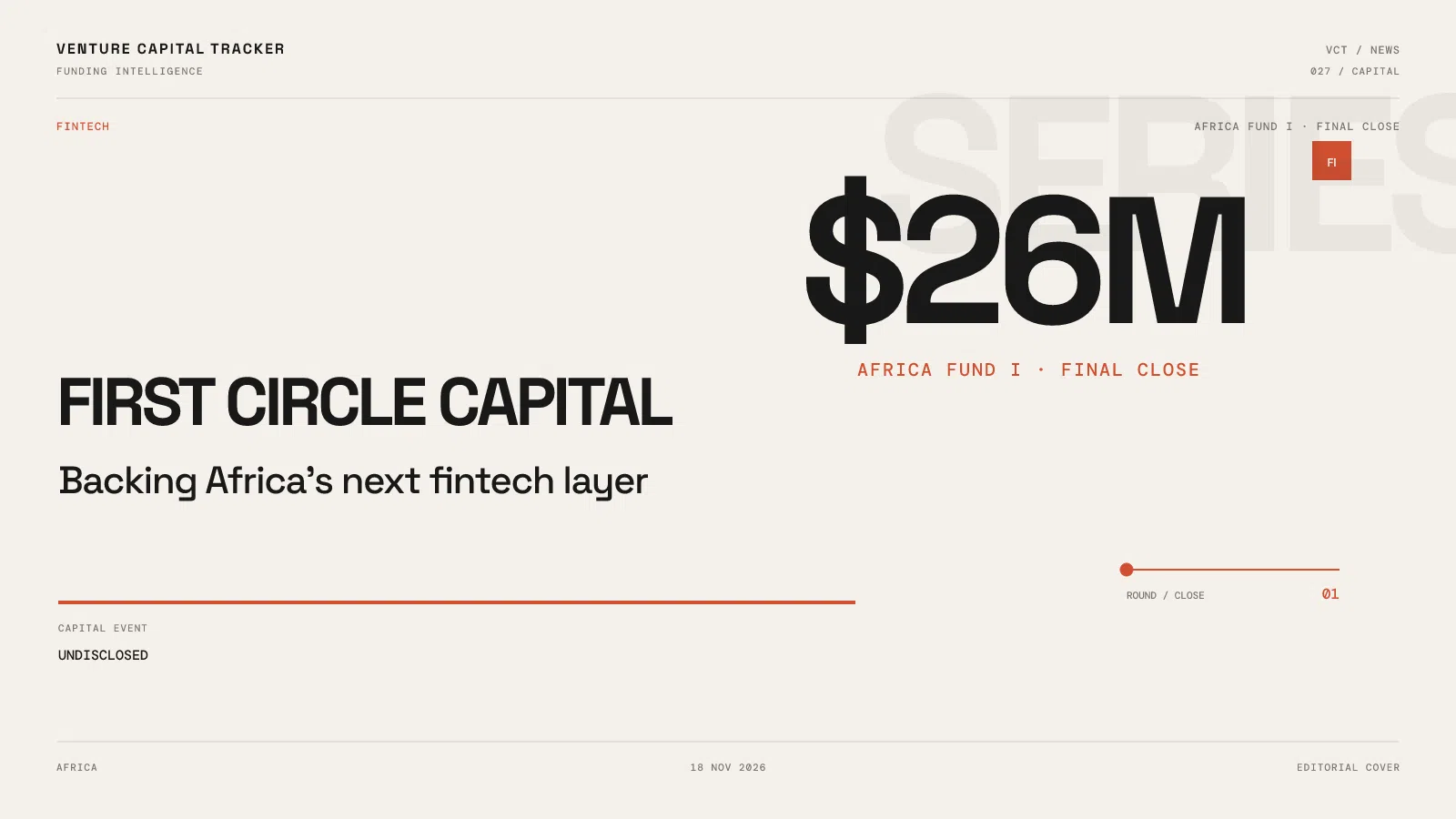
The specialist venture manager has completed the final close of Africa Fund I at $26 million, according to Condia’s November 18 reporting. The vehicle backs pre-seed and seed-stage African fintech companies.
The money is committed to the fund for investment in companies. For founders, the useful questions are which businesses fit its mandate and what the team can offer beyond a first cheque.
What the fund will back
First Circle describes its approach as FinTech 2.0: financial infrastructure and software, insurance, alternative lending, regulatory technology and climate-related financial services. TechMoran’s account of the announcement reports an increasing interest in businesses built around AI, automation and data from inception.
That is an investment thesis, not evidence that AI has already lowered a portfolio company’s costs. A founder still needs to demonstrate who buys the product, what work it performs and whether the economics improve after implementation.
The manager’s own mandate confirms pre-seed and seed investing across Africa, often as a company’s first institutional investor. It promises access to sector expertise and other sources of capital. It does not publish a standard cheque size, ownership target or investment timetable on that page.
How the fund reached its final size
The fund has been attracting institutional support for more than a year. The final close should not be added to earlier LP announcements as though each were a separate pot of money.
| Evidence | What it establishes | What it does not establish |
|---|---|---|
| IFC project 50963, disclosed May 9, 2025 | A $25 million target and $30 million hard cap; up to $4 million from IFC and up to $2 million through We-Fi | That the entire proposed package was paid out on the disclosure date |
| DGGF transaction notice, February 15, 2026 | A $3 million equity commitment to First Circle | An additional $3 million outside the eventual fund total |
| November 18 final-close reporting | $26 million for Africa Fund I | $26 million of uninvested cash available for new companies |
IFC’s record lists approval on June 12, signing on June 23 and investment on September 19, 2025. Its approved own-account equity is $4 million; the separate We-Fi amount is described as up to $2 million. These qualifiers matter when describing the often-reported $6 million package.
Compared with the original $25 million target, the reported final size is 4% larger, a simple calculation. Neither figure is a portfolio valuation or the manager’s total assets under management.
Condia also names Bpifrance, MSMEDA, Axian, Stellar Foundation and FSD Africa among the backers. Individual amounts for those backers were not disclosed in the material reviewed. A standalone issuer release for the final close was not located on First Circle’s public site; the new close is therefore attributed to reporting, supported by primary documents for the mandate and earlier LP participation.
What the portfolio says about founder fit
First Circle’s portfolio page makes the strategy easier to understand:
| Company | Manager’s description | The type of financial problem |
|---|---|---|
| TurnStay | Travel-sector cross-border payments | Moving money for travel businesses |
| Opareta | Infrastructure for mobile-money agent networks | Helping operate the distribution network |
| Orca | Fraud orchestration | Coordinating fraud controls |
| Balad | Remittance infrastructure | Supporting international money transfers |
| Power | Earned wage access | Accessing wages already earned |
| WiASSUR | Insurance brokerage | Distributing insurance products |
These are the manager’s descriptions, not independent product tests. The page also includes other holdings and testimonials, so counting every name would not establish how many investments belong specifically to Africa Fund I.
The close announcement says First Circle has invested in 18 companies, with several progressing towards Series A. That is a reported manager statement, not a verified performance record or a promise of follow-on funding.
For an illustrative founder, imagine a startup supplying reconciliation software to a regulated financial institution. A useful approach to this fund would explain the customer’s existing process, the data the software needs, the integration work, who holds regulatory responsibility and how the company earns revenue. A demo alone would leave the commercial case unfinished. These are VCT’s suggested diligence questions, not a published application checklist or a guarantee of eligibility.
DGGF’s description of the manager’s support is specific: follow-on fundraising, data-driven management, fintech expertise, and people and culture. Founders should ask who delivers that support, how much time is available and which introductions are realistic for their market.
How it differs from other early-stage capital
A specialist fund is one route, with geography and sector determining the alternatives. IFC’s Startup Catalyst directory describes Antler East Africa as a venture builder focused primarily on pre-seed opportunities in East Africa; DisrupTech as an Egypt-based fintech seed fund; and Catalyst Fund as a pan-African pre-seed investor in climate adaptation and resilience.
Those mandates overlap only partly with First Circle’s. A founder should compare current deployment capacity, eligibility and terms directly rather than assume every Africa-focused investor funds the same business.
For related reading, VCT’s 3IF Ventures coverage examines dedicated insurance capital, while its Yellow Card coverage looks at a later-stage financial-infrastructure financing. Neither is evidence of a relationship with First Circle.
What founders and investors still need to ask
The manager’s current team page identifies Selma Ribica and Agnes Aistleitner Kisuule as co-founders and managing partners, and Rob Smith as Principal and Head of Operations. Some announcement reports describe Smith as a founder or partner. This article uses the roles displayed by the manager.
For prospective portfolio companies, more consequential unknowns remain: the amount reserved for follow-ons, remaining new-investment capacity, typical cheque size and ownership expectations. For prospective LPs, fees, distributions and independently verified returns were not established by the public sources reviewed.
The fund’s size and institutional backers establish a financing milestone. The investment test ahead is whether the companies it backs can turn specialist financial software into products customers use, pay for and can trust.
Follow Venture Capital Tracker on Google
Add VCT as a preferred source to see more of our venture-capital reporting in Google Search.
Editorial note: AI tools assisted with research, structure, or drafting. Venture Capital Tracker retains human editorial responsibility for factual accuracy, relevance, and source quality before publication.