· Updated · Venture Capital Tracker · investment-strategies
Transfyr Launches With $25M Seed to Capture the Missing Data Behind Laboratory Work
Transfyr launched with a $25M seed led by General Catalyst to build a physical-AI observability layer for science. The Cambridge team is turning bench actions, context and instrument data into machine-readable training data.
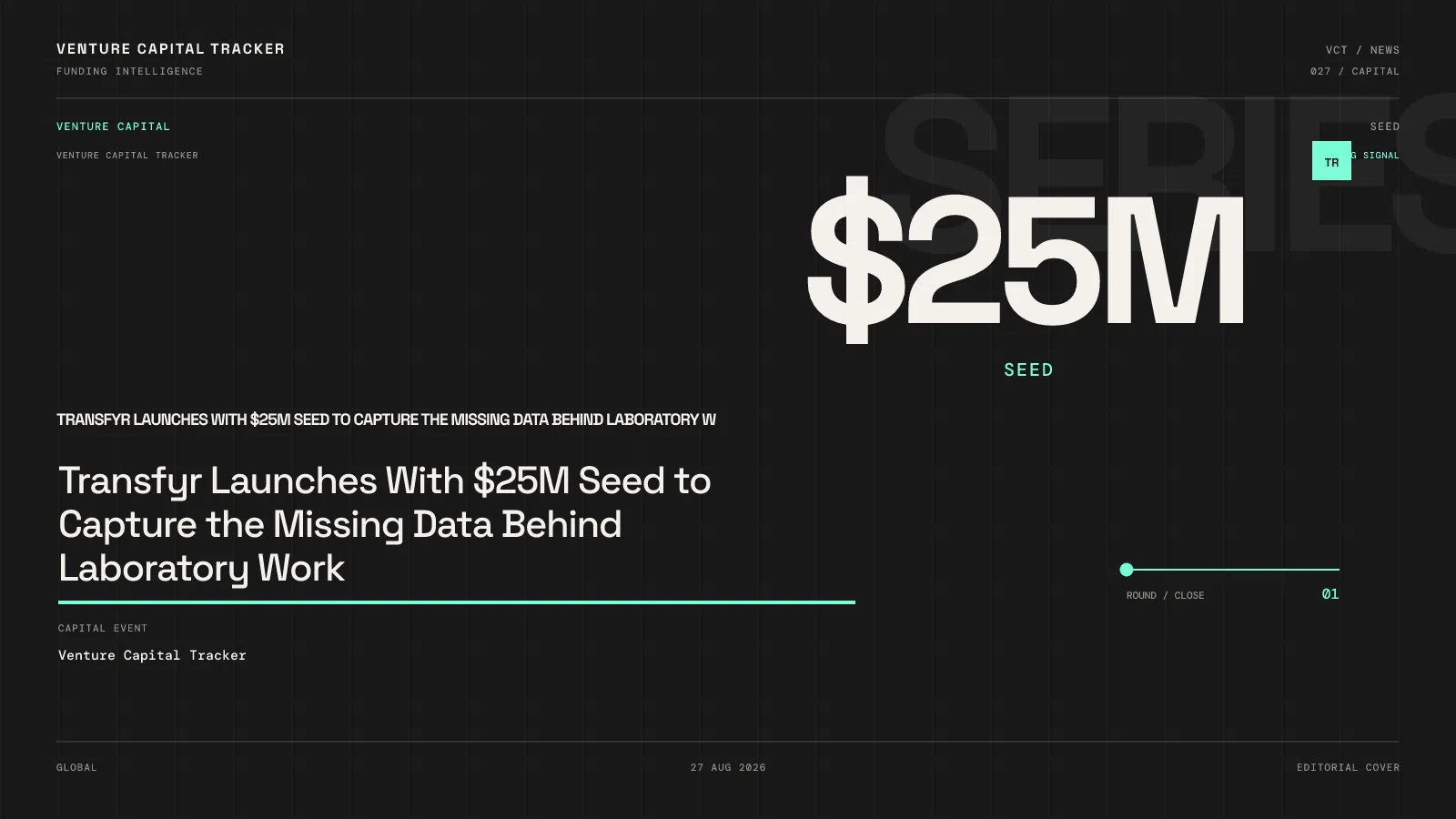
Transfyr launched in Cambridge, Massachusetts, with a $25 million seed round led by General Catalyst. The company’s thesis is that science has an information problem before it has an AI problem: papers and experiment logs record outcomes, but often omit the physical context and tacit decisions that made an experiment reproducible.
That makes Transfyr a data-infrastructure bet for the physical world. Its platform is designed to observe hands-on laboratory execution, translate it into machine-readable context and eventually feed that record into automation, robotics and scientific AI.
The financing and the team
| Field | Detail |
|---|---|
| Company | Transfyr Bio, Inc. |
| Announcement | August 26, 2026 |
| Round | $25M seed |
| Lead | General Catalyst |
| Participants | Lux Capital, Breakout Ventures, Factory, Neo, SV Angel, MVP Ventures, Underscore VC and Lyda Hill |
| Founders | Anna Marie Wagner and Renee Wegrzyn, PhD |
| Headquarters | The Engine, Cambridge, Massachusetts |
| Separate grant context | Nearly $1M Massachusetts Life Sciences Center Gamechanger grant |
Wagner previously led AI and corporate development at Ginkgo Bioworks. Wegrzyn was the founding director of ARPA-H. The combination is unusually relevant to the problem: operating experience in biological automation and institutional experience with high-risk translational science.
What “physical AI for science” means here
Most scientific data systems are optimized for what a researcher intended to do and what an instrument measured. They are weaker at recording what actually happened between those points: the order of actions, environmental conditions, equipment quirks, workarounds and the judgment calls that experienced operators make without writing them down.
Transfyr says it is building integrated sensor systems and multimodal models that capture:
- operator actions and intent;
- environmental context;
- equipment telemetry;
- supply-chain dynamics; and
- instrument-derived results.
The output is not merely a video archive. The company says the data can support root-cause analysis, protocol optimization, training and tech-transfer SOPs, and robotic-level instructions. In the best case, a lab’s operational memory becomes an asset that can move across people, sites and machines.
Why the missing layer matters
Scientific translation often fails during handoff. A protocol that works in one lab can degrade when transferred because the published record leaves out dependencies: timing, handling, calibration, reagent condition, operator technique or a sequence that “everyone in the room” understood.
Transfyr’s announcement cites an Accenture estimate that 64% of drug-launch delays in 2024 stemmed from chemistry, manufacturing and controls issues, with tech transfer a major component. That is a cited secondary estimate, not a Transfyr performance metric, but it frames the commercial wedge: reducing the gap between a successful experiment and a repeatable process.
The approach also fits the current robotics cycle. Robots can execute defined instructions, but they need richer demonstrations and feedback to learn new environments. Capturing how scientists work can create training data for automation without asking researchers to annotate every movement by hand.
The hard technical questions
The product promise is large, and the diligence questions are correspondingly specific:
- Signal quality: Can sensors distinguish meaningful process context from irrelevant motion and noise?
- Data rights: Who owns recordings of lab work, protocols and instrument output, especially when several institutions collaborate?
- Generalization: Does a model trained in one lab transfer to a different operator, instrument or facility?
- Validation: Can a customer audit a model’s reconstruction of an experiment well enough for regulated use?
- Workflow fit: Does passive capture reduce burden, or create a new stream of data that scientists must review?
Transfyr is also building an in-house wet lab to generate foundational training data, test its sensor stack in real workflows and run evaluations for frontier labs. That vertically integrated approach may improve data quality, but it increases capital intensity compared with a software-only laboratory information layer.
Why the round matters for venture markets
The seed round signals that investors see scientific execution as a platform category, not just a tooling feature. If Transfyr works, the value can compound across diagnostics, pharma, academic research, workforce development, robotics and frontier AI because each deployment produces more structured examples of how science is performed.
The risk is equally clear: physical-world data is expensive to collect, messy to standardize and sensitive to privacy and intellectual property. The company must prove that its observability layer creates enough operational value to justify deployment before the long-term “closed-loop science” vision arrives.
Transfyr’s near-term milestone is therefore not a grand autonomous-lab demo. It is a reliable record of scientific work that a second person, a second site or a machine can actually use.
Sources
Last updated:
Editorial note: AI tools assisted with research, structure, or drafting. Venture Capital Tracker retains human editorial responsibility for factual accuracy, relevance, and source quality before publication.