Voltus Raises $225M Series D to Turn Flexible Loads Into Grid Capacity
Voltus raised an oversubscribed $225 million Series D to scale its distributed-energy platform toward 20 GW, with data-center capacity emerging as a central use case.
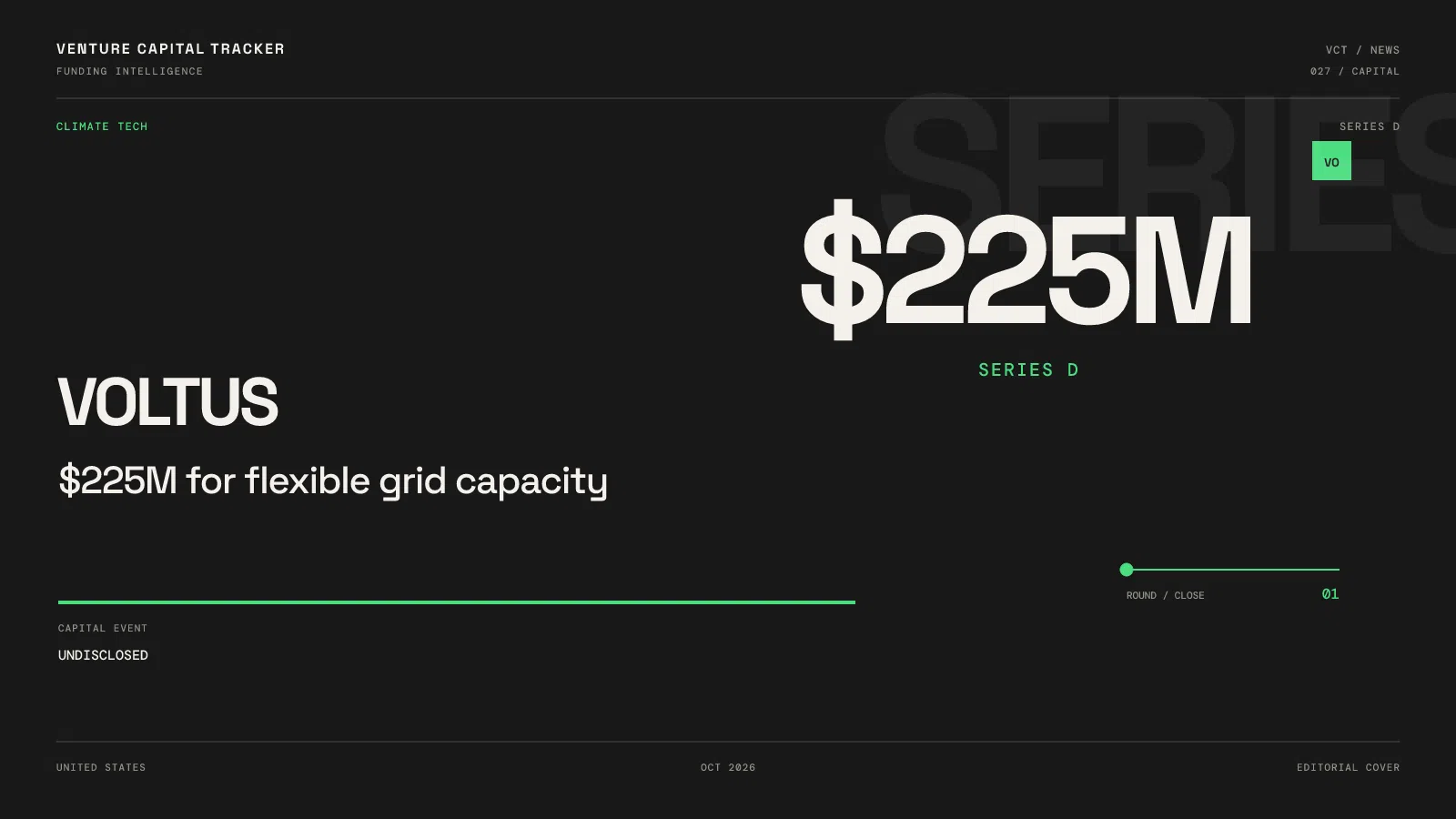
Voltus has raised $225 million in an oversubscribed Series D, giving the distributed-energy company fresh capital to expand a portfolio it says already exceeds 8.5 gigawatts.
Generation Investment Management led the round alongside co-leads Activate Capital and Vitol. Broadscale Group, Climate Investment, NGP, Ajax Strategies and All Aboard Fund also participated. Voltus did not disclose its valuation.
The financing is a bet that the fastest new source of power capacity may not be a new power plant. It may be existing batteries, industrial equipment, building systems and other loads that can reduce or shift electricity use when the grid is constrained.
Voltus funding details
| Field | Detail |
|---|---|
| Round | Series D |
| Amount | $225 million |
| Status | Confirmed close |
| Lead investor | Generation Investment Management |
| Co-leads | Activate Capital and Vitol |
| Other investors | Broadscale Group, Climate Investment, NGP, Ajax Strategies and All Aboard Fund |
| Valuation | Undisclosed |
| Announced | October 8, 2026 |
The company says it will use the capital to expand in the United States and Canada and grow its managed portfolio to 20 GW by 2030. That target is more than twice its current reported scale and should be treated as a company forecast rather than contracted capacity.
Why data centers change the demand-response market
Demand response historically paid factories and large buildings to curtail consumption during grid emergencies. Voltus is trying to turn that intermittent service into a capacity product for a much larger problem: data centers that cannot wait years for new generation and transmission.
Its Bring Your Own Capacity program aggregates controllable loads and batteries around large electricity users. In theory, a data center can support grid reliability with flexible assets while securing access to constrained power markets faster than through conventional infrastructure alone.
That is strategically attractive because interconnection queues and equipment shortages make physical grid expansion slow. But flexible capacity is not identical to firm generation. Customers and system operators still need evidence that enrolled assets will respond when called and for the required duration.
Competitive position
Voltus competes with CPower, EnergyHub, Enel X and other virtual-power-plant and demand-response providers. Its advantages are scale, experience navigating regional power markets and the ability to dispatch many types of distributed assets.
The harder question is whether the company can make those advantages durable. Utilities increasingly want direct control over distributed resources, battery manufacturers are building their own aggregation software and large technology companies can negotiate bespoke energy arrangements.
The Series D therefore finances both growth and a race for market position. If Voltus reaches 20 GW while preserving dispatch reliability and attractive customer economics, it could become important infrastructure for the AI-power buildout. If capacity proves difficult to verify or monetize consistently, the business risks remaining a collection of market-specific programs rather than a scalable platform.
What to watch
Three milestones matter most:
- Verified capacity growth. Managed gigawatts are useful only when assets are enrolled, available and dispatchable under real market rules.
- Data-center contracts. Named customers, duration and payment structure would show whether Bring Your Own Capacity is becoming a repeatable product.
- Unit economics. Voltus has not disclosed revenue, margins or the share of market payments passed to asset owners.
The financing confirms strong investor interest in grid flexibility. It does not remove the central execution risk: proving that thousands of distributed assets can behave like dependable infrastructure when the power system is under stress.
Follow Venture Capital Tracker in Google
Add VCT as a preferred source to make our venture-capital coverage easier to find in Google Search.
Editorial note: AI tools assisted with research, structure, or drafting. Venture Capital Tracker retains human editorial responsibility for factual accuracy, relevance, and source quality before publication.