· Investment Strategies · 5 sources · Updated · Verified
Trajectory's $45M Series A: Continual Learning Platform and Financing Correction
Trajectory now confirms a $45M Sequoia-led Series A at a $300M valuation, revising August's $40M reports. How its production-data training, grading and pricing work.

Editorial team
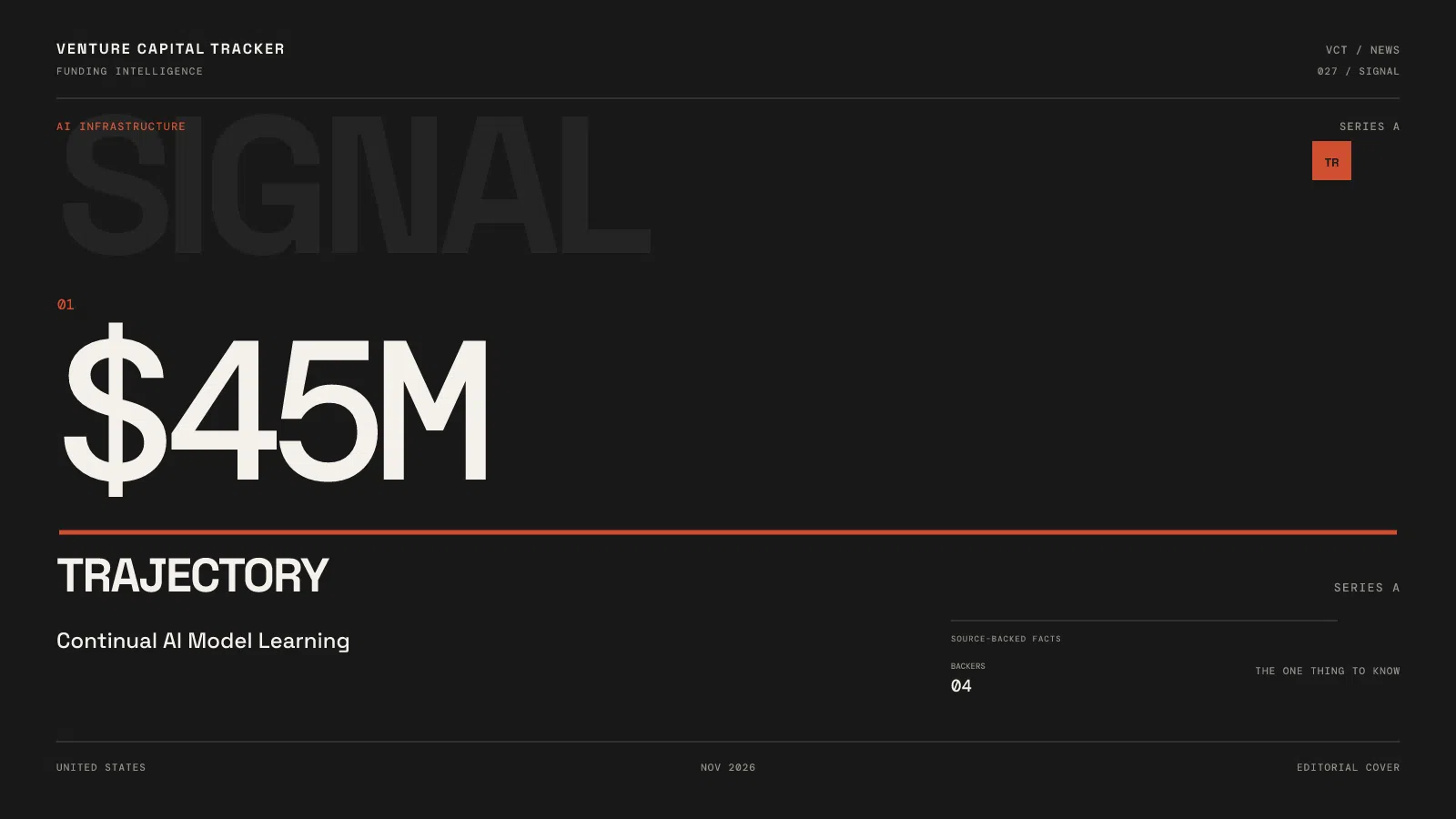
Correction and update — November 4, 2026: Trajectory's own November 2 product launch confirms a $45 million Series A led by Sequoia at a reported $300 million valuation, joined by NVIDIA, Bessemer Venture Partners and Bain Capital Ventures. VCT's original August 2026 coverage, reflecting Dealroom's $40M report and reporting attributed to The Information, previously said $40M. The manager and company reports describe the same Series A, and available evidence does not establish a second $45M round or a separate $5M follow-on. Trajectory has not explained whether the change reflects an upsize, revised accounting or earlier incomplete reporting. The primary company disclosure takes precedence. This article retains its historical URL and original publication date so readers can follow the correction.
Deal details & investors
Funding event
Trajectory
Led by Sequoia Capital
Reported valuation $300M
The company is a San Francisco-based post-training and continual-learning platform for AI applications. It wants product teams to collect real model outputs and corrections, train models on specialist tasks, and redeploy improved versions without staffing a full in-house reinforcement-learning lab. This was initially a research-driven product thesis; the November 2 public launch adds a usable platform, concrete technical research and named customers. TechCrunch independently reported the new announcement.
Funding facts: which money numbers are actually comparable?
| Field | Verified / properly attributed |
|---|---|
| Official Series A announcement | Nov. 2, 2026 |
| Series A size | $45M, company-disclosed; earlier August reports said $40M |
| Lead | Sequoia |
| Other named investors | NVIDIA, Bessemer Venture Partners, Bain Capital Ventures |
| Valuation | $300M, company-disclosed; exact pre/post-money basis is not specified in its November post |
| Earlier seed | Approximately $15M, per August Dealroom reporting |
| Illustrative known-round sum | $60M ($15M seed + $45M Series A); do not add August's $40M report as a second event |
| Founders | Ronak Malde, Michael Elabd and Arjun Karanam, with prior DeepMind/Apple technical backgrounds |
| Customer examples | Harvey, Rogo, Mercor and NVIDIA, named by Trajectory |
| Still undisclosed | Product prices, revenue, gross margin, specific training compute costs, customer counts and legally finalized round date |
The company announcement and earlier Dealroom coverage provide the two snapshots; TechCrunch's Nov. 2 report independently describes the new platform and valuation. A published $300M valuation is not $300M of cash in Trajectory's bank account. Without verified pre/post-money terms, no exact new-investor ownership percentage is established.
Product walkthrough: from a lawyer's feedback to a better specialist model
Consider an illustrative law firm building an internal assistant to review merger contracts. A standard foundation model can draft a memo but may miss a preferred indemnity clause or use a nonstandard legal judgment. Building a bespoke training cluster and reinforcement-learning pipeline would normally require engineers, data specialists and expensive evaluation infrastructure.
- Connect a model and real tasks. An application team starts from a trainable open model, provides a set of representative legal tasks and records agent runs, including errors, corrections and revised outputs. The firm must have appropriate rights, security and privacy controls for client-sensitive material.
- Define what good work looks like. Lawyers grade selected answers against their actual standards. Trajectory's Continual Grading research preview learns a reusable metagrader from a small labeled set rather than asking lawyers to author thousands of individual rubrics. Human reviewers remain responsible for whether those standards are legitimate.
- Train the model. Trajectory's platform combines environment/sandbox handling, evaluations, training and model deployment. Its launch documentation describes these as a self-serve interface and a short integration, not a service requiring a bespoke ML team for every customer.
- Evaluate on held-out work. A before/after trial should check legal correctness, hallucinated citations, regulatory compliance, false confidence, latency and the total compute cost. Reward-model agreement with lawyers is not itself proof that a resulting model is safe for client work.
- Deploy and keep collecting evidence. Trajectory's second preview, Group Size 1 (described in You Only Rollout Once), aims to train directly on production trajectories rather than rebuilding every exact environment for repeated policy rollouts. This remains an evolving research approach, not evidence of fully autonomous safe self-improvement.
The target buyer is the AI engineering/product organization, with subject-matter experts supplying supervision. The economic pitch is that a firm may get specialist models that are cheaper or better on defined tasks than repeatedly sending every query to a frontier API, while avoiding a large internal fine-tuning team. No general per-token, per-hour or subscription fee was disclosed; VCT cannot calculate a verified customer ROI from the release.
What did the company actually demonstrate?
In its November launch, Trajectory says it worked with NVIDIA and Harvey to post-train Nemotron 3 Ultra for legal tasks within 24 hours of the model release. It also reports moving one Nemotron Lightning configuration from 0% to 8.3% all-pass on Harvey's LAB benchmark, which it says matched an Opus 5.5 result at 100 times lower cost and 3.8 times faster speed. These are company-run task-specific benchmarks, not a controlled study proving lower cost or superior accuracy for every law firm or every Claude model. The exact pricing, training inputs and operational environment must be inspected before extrapolating.
Trajectory further says one customer trained more than eight models over two weeks for complex agent workflows. That shows reported iteration velocity, not revenue, long-term retention or independent model efficacy.
Its Continual Grading methods report is more useful than a launch slogan: it describes separately held-out selection and evaluation data, the risk of overfitting a metagrader to too few expert examples, and tests across legal and business tasks. That is still internal, vendor-published evidence, but at least it provides a mechanism, comparisons and explicit limitations.
Why this is harder than observing an AI agent
Traditional evaluation systems primarily record what went wrong. Continual learning needs three additional things: a trustworthy reward signal, training data the company may legally reuse, and a process to deploy a better model without destroying previous skills. A support agent that improves on one product's refund cases could deteriorate on rare edge cases; monitoring average reward alone may hide a safety or reliability regression.
Group Size 1, according to the research article, is proposed partly because classic reinforcement learning often repeats the same task several times. Production interactions occur once in changing environments. Trajectory's research is aimed at getting useful training signal from such single observations rather than recreating identical API states. Its generalization outside tested tasks remains an open question.
Real alternatives for AI product teams
| Route | Where it fits | Main trade-off |
|---|---|---|
| Trajectory | Firms with enough specialist production tasks, correction data and expert reviewers to train a model | Training benefit, data governance and actual cost must be measured; public price missing |
| Frontier API fine-tuning | Teams already using a model provider's hosted customization and deployment workflow | Simpler integration but model/provider limitations, dependency and per-use economics |
| Research-focused training interfaces | Teams able to manage sophisticated models and experiments, such as Thinking Machines Lab's Tinker | Research flexibility versus broader integrated production-data feedback loop |
| Open-source RL training stack | Technically sophisticated teams comfortable with GPUs, eval harnesses, checkpoints and on-call operations | Maximum control, but significant engineering and compute burden |
| Prompt/evaluation-only tooling | Teams whose failures can be corrected without changing model weights | Often cheaper to start, but may not achieve the same model-level specialization |
The purpose of this table is to identify different operating choices, not to manufacture a winner or assert direct benchmark results that are not public. The correct decision depends on the company's data ownership, workloads, required model sovereignty, latency and actual all-in training/inference costs.
The investor thesis and the unanswered questions
Sequoia is betting on post-training infrastructure as a platform consumed by many enterprise AI businesses, rather than one more vertical end-user agent. Bessemer has a cloud/developer-tools history; NVIDIA has a strategic relationship to model-training infrastructure. These are VCT interpretations based on the firms' investment activity, not a fabricated verbatim partner memo. The company's newly named customer list is meaningful for product credibility but doesn't tell us contract sizes or profitability.
The obvious risks: costly training at low usage volume, shaky expert-label quality, sensitive customer data in reinforcement-learning pipelines, model regressions, competing foundation-model vendors adding native self-improvement features, and customers choosing to build internal model-training teams instead.
Bottom line: The new, company-confirmed headline is $45M Series A at $300M valuation. Trajectory's genuinely differentiated question is whether it can convert expert judgment plus production mistakes into measurable improvements at an attractive total cost. That requires independent evaluation of quality, latency and dollars per solved task, not another fundraising headline. See the corrected Trajectory startup profile, Sequoia and Bessemer Venture Partners records.
Follow Venture Capital Tracker on Google
Add VCT as a preferred source to see more of our venture-capital reporting in Google Search.
Last updated:
Editorial note: AI tools assisted with research, structure, or drafting. Venture Capital Tracker retains human editorial responsibility for factual accuracy, relevance, and source quality before publication.