· Investment Strategies · 1 source
Sirdab’s $10M Series A: GCC Logistics Rails After YC
Elm and BECO Capital co-led Sirdab’s $10M Series A — a YC W23 Saudi logistics layer claiming 20x revenue since batch, profitability, and 850+ businesses on a shared warehouse network.

Editorial team
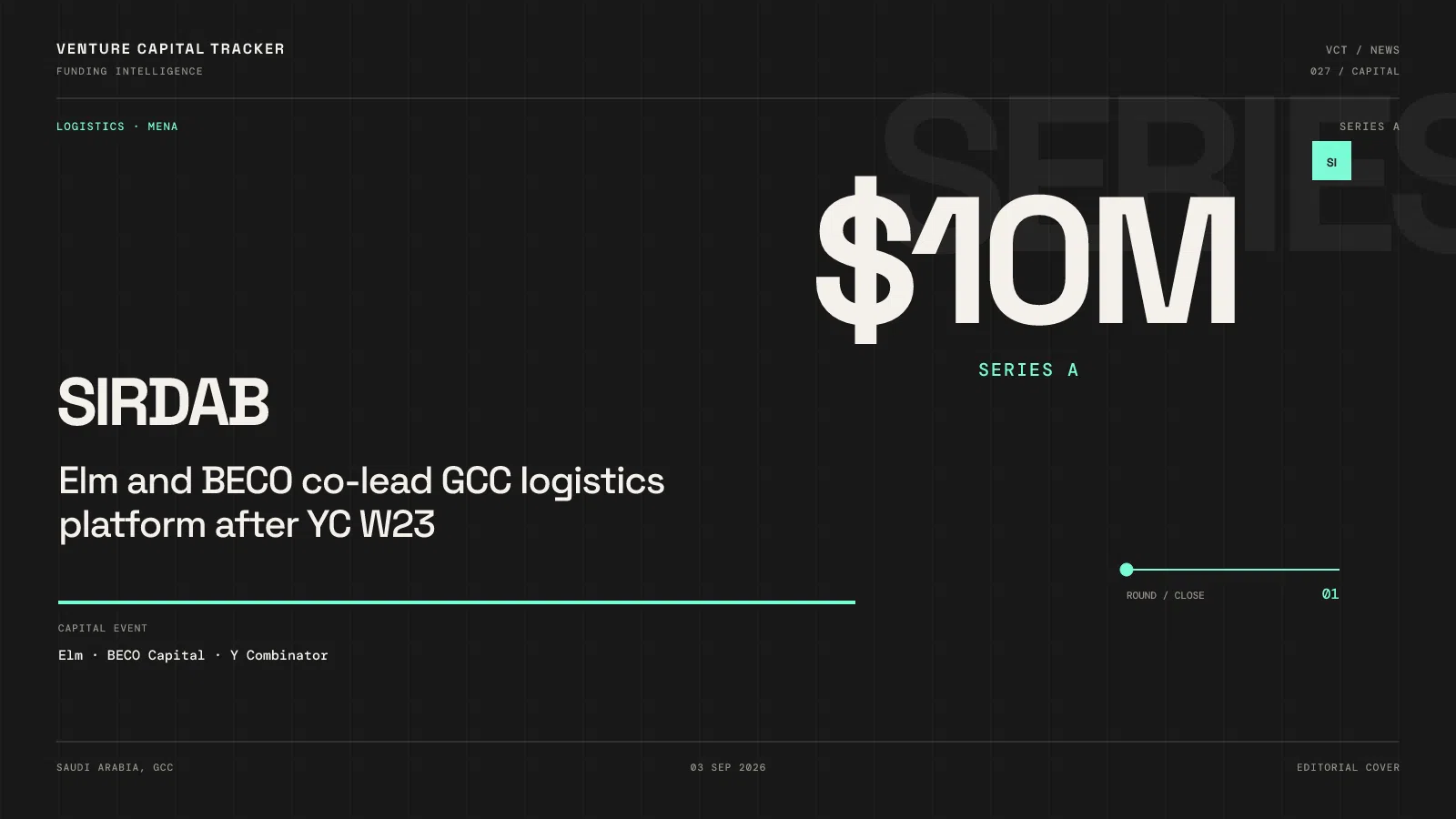
Elm (PIF-backed) and BECO Capital co-led a $10 million Series A for Saudi logistics platform Sirdab on September 3, 2026, with Y Combinator, COTU Ventures, and D Global Ventures participating (Wamda). Amount also cited as SAR 37.5 million.
Spine: Saudi logistics demand is scaling faster than fragmented warehouse and carrier networks — Sirdab sells the software + network control plane, not a fleet of trucks.
Key facts
- Company
- Sirdab
- Round
- $10M Series A
- Co-leads
- Elm, BECO Capital
- Returning / other
- Y Combinator, COTU Ventures, D Global Ventures
- Batch
- YC Winter 2023
- Traction (company)
- 20x revenue since YC; profitable; 850+ businesses; 120+ warehouses; 60+ carriers
- Temperature coverage
- Dry, ambient, chilled, frozen
Who uses the product — and for what job
Users: Saudi and GCC businesses that need multi-location warehousing and transportation without building owned logistics; warehouse and carrier providers who want standardized demand, billing, and compliance.
Job: treat distributed capacity as one controllable system — secure verified space and lanes, manage inventory/orders, monitor service levels, and match capacity with AI-assisted coordination.
Named customer logos beyond “government entities / listed companies / enterprises” were not published in the Wamda write-up — keep that as category claim.
Why now
- Kingdom logistics buildout + e-commerce and industrial localization create capacity discovery problems.
- Asset-light models with a few company-operated hubs scale capital differently than pure 3PL ownership.
- Proceeds: GCC expansion, network growth, and AI for matching + day-to-day coordination (company).
Why Elm and BECO — portfolio fit
Elm brings PIF-adjacent digital infrastructure distribution and public-sector adjacency — useful when logistics buyers include large enterprises and government-linked entities. BECO is a returning regional specialist that already knows the founders’ operating cadence. Y Combinator stays in as the original network and product-pressure investor.
Likely founder rationale: raise from a strategic digital conglomerate that can open doors inside the Kingdom while keeping a regional VC that underwrites GCC expansion risk.
Elm, BECO, COTU, and D Global are editorial only — no /fund/ pages.
Competitive map
| Approach | Tradeoff |
|---|---|
| Traditional 3PL / owned warehouses | Control; slow and capital-heavy to expand cities |
| Marketplace listings without ops software | Thin matching; weak SLAs |
| Global TMS/WMS imports | Feature-rich; localization and network density lag |
| Sirdab network + software layer | Faster capacity access; depends on provider quality |
What is not proven
- Independent audit of “20x revenue” and profitability.
- Valuation not disclosed.
- Exact AI product maturity beyond roadmap language.
Practical takeaway
- Founders (MENA infra): Pair network proof (warehouses, carriers, SLAs) with software — capital follows density.
- Investors: Diligence take-rate vs gross merchandise / logistics volume and provider churn.
- Operators: Relevant if multi-city inventory expansion is blocked by fragmented capacity search.
Follow Venture Capital Tracker on Google
Add VCT as a preferred source to see more of our venture-capital reporting in Google Search.
Editorial note: AI tools assisted with research, structure, or drafting. Venture Capital Tracker retains human editorial responsibility for factual accuracy, relevance, and source quality before publication.