· Investment Strategies · 9 sources · Updated
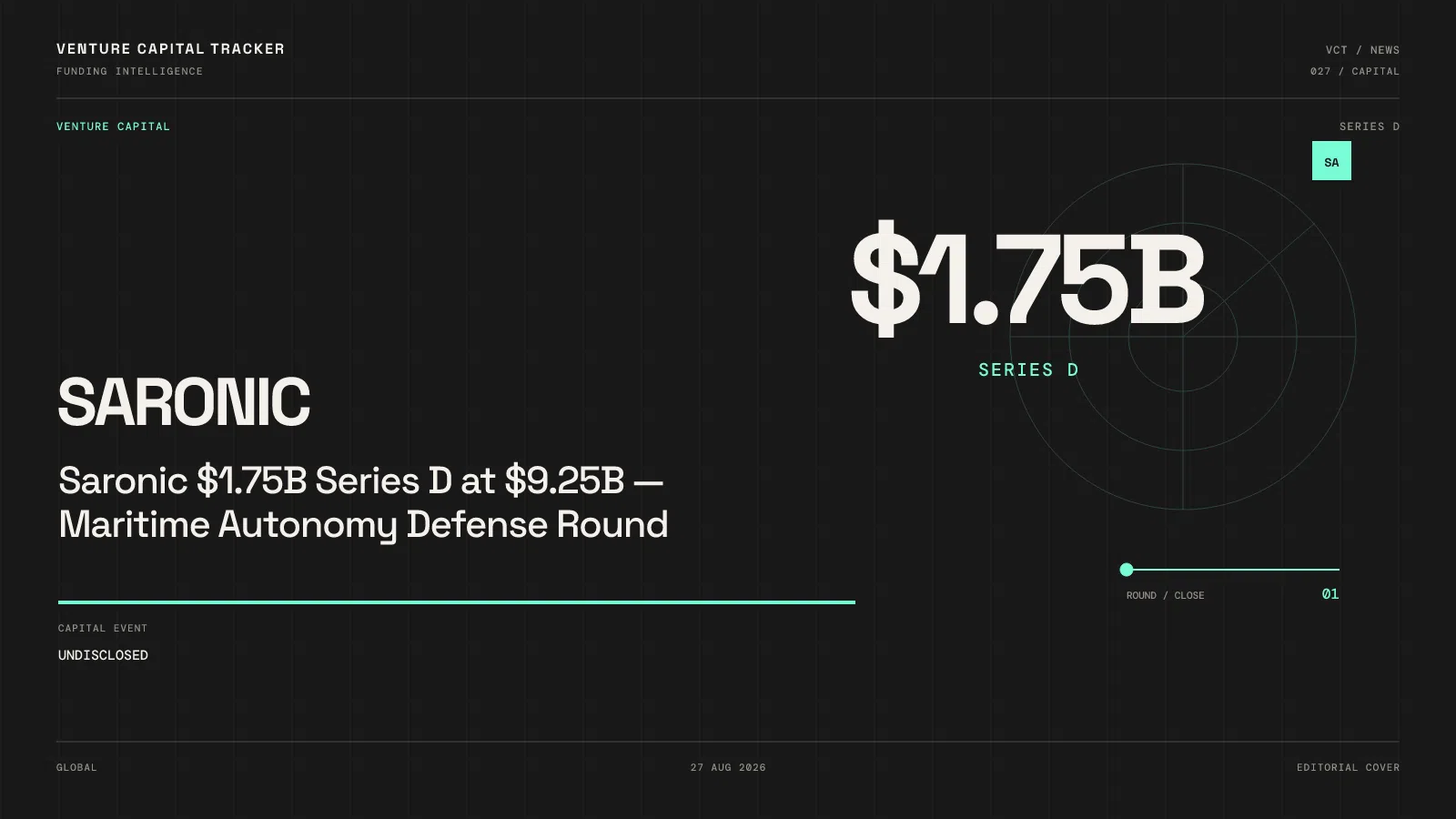
Saronic $1.75B Series D at $9.25B — Maritime Autonomy Defense Round
Saronic's Austin-based Series D led by Kleiner Perkins shows defense-tech capital is now funding production infrastructure, not just prototypes.

Editorial team
Funding event
Saronic
Led by Kleiner Perkins
Reported valuation $9.25B
Saronic raised $1.75B Series D at $9.25B, led by Kleiner Perkins (March 31, 2026) — defense-tech capital funding shipyard-scale autonomous surface vessels, not just prototypes.
For context on comparable financings and companies, explore VCT's 2026 defense-tech funding overview.
Saronic Technologies, the Austin-based autonomous surface vessel (ASV) maker, closed a $1.75 billion Series D at a $9.25 billion valuation on March 31, 2026, led by Kleiner Perkins. The round follows a $600M Series C in 2025 and a $392M U.S. Navy production contract for Saronic's Corsair USV platform.
The problem this startup is attacking
Western navies need affordable, mass-producible, autonomous surface vessels capable of surveillance, force multiplication, and contested-waters logistics — faster than traditional shipbuilding cycles allow.
Why this is a live problem now
- A multi-year bipartisan defense procurement push in the U.S.
- Peer naval competition reshaping priorities in the Pacific and Arctic.
- Shipyard capacity is the bottleneck, not software.
Competitive map
- Anduril (autonomous maritime + broader defense portfolio).
- Shield AI, HavocAI, Ocean Aero: adjacent autonomy and USV stacks.
- Legacy primes: HII, General Dynamics, Austal USA — with different cost and throughput curves.
Market signal (the number to remember)
- Saronic's "Port Alpha" shipyard plan is a reminder: at $9.25B valuation, this is an industrial infrastructure investment, not a software round. Austin's Q1 2026 startup funding hit a record $4.2B, powered in part by this deal.
Practical takeaway (operator + investor)
- Defense-tech founders: Capital is favoring teams who can credibly scale production throughput and demonstrate DoD revenue, not just platforms.
- Investors: The defense-tech opportunity in 2026 is increasingly about manufacturing — shipyards, drone lines, hypersonic components — not new software kits on old airframes.
- Regional signal: Austin has firmly established itself as a hard-tech hub, with Saronic, Apptronik, and CesiumAstro anchoring a defense/robotics cluster.
Follow Venture Capital Tracker on Google
Add VCT as a preferred source to see more of our venture-capital reporting in Google Search.
Last updated:
Editorial note: AI tools assisted with research, structure, or drafting. Venture Capital Tracker retains human editorial responsibility for factual accuracy, relevance, and source quality before publication.