River AI’s $1.1B Seed/A: General Catalyst Bets on Owned Personal Intelligence
xAI co-founder Igor Babuschkin’s River AI raised $1.1B across Seed and Series A led by General Catalyst and AMP PBC — LoRA/RL fine-tuning for open-weight models enterprises can own.
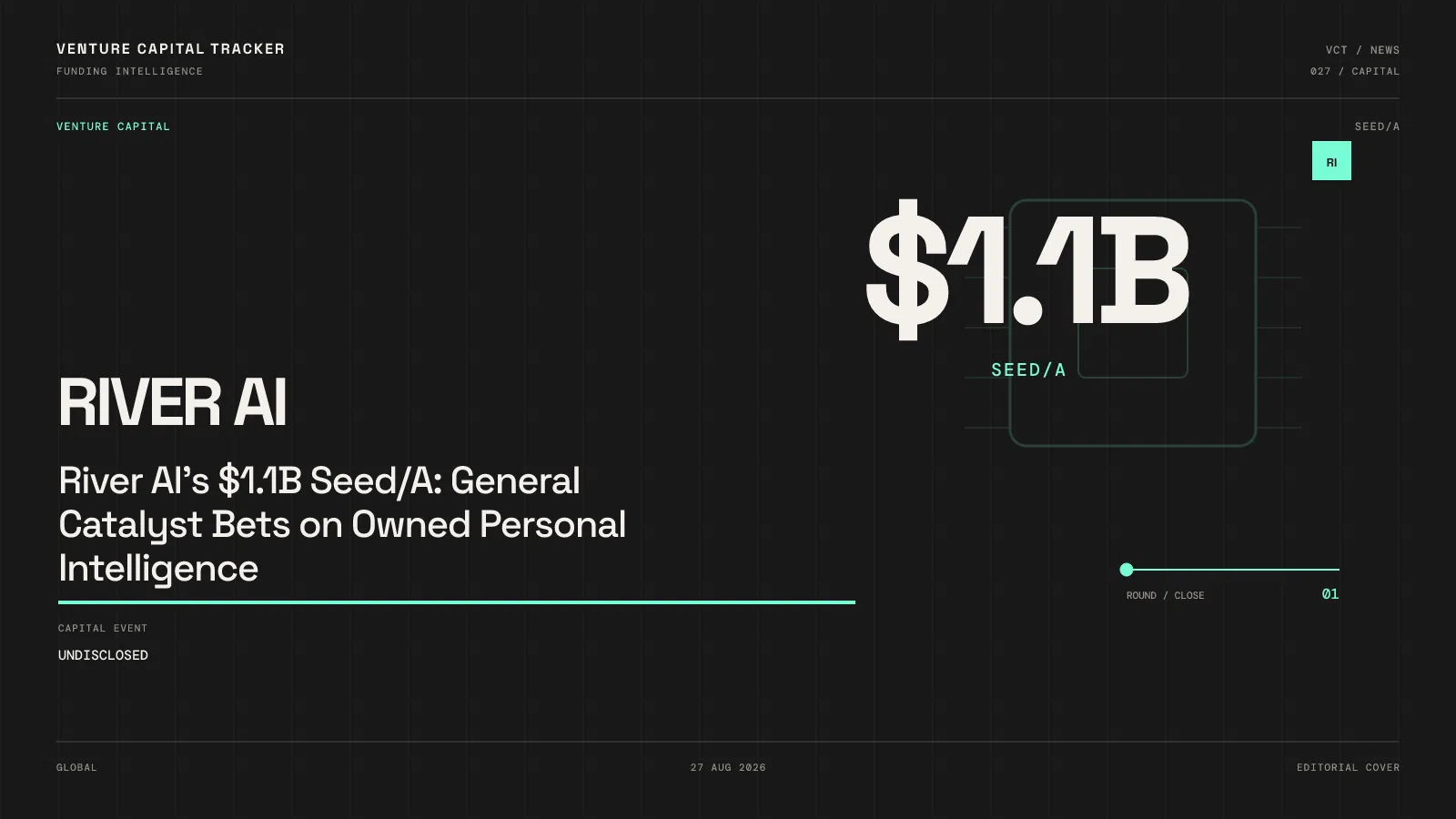
General Catalyst and AMP PBC led a $1.1 billion Seed + Series A into River AI on August 11, 2026 — with NVIDIA, AMD Ventures, Y Combinator, and Temasek. The company is roughly two months from its June stealth emergence and is led by xAI co-founder Igor Babuschkin.
Key facts
| Field | Detail |
|---|---|
| Company | River AI |
| Round | $1.1B across Series Seed + Series A |
| Date | August 11, 2026 |
| Leads | General Catalyst, AMP PBC |
| Strategics / others | NVIDIA, AMD Ventures, Y Combinator, Temasek |
| Product (now) | LoRA + RL fine-tuning API on open-weight models |
| Thesis | Personal AI you own — start with enterprise post-training |
| Founder | Igor Babuschkin (ex–DeepMind, OpenAI, xAI) |
Who uses the product — and for what job
Users today: engineering and applied-AI teams at companies that want custom weights, not only prompts on a closed API.
Job: run LoRA fine-tuning and reinforcement learning on open-weight models in minutes, deploy the trained model as an endpoint, and pay for tokens used — without standing up a GPU ops org.
River’s own claims (treat as company-reported): complex RL runs in 15–20 minutes, 2–4× cost savings vs closed-source alternatives, models from ~35B to ~1T parameters, billing metered on training/inference tokens.
Users tomorrow (stated ambition): individuals who want a private AI that learns from them and runs on hardware they control — “align AI to each person,” not one lab model to billions.
Why now
- Enterprises are mixing open-weight and closed frontier models and want ownership of post-training, not permanent rent.
- Prompt-only workflows hit a ceiling when the job needs durable skill on proprietary data.
- Chip strategics (NVIDIA, AMD) want demand for training/inference stacks beyond hyperscaler chat.
- Talent with lab-scale RL experience is scarce; a nine-figure seed/A is how markets clear that scarcity.
Why General Catalyst — portfolio fit
General Catalyst has been loud on AI infrastructure, transformation, and open ecosystems. Hemant Taneja’s quote frames River as open-weight leadership for American resilience — portfolio language that sits next to GC’s other large AI bets, not a thin SaaS check.
AMP PBC (Anjney Midha, ex–a16z) adds open/frontier model fluency (Black Forest Labs, Mistral, LMArena, OpenRouter adjacency in press).
Likely founder rationale: take capital from a firm that will underwrite a full-stack path (infra → product → hardware) at seed/A size, plus chip strategics that open cloud and silicon channels — rather than a pure consumer AI fund chasing chatbot ARR.
| Dimension | Fit |
|---|---|
| Stage | Seed/A with growth-size capital |
| Thesis | Ownable intelligence / open-weight post-training |
| Distribution | NVIDIA + AMD as strategics |
| Risk | Execution + capital intensity before consumer product |
Competitive map
| Player | Lane |
|---|---|
| Closed frontier APIs (OpenAI, Anthropic, etc.) | Rent intelligence; limited weight ownership |
| Cloud fine-tune SKUs (AWS/GCP/Azure) | Infra available; less “personal AI” product story |
| Other neocloud / RL platforms | Overlap on post-training; River sells ownership thesis hard |
| Local agent stacks (OpenClaw-class) | Personal runtime; weaker enterprise RL/API wedge |
When not to over-read this round
- Wrong if you treat $1.1B at ~2 months as proof of product-market fit — it is a talent + thesis + compute underwrite.
- Wrong if you model River as “another chatbot” ARR story without post-training usage.
- Wrong if you invent a valuation — none was disclosed in primary materials reviewed.
Practical takeaway
- Founders (AI infra): Sell a job enterprises feel now (own custom open-weight agents) with a credible path to consumer personal AI.
- Investors: Separate API traction metrics from manifesto; ask for training-run volume, retention, and gross margin on metered tokens.
- Operators: If you need models on proprietary workflows, evaluate River vs hyperscaler fine-tune — ownership and RL speed are the claimed deltas.
Sources
- River AI (Aug 11, 2026): https://river.ai/series-seed-series-a-funding
- TechCrunch: https://techcrunch.com/2026/08/11/general-catalyst-leads-1-1b-round-into-2-month-old-river-ai/
- Related: /2026-august-11-12-investment-news-personal-ai-defense-health
Follow Venture Capital Tracker in Google
Add VCT as a preferred source to make our venture-capital coverage easier to find in Google Search.
Editorial note: AI tools assisted with research, structure, or drafting. Venture Capital Tracker retains human editorial responsibility for factual accuracy, relevance, and source quality before publication.