· Updated · Venture Capital Tracker · investment-strategies
OpenAI Becomes Sole LP in New $400M Startup Fund
OpenAI Startup Fund II filed a $400M Form D with one investor and no remaining amount to sell. The filing names Ian Hathaway; reporting identifies OpenAI as the sole balance-sheet backer.
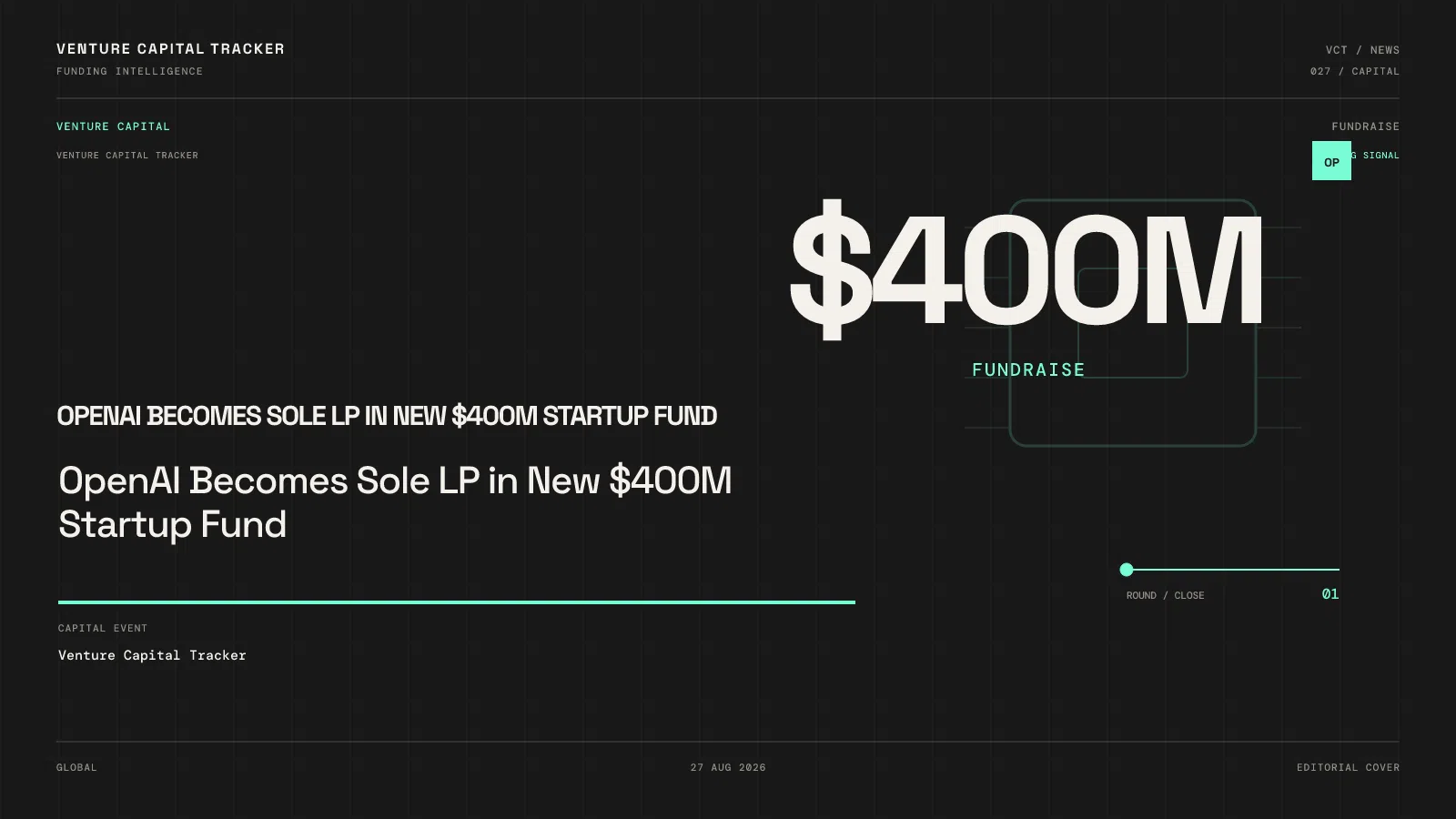
OpenAI has moved its venture arm from an externally backed strategic fund toward a balance-sheet allocator. OpenAI Startup Fund II, L.P. filed a Form D on August 26, 2026 showing a $400 million offering, $400 million sold, zero remaining and one investor. Dealroom reports that OpenAI is the sole investor. No separate OpenAI press release was located, so the filing and the reported identity of the investor should be kept distinct.
What the filing actually tells us
| Field | Filing-backed detail |
|---|---|
| Issuer | OpenAI Startup Fund II, L.P. |
| Filing | New Form D, filed August 26, 2026 |
| Fund type | Pooled investment fund / venture capital fund |
| Total offering | $400M |
| Amount sold | $400M |
| Remaining | $0 |
| Investors | 1 |
| Related person | Ian Hathaway, managing member of the general partner |
| Security | Pooled investment-fund interests |
Form D is a notice of an exempt offering, not an audited fund report. It does not disclose portfolio companies, fees, carry, reserves, ownership targets or the exact identity of the LP in the fields reproduced in the filing. That is why “one investor listed” is the filing fact, while “OpenAI is the sole LP” is the reported interpretation.
A different vehicle from the 2021 fund
OpenAI’s first Startup Fund launched in 2021 with $175 million from external backers, including Microsoft, according to TechCrunch. It backed companies including Cursor/Anysphere, Harvey, Speak, Descript, Figure AI and Physical Intelligence, while separate special-purpose vehicles financed individual opportunities.
The new vehicle is more than twice the size of that original fund and changes the economic alignment. External LP capital can broaden risk-sharing and bring a network of strategic relationships. A sole balance-sheet LP lets OpenAI keep the returns and make investment decisions around its own platform priorities, but it also concentrates capital, governance and reputational risk inside the model company.
The manager named in the filing, Ian Hathaway, is important context. Axios reported in 2024 that control of the original fund had moved away from Sam Altman personally to Hathaway. The new filing therefore points to OpenAI-owned capital with professional fund management, rather than a personal Altman vehicle.
Why a model company would fund the ecosystem directly
OpenAI’s strategic advantage is not limited to selling model access. Startup investments can create:
- Distribution: portfolio companies turn models into workflows used by employees and consumers.
- Feedback: real deployments reveal where models fail in production, not just in benchmarks.
- Option value: OpenAI can deepen partnerships or acquire teams and products that become strategically important.
- Market formation: capital can accelerate categories that depend on frontier-model capabilities.
That logic comes with a conflict question founders should ask before accepting a check: does the investment require a commercial commitment, preferred model access or technical dependence that reduces future platform choice? A founder should diligence the investment agreement, information rights, model pricing, exclusivity language and the process for handling competing providers.
The new fund’s likely job — and the limits of the evidence
Reporting describes a concentrated early-stage AI strategy, with roughly 8–10 investments a year and occasional checks that could reach $50M–$100M. Those strategy details are reported, not in the Form D. They should be treated as a working thesis rather than a published mandate.
The fund’s size is meaningful because AI companies are raising larger rounds earlier, but the math does not mean every investment will be a $50M check. A $400M vehicle must reserve for follow-ons, management fees and portfolio construction. The better signal is that OpenAI wants a repeatable seat at the table across the application, infrastructure and physical-AI layers.
What to watch next
The next useful disclosures are not another headline about fund size. They are the first portfolio investments, the fund’s published mandate and whether OpenAI’s corporate relationships give portfolio companies durable distribution without forcing platform lock-in.
For venture markets, the change is clear enough: OpenAI is no longer only an ecosystem supplier or occasional strategic investor. It is becoming a direct VC allocator using its own balance sheet, with the upside and conflict questions that come with that role.
Sources
Last updated:
Editorial note: AI tools assisted with research, structure, or drafting. Venture Capital Tracker retains human editorial responsibility for factual accuracy, relevance, and source quality before publication.