· Investment Strategies · 3 sources
Lightfield’s $47M Series A: a16z Bets on CRM Built for Agents, Not Forms
Tome founders pivoted to an AI-native CRM. a16z led $47M on Sep 9, 2026 as Lightfield claims 5,000+ company signups and agent-ready customer context Salesforce was never designed to hold.

Editorial team
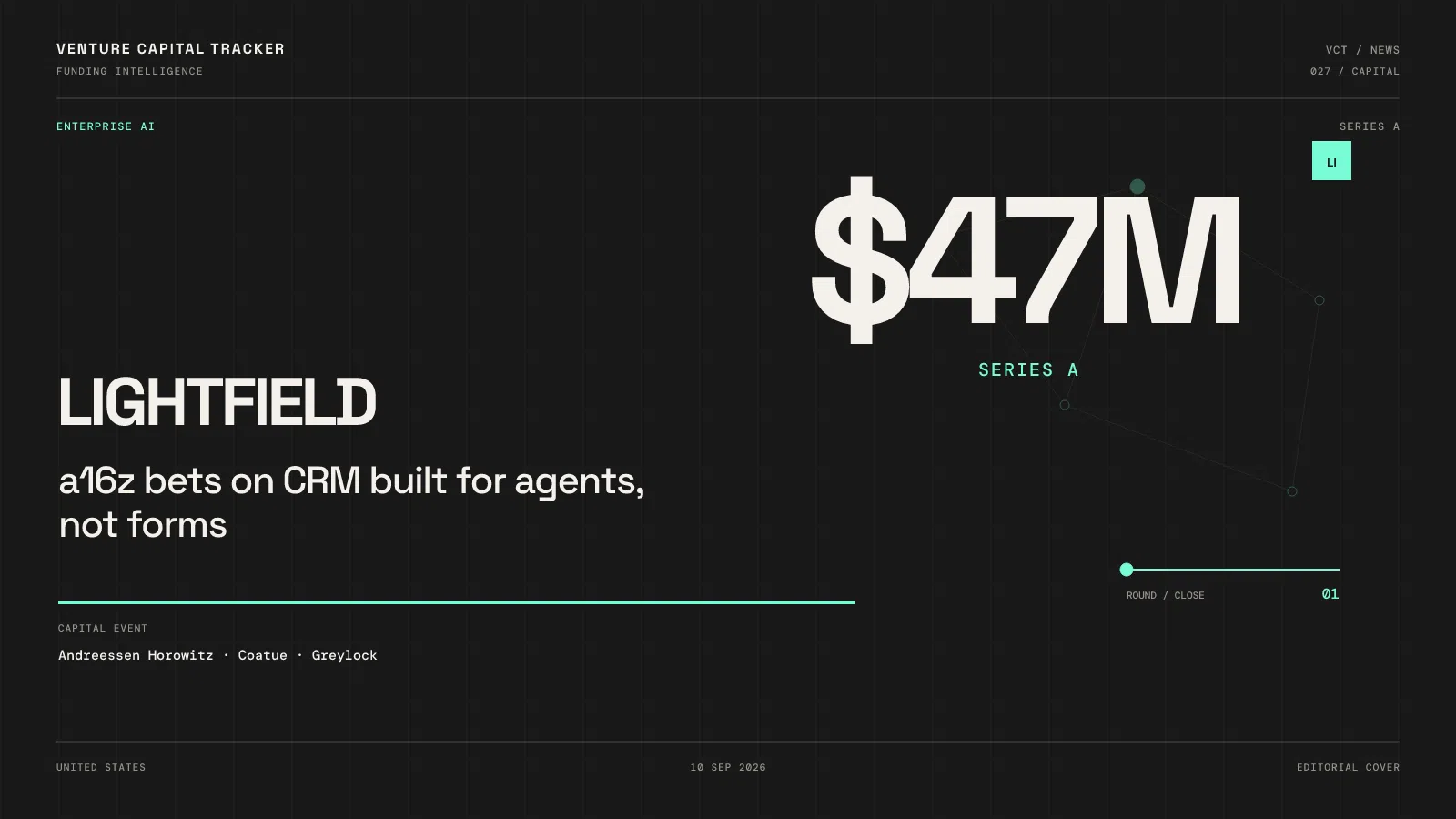
Lightfield closed a $47 million Series A on September 9, 2026, led by Andreessen Horowitz. Coatue, Greylock, Maverick Capital, Audacious, Alumni Ventures, and Lightspeed Venture Partners joined (company PR / a16z note). Valuation and ARR were not disclosed.
Spine: CRM was built for humans typing fields. Agents fail on incomplete notes and stale stages — so the Tome founders rebuilt the system of record itself, not another Salesforce copilot.
Key facts
- Company
- Lightfield (lightfield.app)
- Round
- $47M Series A
- Lead
- a16z (Joe Schmidt IV, Alex Rampell, Fabrizio Serafini on the memo)
- Launch
- November 2025 (company)
- Traction (company / Upstarts)
- >5,000 company signups; some teams 100+ seats; ~400% net dollar retention claimed; ~40 employees
Who uses the product — and for what job
Users: high-growth GTM orgs — founders through scaling sales/CS teams — that want agents to build pipeline and work deals without inheriting garbage CRM fields.
Job: capture every customer interaction as it happens → structure a temporal “world model” of people, deals, and accounts → let humans and agents operate through the same API/SDK/MCP surface.
a16z’s memo claims teams are ripping out Salesforce, HubSpot, and Attio. Treat that as investor/customer anecdote, not a market-share study. Named ARR was not published.
Why now
- Agent demos are everywhere; verified customer context is the bottleneck Peiris names in the release.
- Classic CRM “AI features” still sit on hand-entered fields. That architecture breaks when agents need reproducible work.
- The founders already scaled Tome to 25 million users (a16z) then shrank and pivoted — a rare reset that kept enterprise-grade talent on a greenfield system-of-record problem.
Why these investors — portfolio fit
a16z framed Lightfield as the agent-era Salesforce/HubSpot bet: new platform shifts mint new systems of record. Leading $47M is consistent with owning the GTM data plane agents will hit first.
Coatue and Greylock add crossover and classic enterprise-seed/Series A pattern recognition for category resets. Upstarts notes many backers overlap prior Tome capital — read this as a continuity check on the team as much as a net-new logo hunt.
Maverick Capital, Audacious, Alumni Ventures, and Lightspeed Venture Partners have no /fund/ pages here (do not confuse Maverick Capital with Maverick Silicon, or Lightspeed with our NYC Lightspeed entity).
Competitive map
| Approach | Tradeoff |
|---|---|
| Salesforce / HubSpot + AI add-ons | Distribution; agents inherit incomplete fields |
| Attio / modern flexible CRM | Cleaner UX; still mostly human-first entry |
| Point sales agents on email alone | Fast demos; weak shared system of record |
| Lightfield world model + agent harness | Purpose-built for agents; must win trust as SoR |
What is not proven
- Valuation, ARR, and churn — only signup count and claimed NDR are public.
- How deep “rip and replace” goes beyond early adopters.
- Whether $47M is enough before incumbents ship “good enough” agent CRM layers.
Practical takeaway
- Founders (GTM tooling): Sell against untrustworthy CRM data for agents, not “AI that fills fields.”
- Investors: Diligence NDR and seat expansion vs. freemium signup vanity; confirm Salesforce displacement rates.
- Operators: Relevant if reps refuse CRM hygiene and you still want agents touching pipeline.
Follow Venture Capital Tracker on Google
Add VCT as a preferred source to see more of our venture-capital reporting in Google Search.
Editorial note: AI tools assisted with research, structure, or drafting. Venture Capital Tracker retains human editorial responsibility for factual accuracy, relevance, and source quality before publication.