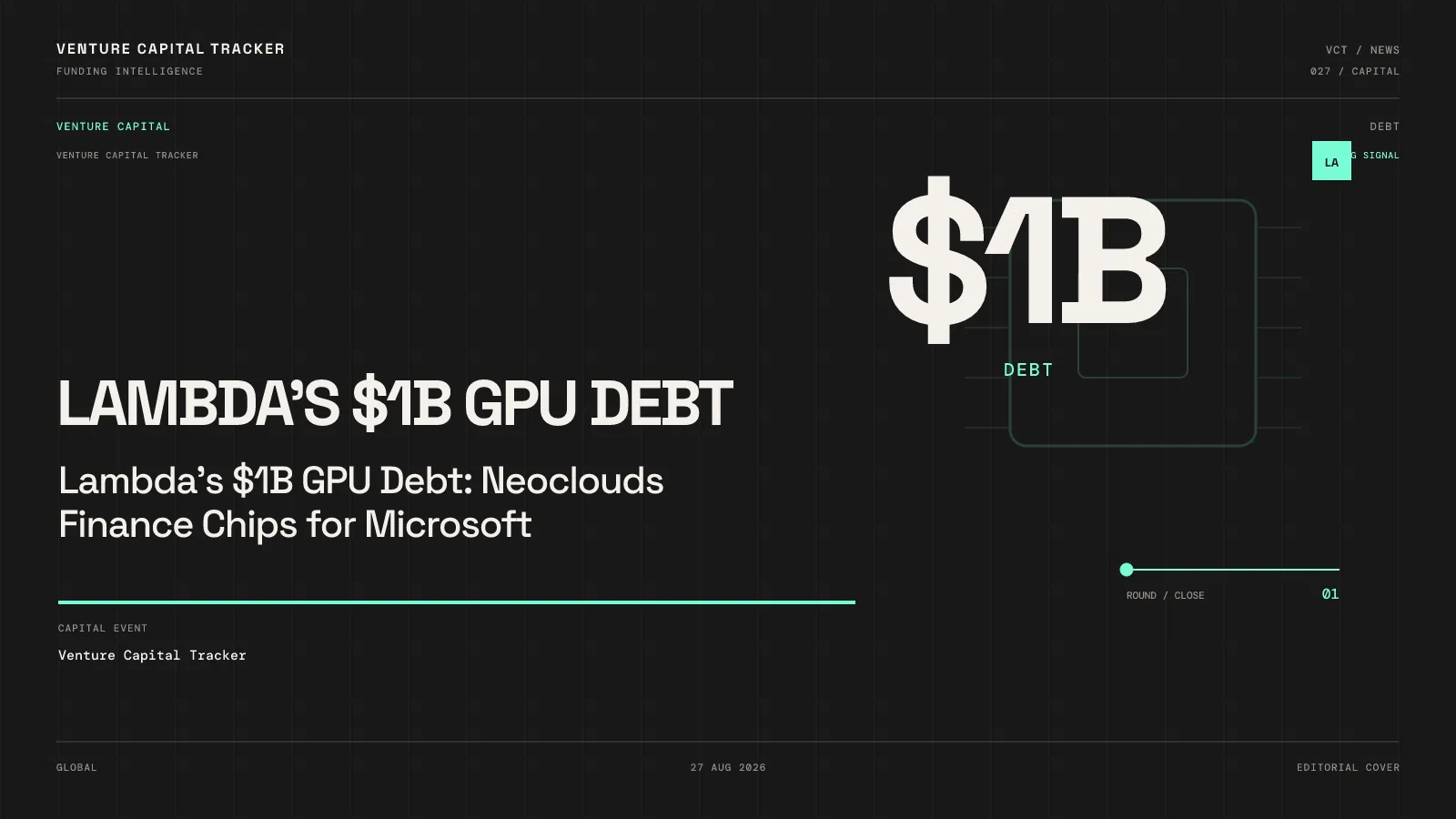
Lambda’s $1B GPU Debt: Neoclouds Finance Chips for Microsoft
Lambda raised $1B in short-dated private debt arranged by JPMorgan to buy Nvidia GPUs for Microsoft — part of a 2026 AI debt wave as a $3B pre-IPO equity round is reportedly in talks.
Lambda, the AI neocloud that buys GPUs and rents them to customers, secured roughly $1 billion in private, short-dated debt to purchase Nvidia chips for a Microsoft deployment — arranged by JPMorgan Chase, per TechCrunch citing Bloomberg on August 28, 2026.
Unexpected truth: the loudest “AI funding” print on this news day is not a venture round. It is structured debt against contracted chip utilization — while equity markets whisper about a $3B pre-IPO raise.
Key facts
| Field | Detail |
|---|---|
| Company | Lambda (AI cloud / neocloud) |
| Instrument | $1B private short-dated debt |
| Arranger | JPMorgan Chase (Bloomberg via TC) |
| Use | Buy Nvidia GPUs → lease to Microsoft |
| Same-week context | $926M loan for GB300 GPUs (Nvidia deployment contract) |
| Prior credit | $1B secured facility (May) |
| Last equity mark | $1.5B @ $5.43B post (Nov, PitchBook via TC) |
| Reported next | Talks for $3B pre-IPO equity |
Who uses the product — and for what job
Users: enterprises and labs that need GPU capacity without building their own clusters — here, Microsoft as the contracted lessee.
Job: turn Nvidia silicon into billable cloud capacity faster than hyperscaler self-build timelines allow.
Why now
- AI capacity demand outruns equity-only financing; Bloomberg (via TC) cites >$400B AI-related debt raised globally in 2026 YTD.
- Short-dated debt fits when chips can be deployed and monetized quickly against known customers.
- Neoclouds sit between hyperscalers and pure co-los — financing flexibility is the product.
Why this capital structure — “portfolio” fit for lenders
| Party | Likely fit |
|---|---|
| JPMorgan / debt markets | Asset-backed / contracted-cash-flow lending on GPUs |
| Microsoft | Capacity without owning every rack |
| Nvidia | Demand pull for GB300 and prior generations |
| Equity holders | Avoids diluting at every capacity step; saves dry powder for pre-IPO |
Likely founder/operator rationale: finance GPUs with debt when utilization is contracted; save equity for balance-sheet and growth narrative at IPO scale.
Competitive map
| Player | Difference |
|---|---|
| Hyperscalers (Azure/GCP/AWS) | Own stack; still buy external capacity |
| Firmus / Volta | Equity/strategic AI factory builds |
| CoreWeave-style neoclouds | Same debt-heavy GPU playbook |
When not to over-read
- Bloomberg/TC reported — not a Lambda IR PDF in our sources.
- Debt ≠ healthy margins; utilization and chip depreciation can break the model.
- Pre-IPO $3B talks are reported, not closed.
Practical takeaway
- Founders: Match instrument to asset — GPUs with contracted lessees → debt; invention → equity (see Machine Age).
- Investors: Dilution math for neoclouds now includes a credit cycle — model leverage, not only burn.
- Operators: Treat Aug 28 as a capital-structure news day: a16z equity for hardware innovation + Lambda debt for silicon deployment.
Sources
- https://techcrunch.com/2026/08/28/neocloud-lambda-secures-1b-in-debt-to-buy-more-chips/
Follow Venture Capital Tracker in Google
Add VCT as a preferred source to make our venture-capital coverage easier to find in Google Search.
Editorial note: AI tools assisted with research, structure, or drafting. Venture Capital Tracker retains human editorial responsibility for factual accuracy, relevance, and source quality before publication.