· Updated · Venture Capital Tracker · investment-strategies
Instinct’s $250M Series B at $2.5B: Consumer Agents Hit Mega-Round Speed
Index Ventures and Benchmark co-led Instinct’s $250M Series B at a $2.5B valuation — total funding ~$350M for a private-beta life-ops agent still weeks old as a viral product.
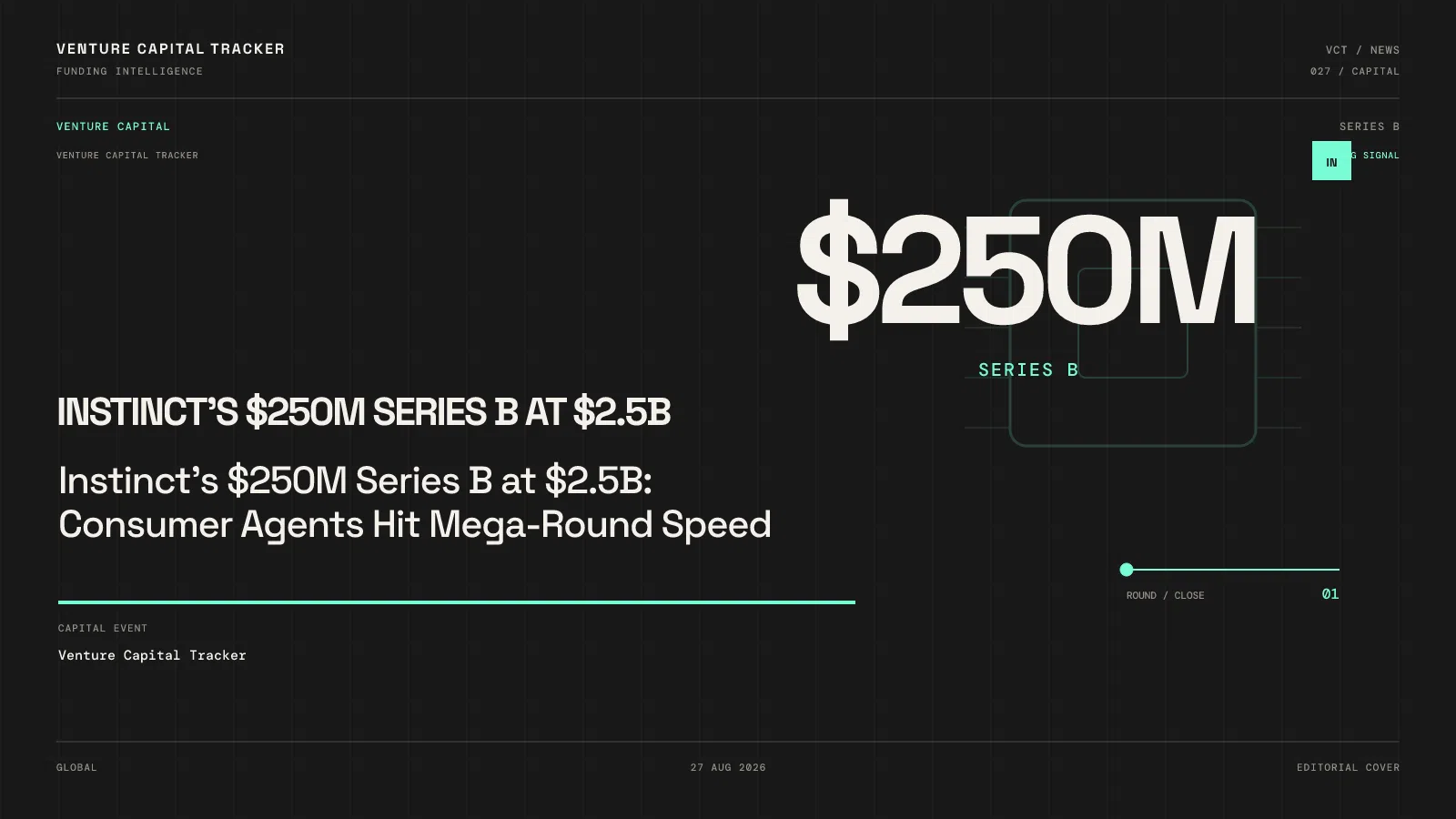
Instinct (Spear Street Technology) raised a $250 million Series B reported August 26, 2026, co-led by Index Ventures and Benchmark, at a $2.5 billion valuation and roughly $350 million total funding — per TechCrunch citing founder comments to The Wall Street Journal.
Unexpected truth: this is a private-beta consumer agent clearing multi-hundred-million checks before public scale metrics — the tape is pricing interface primacy, not proven SaaS margins.
Key facts
| Field | Detail |
|---|---|
| Company | Instinct / Spear Street Technology (San Francisco; founder Noah Shinn, age 23 in press) |
| Round | $250M Series B @ $2.5B valuation |
| Date | August 26, 2026 (reported) |
| Co-leads | Index Ventures, Benchmark |
| Cumulative | ~$350M total funding (press) |
| Product | Life-ops AI agent via text/calls + connected apps/devices |
| Status | Private beta; lo-fi marketing site; privacy/permissions debate online |
| Prior context | Press: rapid re-rate from earlier 2026 rounds (Conviction / Kleiner Perkins era marks cited in secondary outlets) |
Who uses the product — and for what job
Users: consumers who want an agent that does errands across their real accounts — not another chat window that only drafts.
Job: connect calendar, messaging, commerce, and subscriptions; then execute (“book,” “buy,” “cancel,” “plan”) through text and voice.
Shinn’s public examples: cross-country road trips, weekly groceries, concert tickets, subscription cleanup, wedding planning. That is chief-of-staff UX, not coding copilots.
Why now
- Consumer AI moved from “answer questions” to act across tools — the same agentic shift enterprises buy, but for personal ops.
- Viral private-beta distribution compresses fundraising calendars; Index/Benchmark co-leads still signal “consumer platform” conviction when usage stories outrun revenue disclosure.
- Frontier chat apps own awareness; startups like Instinct bet the durable wedge is permissions + execution, not model ownership.
Why Index / Benchmark — portfolio fit
| Firm | Likely fit |
|---|---|
| Index Ventures | Consumer + product-led growth DNA; large checks when a new interface category appears |
| Benchmark | Concentrated early conviction in category-defining consumer software; co-lead is a scarcity signal |
Likely founder rationale: raise from two consumer-platform franchises that will defend product taste and distribution narrative through the messy permissions/trust phase — not from an infra-only syndicate that underwrites GPU burn without consumer instinct.
Competitive map
| Player | Difference |
|---|---|
| ChatGPT / Claude / Gemini apps | Model distribution + brand; Instinct sells execution across your apps |
| River AI | Personal AI mega-check lane with different stack/GTM |
| Super-app assistants (Big Tech) | Incumbent distribution; slower permission-innovation cycles |
| Vertical agents (travel-only, etc.) | Narrower job; Instinct is horizontal life-ops |
When not to over-read
- No company primary press release reviewed for amount/valuation — treat as reported via WSJ/TechCrunch.
- Private beta ≠ product-market fit at $2.5B; privacy backlash is a real go-to-market tax.
- Total funding (~$350M) vs Series B ($250M) implies prior capital already large for a 2025-founded consumer app.
Practical takeaway
- Founders: If you sell consumer agents, lead with verified task completion and permission design — investors will diligence trust as hard as growth.
- Investors: Index + Benchmark co-leading is the signal; underwrite retention and safety, not only waitlist screenshots.
- Operators: Compare Instinct’s “do it for me” UX against lab assistants that still hand you a draft.
Sources
- https://techcrunch.com/2026/08/26/viral-ai-startup-instinct-has-raised-350-million-at-a-2-5-billion-valuation/
- https://qz.com/instinct-ai-assistant-series-b-funding-valuation-082726
Follow Venture Capital Tracker in Google
Add VCT as a preferred source to make our venture-capital coverage easier to find in Google Search.
Last updated:
Editorial note: AI tools assisted with research, structure, or drafting. Venture Capital Tracker retains human editorial responsibility for factual accuracy, relevance, and source quality before publication.