Human Archive's $8.2M Seed: India's Gig Economy Trains the Robots
Human Archive raised $8.2M seed in May 2026 — backed by Y Combinator and angels from OpenAI and Nvidia — using India's gig economy to collect physical-AI training data.
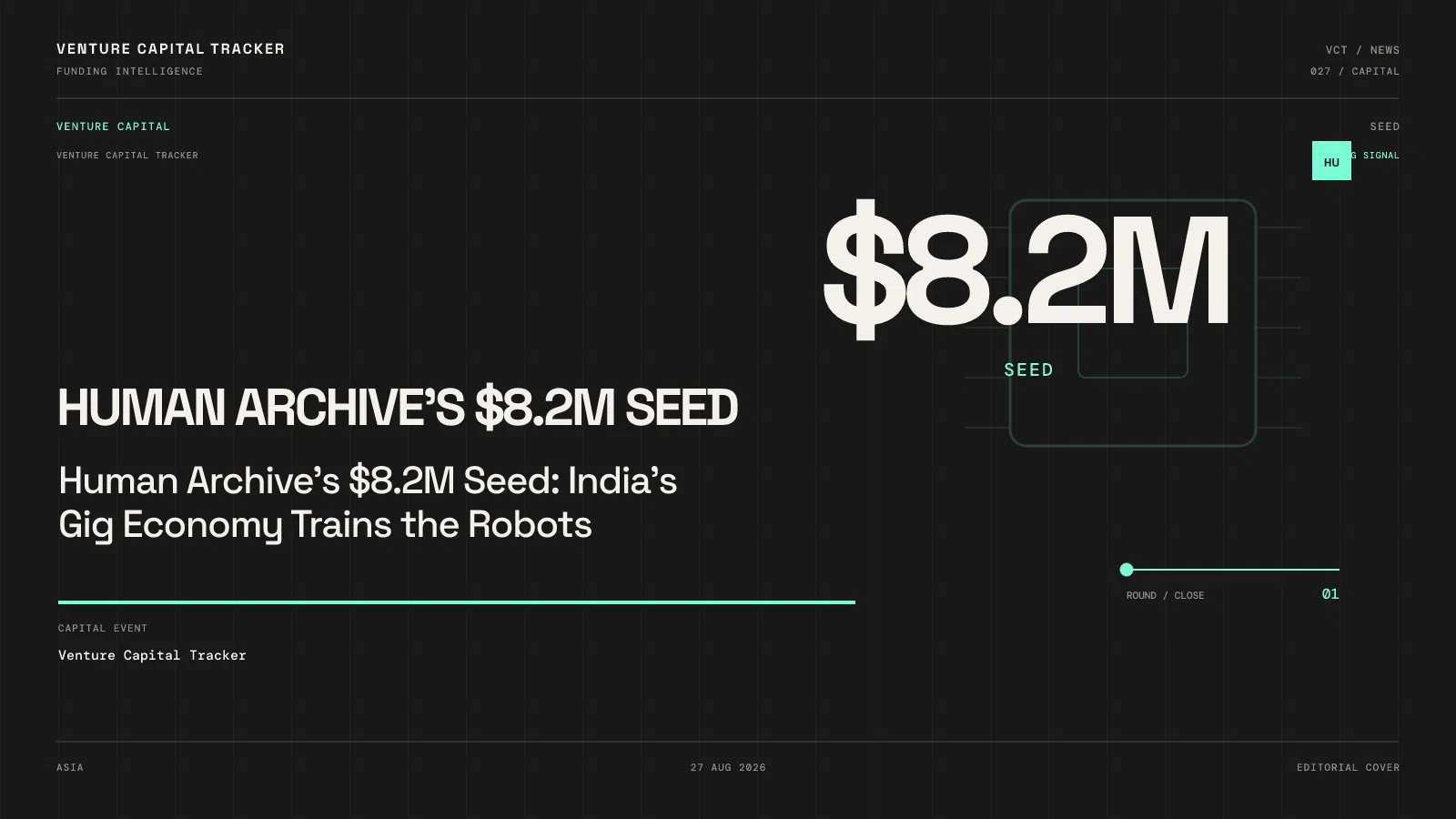
Human Archive's $8.2M seed in May 2026 sits at the intersection of two megatrends: physical AI and India's labor advantage. It uses the gig economy to collect the action data robots need to learn.
The problem this startup is attacking
Physical-AI systems are bottlenecked by training data — real-world demonstrations of human action. Human Archive crowdsources this data at scale via India's gig workforce.
Why this is a live problem now
- Robotics and physical AI raised ~$55.8B in 2026; data is the constraint.
- India offers a vast, cost-effective workforce for data collection.
- Leading AI figures (OpenAI, Nvidia angels) see data as the moat.
Competitive map
- Robotics data and teleoperation startups.
- In-house data programs at humanoid companies.
- Synthetic-data and simulation approaches.
Market signal (the number to remember)
- Y Combinator + angels from OpenAI, Nvidia, Google, Meta — elite backing for a seed signals conviction that physical-AI data is a foundational, investable layer.
Practical takeaway (operator + investor)
Human Archive shows the data layer of physical AI is its own opportunity — and India is well-positioned to supply it. Founders should build proprietary data pipelines; investors should treat training data as a durable moat in robotics.
Sources
- Drudhh (Human Archive $8.2M seed): https://drudhh.com/india-startup-funding-analysis-may-26-31-2026/
Editorial note: AI tools assisted with research, structure, or drafting. Venture Capital Tracker retains human editorial responsibility for factual accuracy, relevance, and source quality before publication.