· Investment Strategies · 2 sources
Gravis Robotics Raises $200M Series A from SoftBank — Retrofit Excavator Autonomy
SoftBank is the sole investor in Gravis’s $200M Series A (Aug 17, 2026). ETH Zurich spinout sells a mixed-fleet autonomy kit — physical AI for earthmoving, not a new OEM.

Editorial team
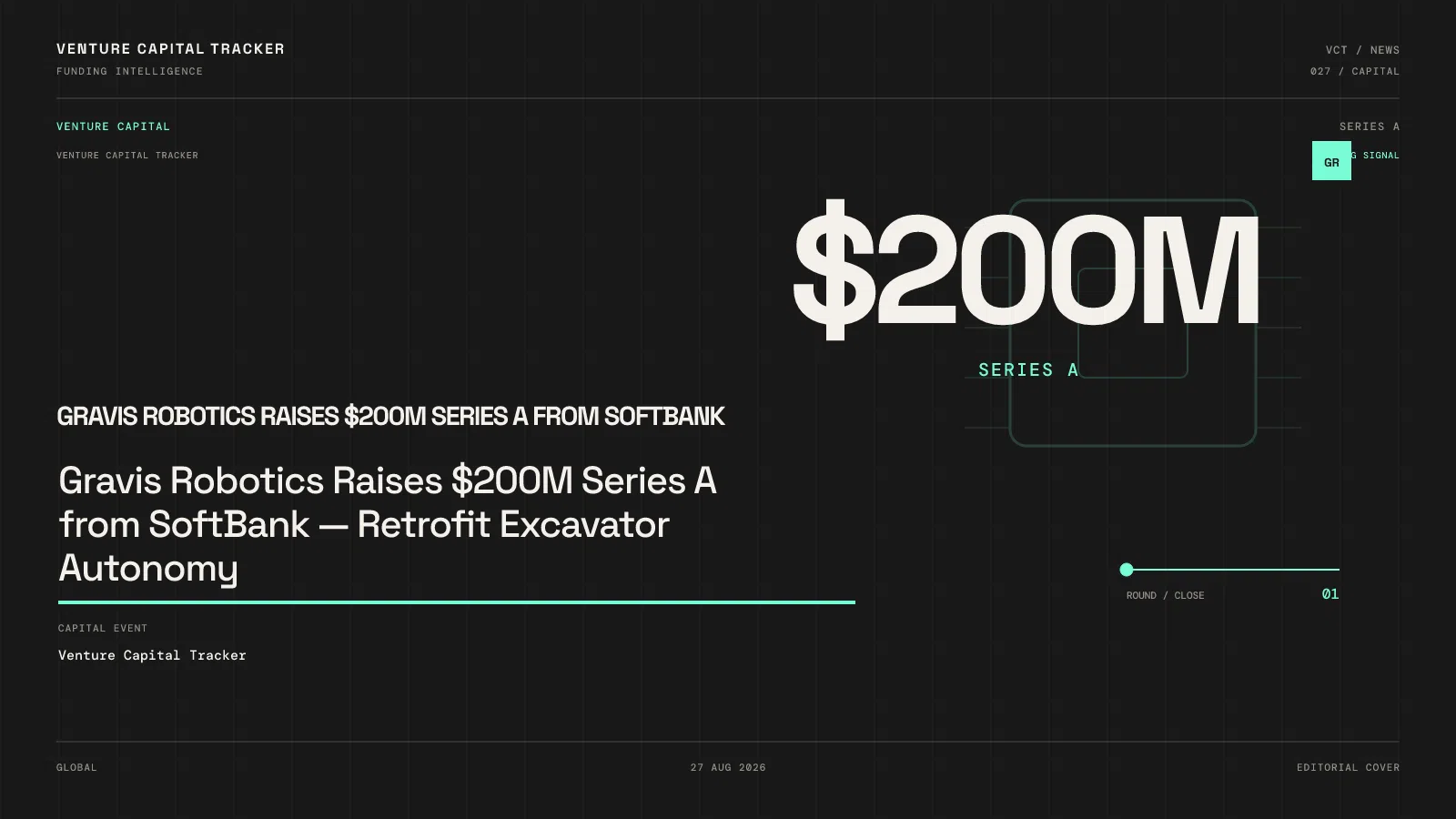
Gravis Robotics announced a $200 million Series A on August 17, 2026. SoftBank is the sole investor. Company: largest Series A in construction robotics. HQ: Zurich (ETH spinout), with US/UK presence.
Key facts
- Company
- Gravis Robotics — physical AI for heavy construction
- Round
- $200M Series A · SoftBank sole
- Date
- August 17, 2026
- Prior
- ~$23M (Nov 2025; IQ Capital / Zacua et al. — press)
- Product
- Gravis Rack kit + Copilot / full autonomy; mixed OEM fleets
- Named OEMs (company)
- Caterpillar, Case, Develon, John Deere, JCB, Hitachi, Sumitomo, Yanmar, Volvo, more
- Traction (company)
- Deployments on four continents; UK CAM Pathfinder (£/$ mix — company says $8M UK government-backed project with Flannery Plant Hire)
- Productivity claim
- Up to 30% vs peak manual — company
Who uses the product — and for what job
Users: contractors and rental houses that already own mixed excavator fleets and cannot scrap iron to buy a robot brand.
Job: move earth for housing, grids, and data centers when skilled operators are scarce — without waiting for a single-OEM autonomous lineup.
Most physical AI navigates a static world. Gravis’s pitch: excavators destroy and reshape terrain. Software has to model soil and hydraulics, not just lanes.
Modes: operator in cab with 3D copilot, or supervise a fleet remotely. Every machine is also a site sensor.
Why now
- AI campuses and energy projects are earthmoving-constrained. That is the same bottleneck Hadrian sells from the factory side.
- SoftBank has been vocal on physical AI. Dai Sakata (SoftBank Group) is quoted on the company page.
- Retrofit beats rip-and-replace in a fragmented OEM market (company: ~two-thirds of demand outside the top three manufacturers).
Why SoftBank — portfolio fit
In Gravis’s funding announcement, SoftBank managing director Dai Sakata describes construction autonomy as part of the group’s physical-AI investment thesis. The announcement does not disclose board rights or other governance terms.
| Investor type | What they bring |
|---|---|
| SoftBank (sole) | $200M, physical-AI narrative, follow-on capacity — and concentrated control |
| Seed holders (IQ Capital, Pear VC, Holcim MAQER, etc.) | Diluted but still on cap table (LinkedIn/Inc.; not restated on Series A page) |
Competitive map
| Player | Lane |
|---|---|
| OEM autonomy (Cat, Volvo, etc.) | Closed fleets |
| Bedrock Robotics | Autonomous earthmovers / haulers (different stack) |
| Hadrian | Factories, not jobsites |
| Traditional machine control (Trimble, etc.) | Guidance, not full autonomy kits |
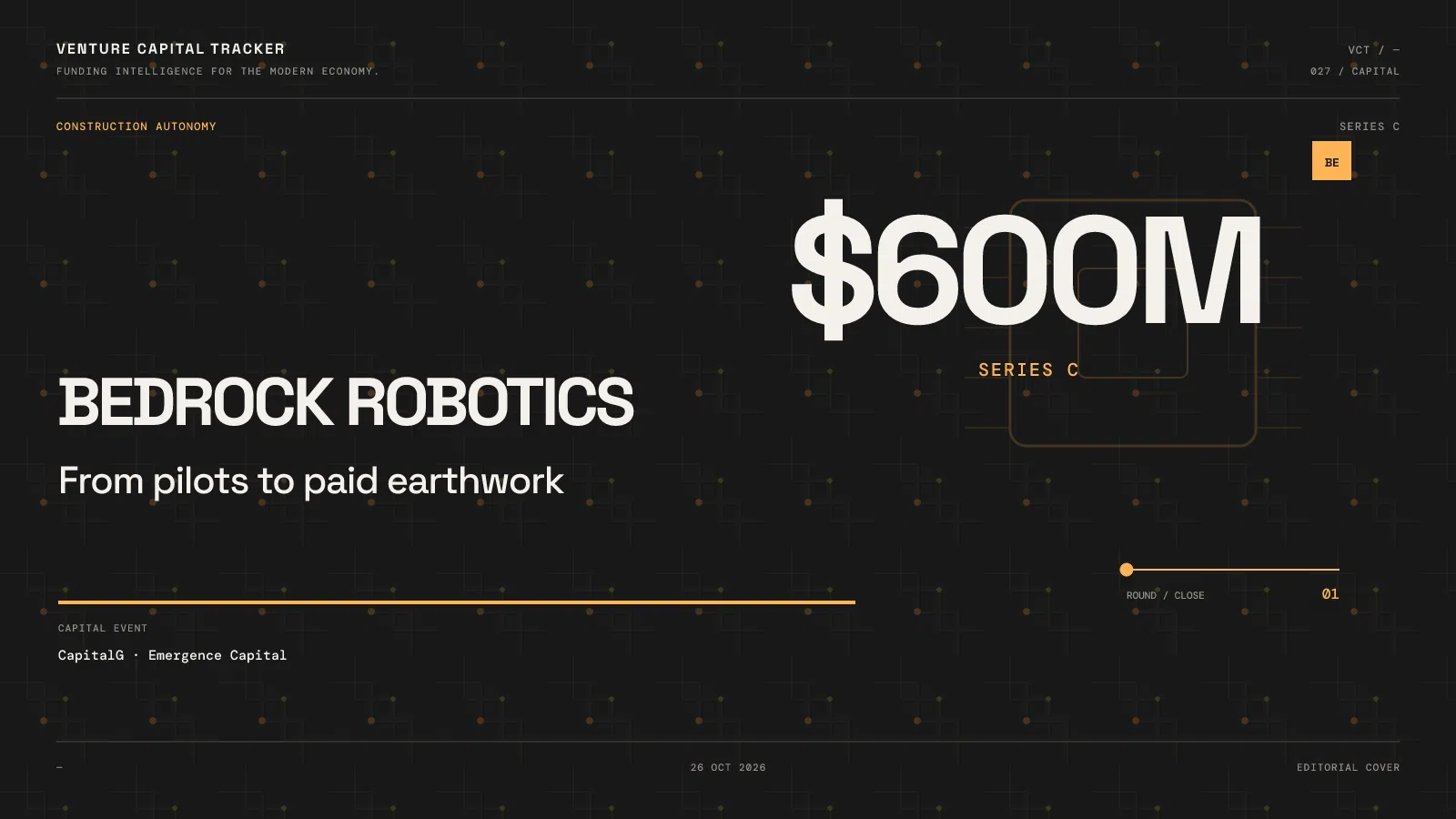
Bedrock’s October 26, 2026 $600M Series C provides a newer direct comparison. Its co-lead CapitalG describes paid work on commercial construction sites. Both companies retrofit existing machinery; comparable fleet-level operating costs and independently measured safety outcomes remain important evidence gaps.
Market signal
A $200M Series A with one investor is a deployment round. The 30% productivity number will be diligence or marketing depending on whether independent jobsites replicate it.
$1B post-money is widely reported (Inc./TFN) but absent from Gravis’s own post. We do not treat it as company-confirmed.
When not to use this as a template
- Wrong if you need a diversified Series A syndicate as a governance model.
- Wrong if the product only works on one OEM.
- Wrong if you quote $1B without labeling it as press-reported.
Practical takeaway
- Founders (physical AI): Sell kit-on-installed-base, not a new yellow machine.
- Investors: Underwrite safety cases, union/jobsite process, and OEM politics.
- Operators / GCs: Ask for hours of autonomous production on your soil type, not a Zurich demo.
Editorial note: AI tools assisted with research, structure, or drafting. Venture Capital Tracker retains human editorial responsibility for factual accuracy, relevance, and source quality before publication.