· Investment Strategies · 2 sources
Gimlet Labs’ $300M at $3B: Multi-Chip Inference Gets a16z Scale
Andreessen Horowitz led Gimlet Labs’ $300M round at a $3B valuation — six months after an $80M Series A — with Arm and Microsoft’s M12 joining the inference-routing bet.

Editorial team
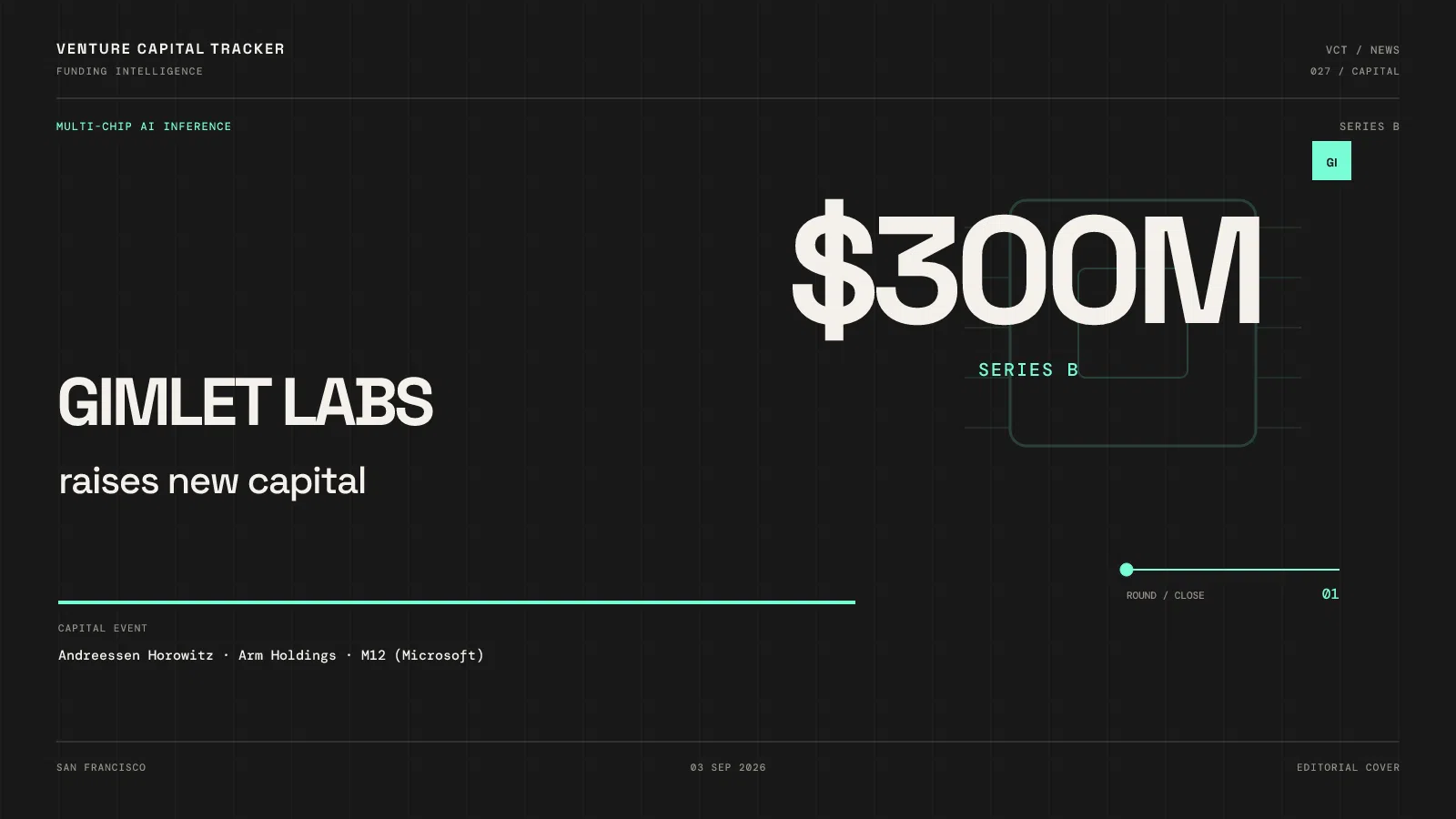
Andreessen Horowitz led Gimlet Labs’ $300 million round announced September 3–4, 2026, valuing the company at $3 billion (Bloomberg interview with CEO Zain Asgar). New backers Arm Holdings and Microsoft’s M12 joined. Six months earlier, Menlo Ventures led an $80 million Series A.
Spine: inference cost — not model quality — is the bottleneck buyers will pay platform rent to escape, and chip diversity is the lever.
Key facts
- Company
- Gimlet Labs (San Francisco)
- Round
- $300M at $3B
- New strategics
- Arm, M12 (Microsoft)
- Prior
- $80M Series A (Menlo, Mar 2026); $12M seed
- Product
- Multi-architecture inference routing / orchestration
- CEO
- Zain Asgar
Who uses the product — and for what job
Users: enterprises, labs, and clouds running agent and LLM inference where GPU SKUs are heterogeneous, scarce, or price-volatile.
Job: split and schedule AI tasks across NVIDIA, AMD, Intel, Arm, and specialized accelerators so utilization and $/token improve without rewriting every workload for one vendor.
March TechCrunch coverage described eight-figure revenue out of the gate and a customer base that included a major model maker and a large cloud — unnamed. Treat those as company-claimed traction signals from the Series A era.
Why now
- Training megacycles still dominate headlines; production inference dominates OpEx.
- Six months from Series A to a $3B mark implies investors believe routing software can sit above the GPU land grab.
- Arm + M12 participation is a compatibility and distribution signal: make the software work on Arm silicon and sit next to Microsoft’s AI stack conversations.
Why a16z — portfolio fit
a16z’s AI infra book favors platform layers that compound as model and chip vendors proliferate. Gimlet is the anti-lock-in bet: if customers refuse single-vendor inference, the router becomes sticky.
Likely founder rationale: raise with a brand-name growth lead that already backs frontier AI ecosystems, while adding chip (Arm) and cloud (M12) strategics that de-risk roadmap partnerships.
| Dimension | Fit |
|---|---|
| Stage | Post–Series A scale-up |
| Thesis | Chip-agnostic inference efficiency |
| Risk | Hyperscalers/build-your-own schedulers; GPU vendor SDKs absorbing features |
Competitive map
| Player | Lane |
|---|---|
| Cloud inference offerings | Vertical stacks per hyperscaler |
| NVIDIA software stack | Dominant single-vendor path |
| Other inference optimizers / compilers | Overlapping but often single-architecture |
What remains undisclosed
ARR at close and named customers were not in the Bloomberg brief excerpt reviewed.
Takeaway
Gimlet’s jump to $3B says the market will capitalize orchestration that makes mixed silicon usable. The unresolved question: can an independent router stay ahead of free cloud/vendor tooling once every accelerator vendor ships its own “heterogeneous” story?
Sources
- Bloomberg: https://www.bloomberg.com/news/articles/2026-09-04/andreessen-backed-ai-startup-gimlet-is-valued-at-3-billion-in-new-round
- TechCrunch (Series A context): https://techcrunch.com/2026/03/23/startup-gimlet-labs-is-solving-the-ai-inference-bottleneck-in-a-surprisingly-elegant-way/
Follow Venture Capital Tracker in Google
Add VCT as a preferred source to make our venture-capital coverage easier to find in Google Search.
Editorial note: AI tools assisted with research, structure, or drafting. Venture Capital Tracker retains human editorial responsibility for factual accuracy, relevance, and source quality before publication.