· Investment Strategies · 2 sources
Flagler Health’s $50M Series B: Bessemer Backs the MSK Clinic Operating System
Bessemer led Flagler Health’s $50M Series B (total ~$63M) for an AI-native OS that runs musculoskeletal clinics inside existing EMRs — triage, care, billing, and patient comms.

Editorial team
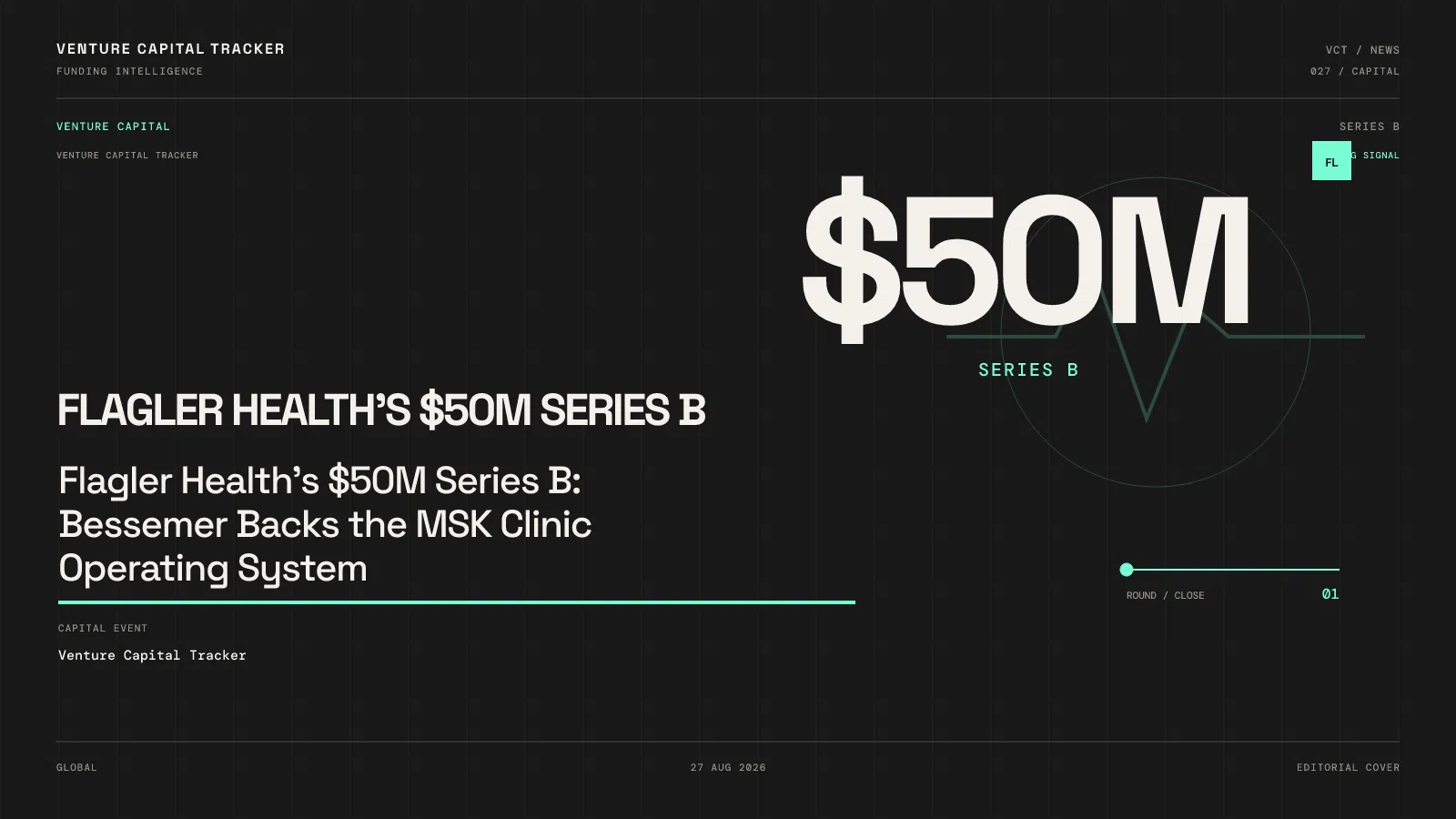
Bessemer Venture Partners led Flagler Health’s $50 million Series B on August 11, 2026, bringing total funding to about $63 million. Participants: SignalFire, Alumni Ventures, Streamlined, 186 Ventures, Proof VC, Tribeca Venture Partners, and Offscript.
Key facts
- Company
- Flagler Health (NYC)
- Round
- $50M Series B · ~$63M total
- Date
- August 11, 2026
- Lead
- Bessemer Venture Partners
- Sector
- AI OS for musculoskeletal (MSK) care
- Founders
- Albert Katz (CEO), Dr. Leon Anijar (CMO), Will Hu (CTO)
- Market frame (company)
- >$400B U.S. MSK spend; >50% of adults affected
Who uses the product — and for what job
Users: MSK practice operators and clinicians who lose most of the day to non-clinical work (company cites ~75% of physician time on non-revenue tasks).
Job: run the full patient lifecycle — triage → care management → billing → communications — inside the EMR they already use, without a new login maze.
Coastal Health’s Dr. Christopher Netzel (quoted in the release) frames the buyer job as remote outcome tracking with zero workflow change.
This is not a consumer wellness app. It is specialty practice infrastructure.
Why now
- MSK is huge, reimbursements squeeze margins, and admin load burns clinicians out.
- Generative AI finally makes ambient documentation + care orchestration credible inside EMRs.
- Buyers want ROI in dollars per provider, not another portal.
- Under-three-years scale to multi-state deployments (company) is the Series B trigger for a healthcare OS bet.
Why Bessemer — portfolio fit
Bessemer partner Steve Kraus’s quote is explicit: right founder mix (ops + clinical + AI) applied to a large underserved specialty, with traction that looks like an operating system, not a feature.
Likely founder rationale: pick a firm that has financed multi-site healthcare software before, can help with enterprise GTM, and will follow specialty OS winners through growth — not a consumer health brand fund.
| Dimension | Fit |
|---|---|
| Stage | Series B expansion across U.S. MSK |
| Thesis | Vertical AI OS inside EMR workflows |
| Proof | Multi-state provider footprint + claimed $/provider lift |
| Risk | EMR integration variance; reimbursement/policy shifts |
Competitive map
| Player | Lane |
|---|---|
| Generic ambient scribes | Documentation only; not full MSK OS |
| Horizontal practice management | Broad specialties; thinner MSK depth |
| Point solutions (billing, RCM, PT apps) | Single workflow; Flagler sells orchestration |
| Health-system EHR modules | Incumbent distribution; slower specialty UX |
When not to overclaim
- Wrong if company ROI / outcome percentages are treated as audited GAAP metrics.
- Wrong if “every MSK clinic in America” is modeled as near-term TAM capture.
- Wrong if you ignore EMR switching costs and specialty sales cycles.
Practical takeaway
- Founders (healthtech): Sell background automation with named $/provider math, not another dashboard.
- Investors: Diligence EMR coverage, churn, and net revenue retention by practice type.
- Operators: Ask what runs hands-free vs what still needs staff — that is the real buy decision.
Editorial note: AI tools assisted with research, structure, or drafting. Venture Capital Tracker retains human editorial responsibility for factual accuracy, relevance, and source quality before publication.