· Updated · Venture Capital Tracker · investment-strategies
Aiforia Gets €20M EIB Financing for AI Cancer Diagnostics
Aiforia announced €20M in EIB financing. Here is what was disclosed, what the financing label means, and what investors should verify next.
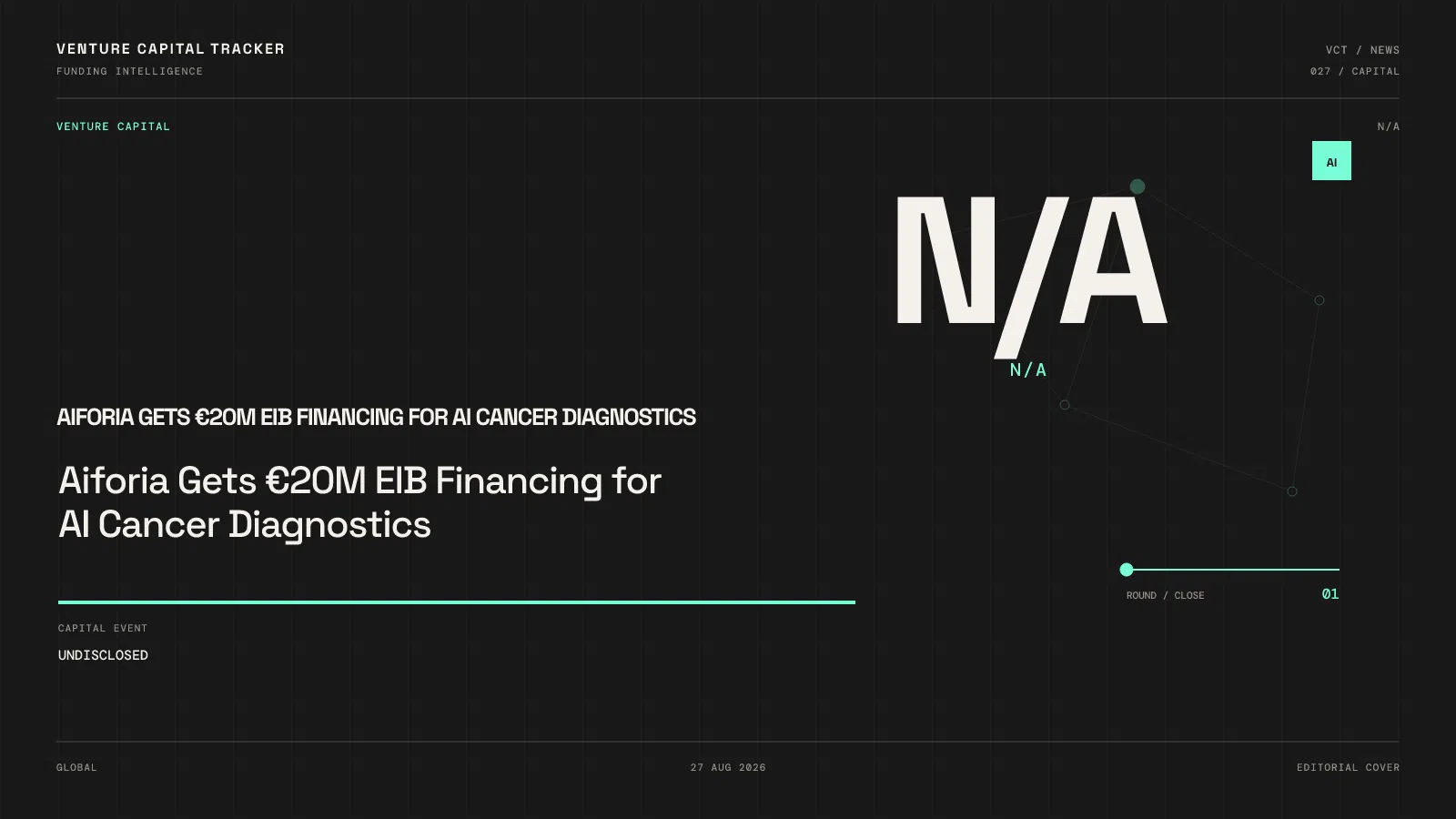
Aiforia announced €20M in EIB financing. The number is useful only with the label attached: this is structured financing rather than a plain venture round. The investable question is what the capital changes, not whether the headline is large.
Last verified: August 18, 2026. The cited announcement is the source of record for the amount and financing label. This memo does not fill undisclosed terms with database estimates.
The round at a glance
| Field | Disclosed detail |
|---|---|
| Company / manager | Aiforia |
| Announcement | 2026-08-09 |
| Amount | €20M |
| Financing label | EIB financing |
| Core angle | European institutional financing for ai-assisted pathology and cancer detection |
| Valuation | Not disclosed in the source used for this memo |
What changed
The announcement puts fresh capital behind European institutional financing for AI-assisted pathology and cancer detection. That is the strategic fact. The round size indicates the scope of the backers’ commitment, but it does not prove adoption, margins or deployment speed.
For founders and scouts, the useful read-through is market structure. Capital is moving toward products that control a difficult workflow or scarce data layer, not generic “AI” positioning. Aiforia now has to convert financing into measurable product delivery and customer outcomes.
How to classify the financing
This amount should not be added to equity-funding league tables. Facilities and commitments can be drawn over time, may carry covenants or conditions, and do not by themselves establish a new company valuation.
That distinction matters when comparing the event with the rest of the August tape. A fund close expands a manager’s future purchasing power. Equity finances a company and can reset its valuation. Debt, institutional facilities and conditional commitments add liquidity with different claims on the business. Those categories should sit in separate columns.
What the announcement does not answer
- Economics: revenue, gross margin and burn were not supplied in the research ledger.
- Terms: liquidation preferences, covenants and board rights were not disclosed.
- Deployment: an announced amount does not tell readers how quickly capital becomes operating spend.
- Competitive proof: product claims should be tested against customer retention and real workloads.
The absence of a number is not permission to estimate it. We keep unknown valuation and revenue fields blank until the company or a clearly attributed report supplies them.
Investor read-through
The next evidence should be operating rather than promotional: named deployments, renewal behavior, unit economics and a clear explanation of how the product wins. For startup investors, the relevant test is whether the new capital compounds a repeatable advantage rather than subsidizing a crowded category.
The clean comparison set is the August VC news index and the dated European funding tape. Those pages keep venture equity separate from facilities, grants, bonds and reported-but-unclosed raises.
Source
- European Investment Bank — Aiforia financing — announcement/report used for amount and classification (accessed August 18, 2026).
Follow Venture Capital Tracker in Google
Add VCT as a preferred source to make our venture-capital coverage easier to find in Google Search.
Last updated:
Editorial note: AI tools assisted with research, structure, or drafting. Venture Capital Tracker retains human editorial responsibility for factual accuracy, relevance, and source quality before publication.