· Venture Capital · 4 sources · Verified
XRlabs Raises $8.4M Seed for Surgical Intelligence
Playground Global led XRlabs' $8.4M seed round. The investment case turns on clinical evidence, repeatable integrations and hospital deployment economics.

By Venture Capital Tracker
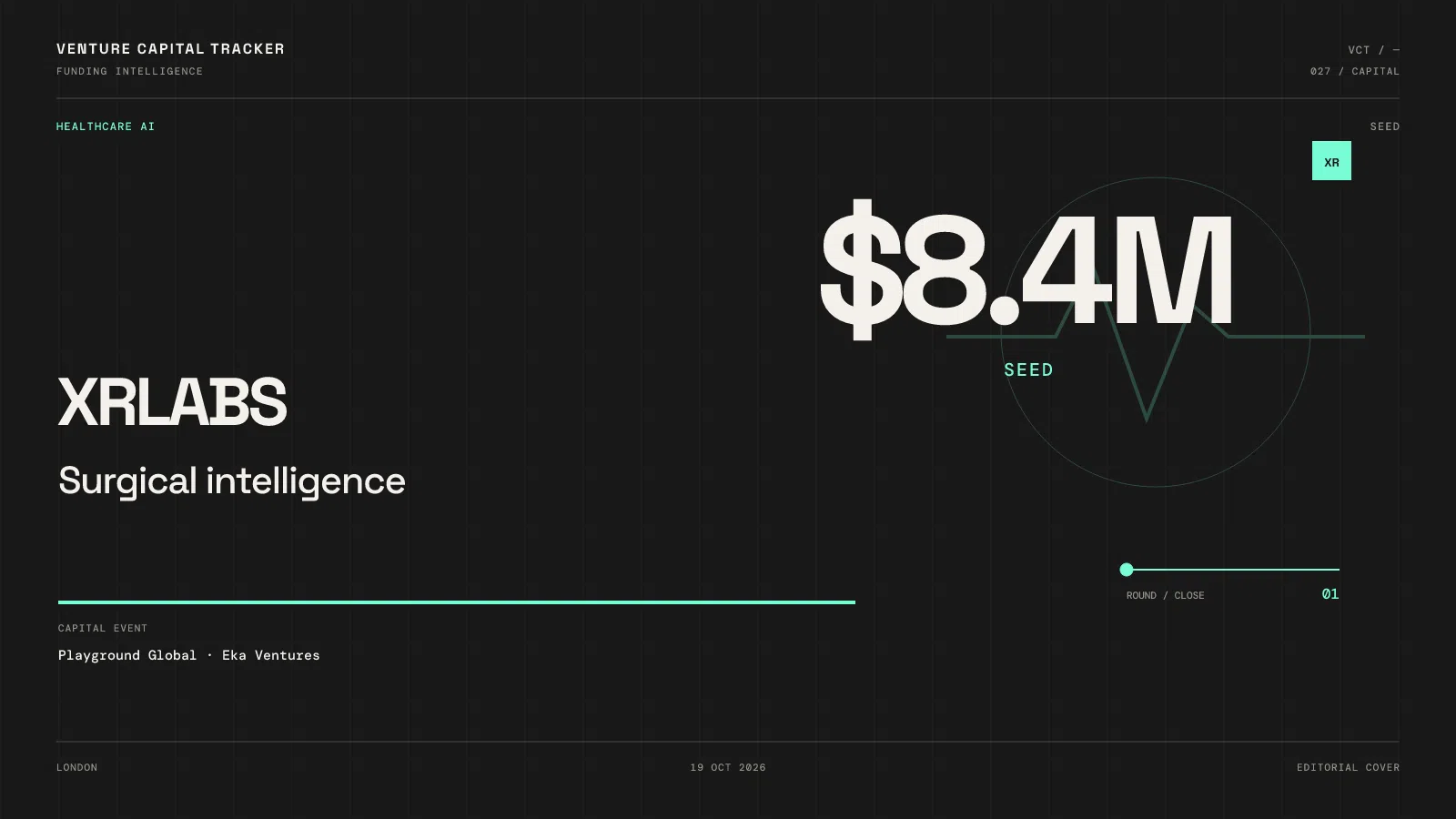
XRlabs announced $8.4 million in seed funding on October 19, 2026, led by Playground Global with participation from Eka Ventures. The London-headquartered company plans to expand engineering and clinical work, pursue regulatory pathways and build its evidence base.
The financing supports a surgical-software thesis, not an autonomous-surgery product launch. XRlabs' own website says SurgicalOS is in development and not commercially available. Research use and financing confirmation therefore belong in different evidence categories: the round is announced; broad clinical benefit and commercial repeatability still need to be demonstrated.
Financing snapshot
| Item | Disclosed fact |
|---|---|
| Company | XRlabs |
| Financing | $8.4M seed round |
| Lead | Playground Global |
| Participant | Eka Ventures |
| Announcement | October 19, 2026 |
| Valuation and ownership | Not disclosed |
| Exact legal closing date | Not disclosed |
The company also disclosed a UK AI Research Resource compute allocation. That is separate support, not an additional cash investment or a component to add to the $8.4M total. No dollar value for the allocation was supplied in the announcement. This is not a debt-facility or acquisition announcement.
Two products, two different evidence questions
XRlabs distinguishes its planning product, XRlabs SIM, from SurgicalOS. SIM creates imaging-derived patient models for visualization and rehearsal. SurgicalOS is being developed to bring surgical video, navigation and imaging into a shared operative view.
That separation matters for underwriting. Experience with planning software does not automatically establish that an intraoperative system is ready for routine use. A hospital can value a visualization tool while requiring a different validation process before adopting software during a procedure. Neither a successful demonstration nor use under research governance substitutes for the evidence needed for a particular commercial indication.
The business question is where the first repeatable purchase occurs. A focused planning application may have a clearer initial buyer; a broader integration layer may offer a larger eventual role but involve more departments, interfaces and implementation work. XRlabs has not disclosed enough pricing or revenue information to quantify either route.
Installed equipment is an opportunity—and an integration obligation
The company's device-agnostic approach aims to work with equipment hospitals already own. As an investment thesis, that could reduce the need for a replacement-hardware purchase. It does not remove implementation costs.
Each supported configuration needs dependable data exchange, version management, installation support and clear responsibility when something fails. A persuasive demonstration in one operating room can still require extensive work before it becomes a repeatable deployment elsewhere.
The useful commercial metric would be the engineering and support effort required for each additional site. If configurations become reusable, expansion could become more efficient. If every customer requires a substantially bespoke project, services costs could absorb much of the software margin. No such unit economics were disclosed.
Clinical progress and financial progress need separate scorecards
Investors should distinguish technical feasibility, clinical validation and procurement conversion. Progress on one does not prove the others.
For clinical development, useful future disclosures would identify the intended use, study design, comparator and endpoints, rather than relying on a headline case count. This article does not infer improved outcomes from early research evaluations or suggest any regulatory clearance not established by the reviewed sources.
For the business, the corresponding milestones are paid deployments, renewals, implementation time and support obligations. A sophisticated tool can be clinically interesting without yet having a scalable purchasing pathway. Conversely, early commercial demand would not by itself establish superior patient outcomes.
What the seed round needs to buy
The central test is whether this capital turns an ambitious integration concept into a narrower, reproducible deployment process. That means evidence clinicians can assess, configurations partners can maintain and a purchasing proposition hospitals can evaluate.
The $8.4M seed round creates resources to pursue those milestones. It does not establish their completion. The strongest next announcement would pair a precise product status with measured clinical or commercial progress, while continuing to keep research evaluations, available products and future capabilities distinct.
Sources
Follow Venture Capital Tracker in Google
Add VCT as a preferred source to make our venture-capital coverage easier to find in Google Search.
Editorial note: AI tools assisted with research, structure, or drafting. Venture Capital Tracker retains human editorial responsibility for factual accuracy, relevance, and source quality before publication.