· Venture Capital · 4 sources · Verified
Probably Genetic Raises $12M Series A for Rare-Disease Data
Probably Genetic’s reported $12M Series A backs rare-disease data. We separate venture financing from research support and examine data quality and partner economics.

By Venture Capital Tracker
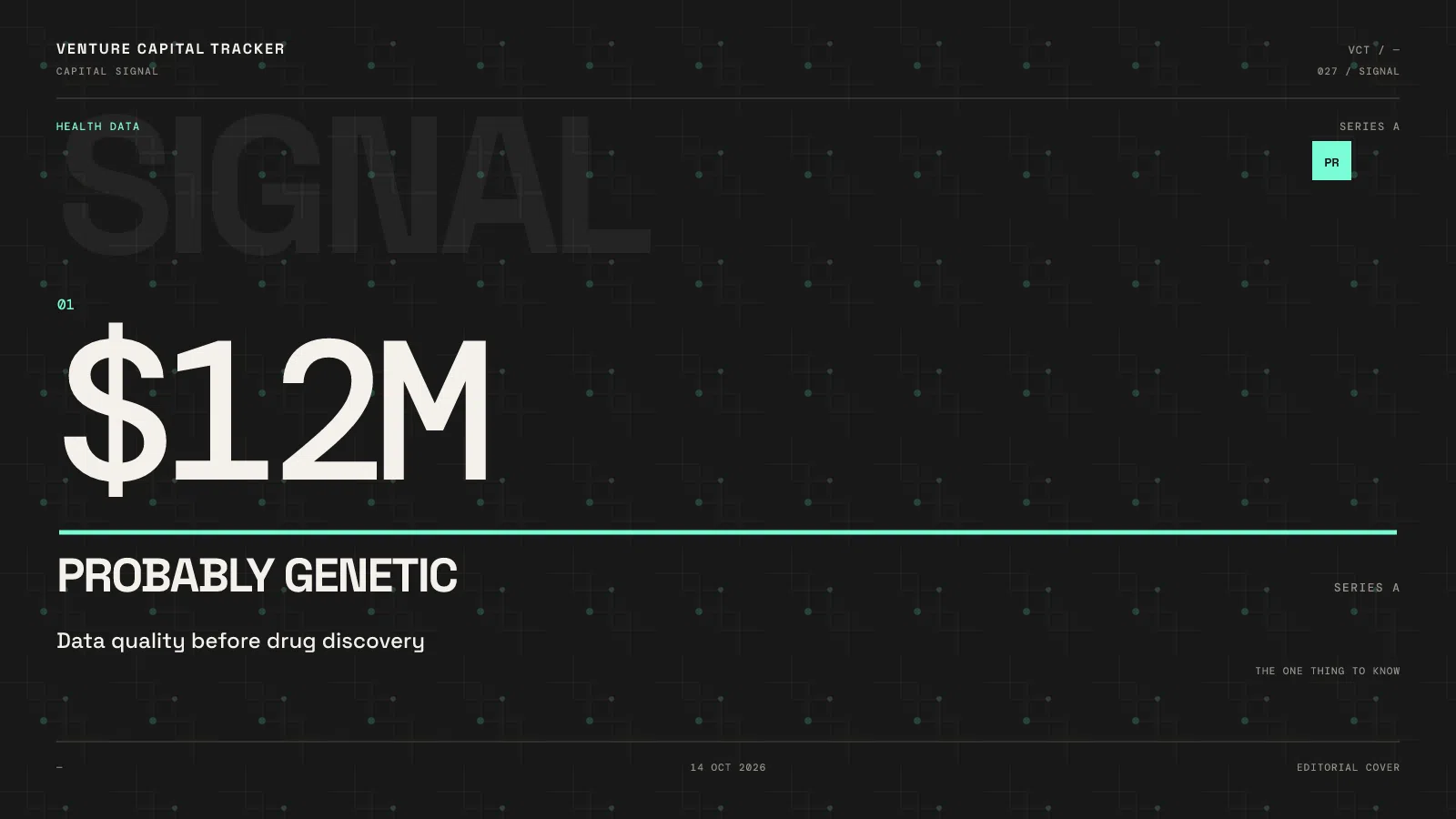
Probably Genetic raised a $12M Series A, according to Fierce Healthcare's October 14, 2026 report. Threshold Ventures led, with Y Combinator and other existing investors participating.
Fierce's reporting includes comments from CEO Lukas Lange and Threshold managing partner Emily Melton. We classify the financing as media-confirmed, not a rumor, while leaving valuation, individual allocations and the exact legal closing date undisclosed.
The investment question is whether a patient-access business can produce data that biopharma partners can use repeatedly—not whether a larger dataset automatically produces successful drugs.
Keep the Series A separate from research support
| Item | Reported detail |
|---|---|
| New financing | $12M Series A |
| Lead | Threshold Ventures |
| Other backers | Y Combinator; unnamed existing investors |
| Report publication | October 14, 2026 |
| Valuation | Undisclosed |
Fierce separately reported an earlier ARPA-H award of up to $10M in August. That research award is not added to the Series A, treated as venture equity or assumed to have been fully paid. It is also not a new October research-award announcement.
This distinction matters because corporate financing and project-specific support answer different questions. Neither figure is revenue, a drug-development milestone or proof that a diagnostic model has been independently validated.
Patient access and research value are related, not identical
The company's public website describes physician-ordered testing through condition-specific sponsored programs and an insurance-billed pathway. Its partner offering focuses on identifying patients for drug development and commercialization.
Those two sides may reinforce one another: a useful patient service can create structured information that helps an institutional customer. But the relevant evidence is not simply how many people begin an assessment.
A research customer needs to know which records contain usable genetic results, how symptoms were characterized and whether outcomes can be followed consistently. A patient profile, a completed test and a longitudinal research record are different units. Combining them into a single growth metric would hide the work needed to make the data useful.
Data quality has to survive changes in the patient funnel
Online discovery can reach people outside conventional referral routes. It can also create a cohort shaped by who finds the service, who completes the assessment and who qualifies for a particular program.
Our analytical view is that investors should examine missing information, repeat measurements and differences between tested and untested participants. These are questions about data provenance and representativeness, not findings that Probably Genetic's dataset is either biased or clinically validated.
Reproducible definitions matter as the company expands. More modalities or records can improve research options, but they also increase the cost of harmonization, review and maintaining consistent metadata.
Sponsored access needs repeatable economics
A service that is free to an eligible patient still has a payer and a delivery cost. Sponsored programs, insurance billing and research partnerships can have different budgets, timelines and incentives.
Useful commercial measures would include partner renewals, cost per completed eligible pathway and the amount of manual work needed to produce a research-ready record. Those are proposed diligence measures, not disclosed unit economics.
Patient choice and clear boundaries around permitted uses of information are also part of the operating model. Public security or privacy representations should not be confused with independent verification of every workflow or contract.
Discovery remains a separate evidence hurdle
Better-organized human data can support hypotheses. It does not establish a causal disease target, a safe therapy or clinical benefit.
That makes the transition from patient identification into discovery a staged investment case. Early evidence would show that partners repeatedly use the data for defined research questions; later evidence would have to show whether those questions yield useful biological findings.
The Series A funds the company pursuing that opportunity. It does not remove the need to evaluate each step independently.
Source note: Financing and the separate earlier award are attributed to Fierce Healthcare's reporting. Service descriptions come from Probably Genetic. The data-quality, economics and research-milestone discussion is VCT analysis, not medical advice or a clinical-performance claim.
Follow Venture Capital Tracker in Google
Add VCT as a preferred source to make our venture-capital coverage easier to find in Google Search.
Editorial note: AI tools assisted with research, structure, or drafting. Venture Capital Tracker retains human editorial responsibility for factual accuracy, relevance, and source quality before publication.