· Venture Capital Tracker · venture-capital
Undecimal Bio Raises $18M Seed to Push siRNA Delivery Beyond the Liver
4BIO Capital and IQ Capital co-led an $18 million seed round for Undecimal Bio, an Eleven Therapeutics spinout developing AI-assisted siRNA delivery conjugates.
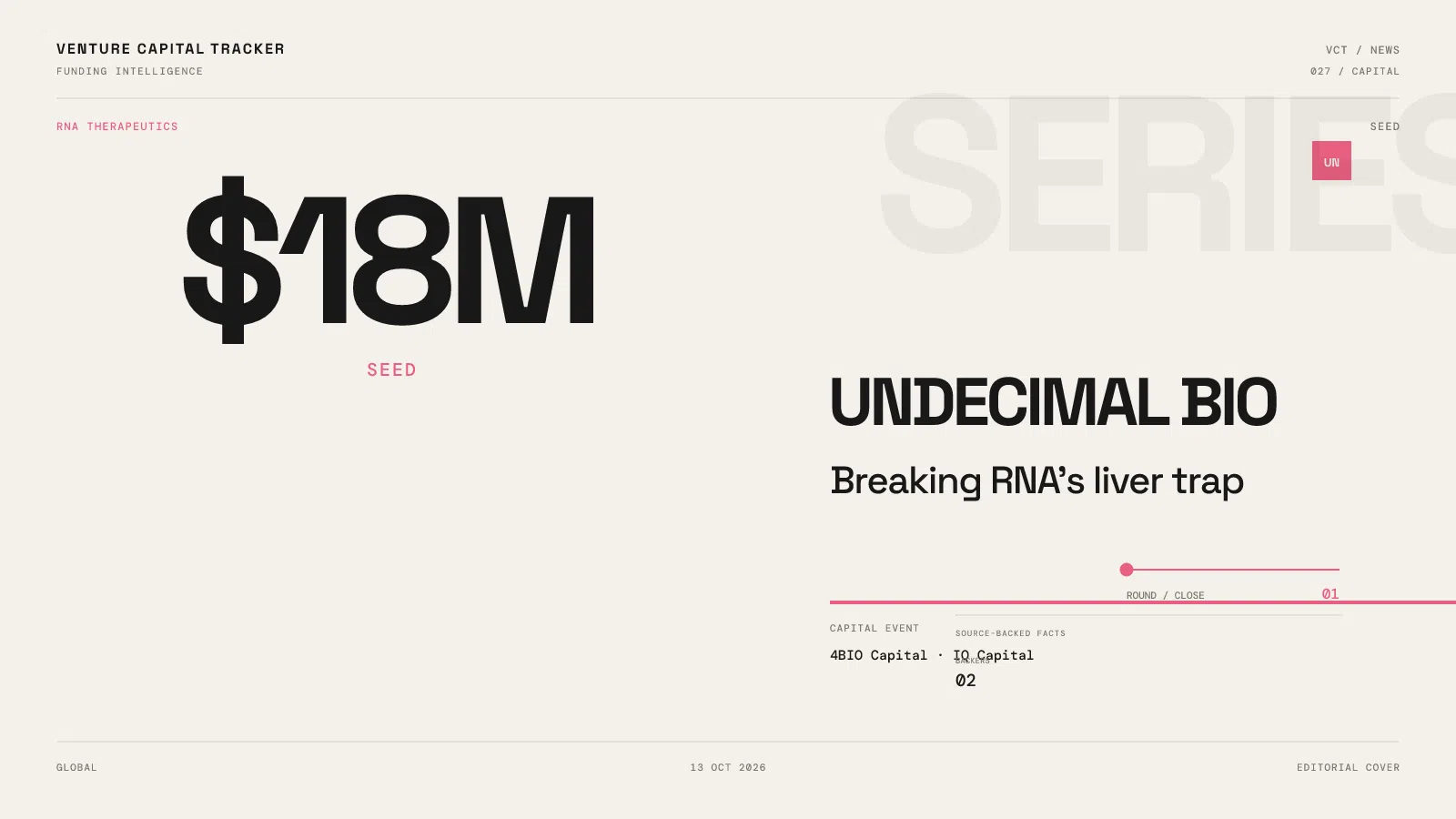
Undecimal Bio has launched with an oversubscribed $18 million seed financing to tackle one of RNA medicine’s hardest problems: delivering small interfering RNA to useful tissues beyond the liver.
4BIO Capital and IQ Capital co-led the round. Verve Ventures, Harel Tech, Entrée Capital, Kerna Ventures and Saras Capital also participated.
The company is a spinout from Eleven Therapeutics and operates across Cambridge, England, and Tel Aviv. It will use the financing to expand its DELiveri platform, advance renovascular programs and grow its laboratory team at the Cancer Research UK Cambridge Institute.
Round details
| Item | Detail |
|---|---|
| Amount | $18M |
| Stage | Seed |
| Leads | 4BIO Capital and IQ Capital |
| Participants | Verve Ventures, Harel Tech, Entrée Capital, Kerna Ventures and Saras Capital |
| Initial focus | Kidney and vascular delivery for renovascular disease |
| Platform | DELiveri |
The delivery problem behind the financing
RNA interference can selectively silence genes, giving drug developers a way to intervene upstream of many disease processes. The modality has been most successful in the liver because existing delivery systems naturally accumulate there.
That same behavior creates a “liver trap”: a delivery technology optimized for hepatic uptake may struggle to reach kidney, vascular, muscle, immune or other cell types at a therapeutically useful dose.
Undecimal’s thesis is that delivery molecules should be discovered through large functional screens rather than selected mainly from narrow libraries or inferred from chemistry alone.
Its DELiveri platform screens combinatorial libraries of candidate ligands and measures productive delivery into target cells. The resulting experimental data are then analyzed with AI systems to map structure-activity relationships and prioritize conjugates that could carry siRNA to specific cell types.
The distinction is important. The AI is not a substitute for biological evidence; it is the analysis layer on top of experimentally generated delivery data.
Why renovascular disease is a useful first test
Undecimal is initially focusing on diseases involving the kidney and vasculature. These tissues provide a commercially meaningful demonstration of extrahepatic delivery, and the company argues that human genetics has already identified attractive disease drivers that existing delivery systems cannot reach effectively.
The company has not disclosed a lead drug candidate, development timeline or the chemical class of its conjugates. Its programs therefore remain early and preclinical.
Undecimal also says it has entered research collaborations with several large pharmaceutical companies, but it has not named the partners or disclosed economics. Those collaborations are a validation signal only in a limited sense until counterparties, milestones or data are public.
What the investor syndicate signals
4BIO Capital brings specialization in advanced therapies, including RNA-based medicines. IQ Capital adds deep-tech experience spanning biology and engineering. Their co-leadership suggests the investors view delivery as both a therapeutic-development problem and a platform-engineering problem.
Board representation from 4BIO, IQ Capital and Harel Technologies gives the syndicate meaningful governance influence at launch. Verve Ventures joins as an observer.
That structure is typical for an institutional seed round, but the size is notable: $18 million provides enough capital to build a platform team and progress internal programs, while still leaving substantial financing needs before clinical proof.
The milestones that matter
The platform will need to show more than library scale. The decisive evidence will be reproducible tissue selectivity, delivery efficiency at tolerable doses, durability of gene silencing and performance against established lipid and conjugate approaches.
Investors should also watch whether Undecimal advances its own therapeutic pipeline or relies primarily on partnerships. Internal programs retain more economics but require much more capital; platform collaborations can fund development earlier but may limit long-term upside.
Bottom line
Undecimal is attacking a genuine constraint in RNA therapeutics with a data-generating platform rather than an AI-only discovery story. The $18 million seed gives it the resources to show whether its screens can produce delivery conjugates that work in living systems. Until it discloses candidate chemistry and in-vivo performance, however, the investment case rests on platform potential rather than drug-level proof.
Follow Venture Capital Tracker in Google
Add VCT as a preferred source to make our venture-capital coverage easier to find in Google Search.
Editorial note: AI tools assisted with research, structure, or drafting. Venture Capital Tracker retains human editorial responsibility for factual accuracy, relevance, and source quality before publication.