Matchpoint Therapeutics Raises $150M Series B for Covalent Medicines
Nextech Invest and Norwest co-led Matchpoint Therapeutics' $150M Series B as the preclinical biotech prepares oral T-cell modulator MPT-062 for human testing.
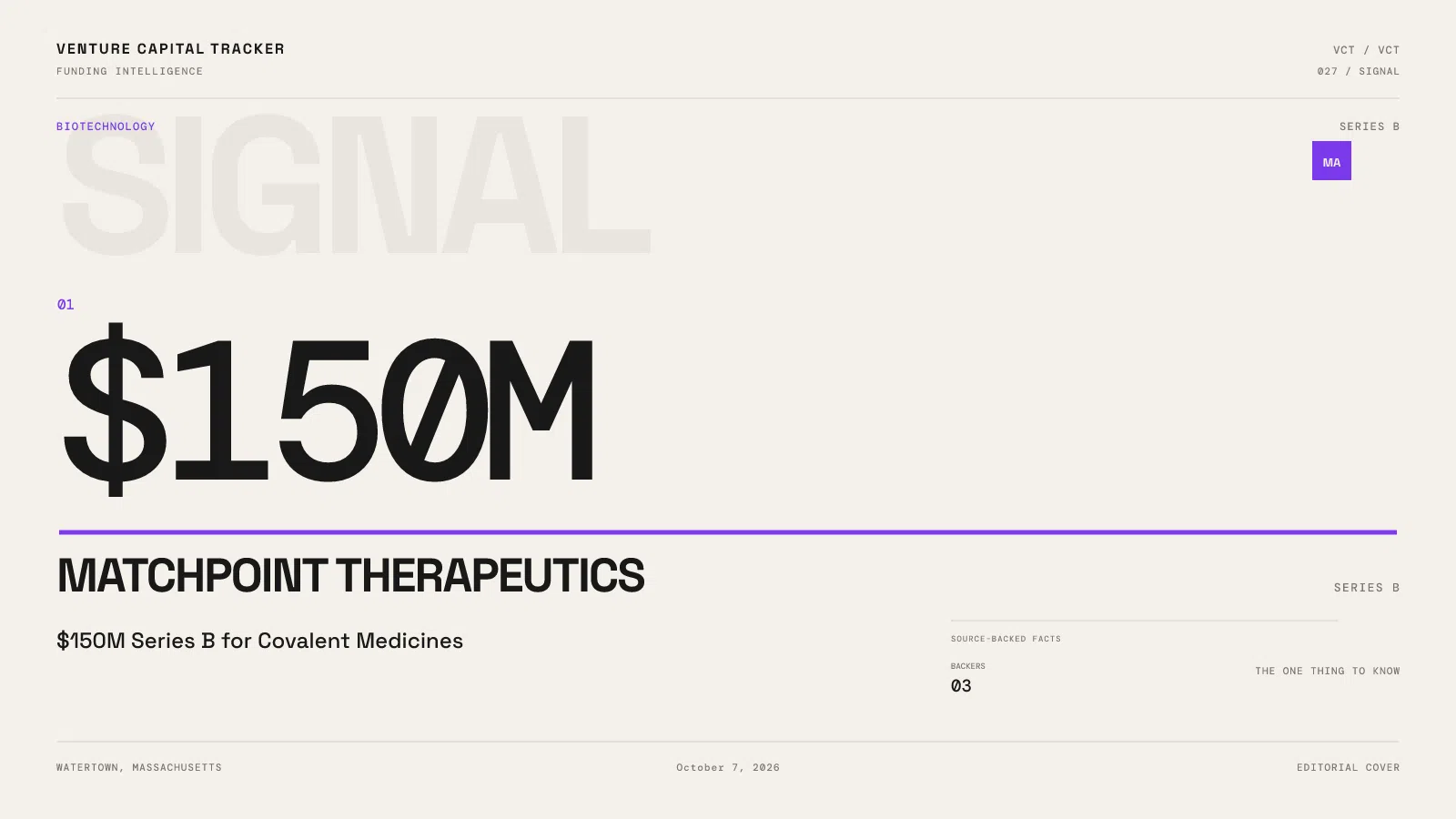
Matchpoint Therapeutics has closed a $150 million Series B to move its lead oral autoimmune program toward clinical proof of concept and expand a precision covalent-medicine pipeline.
Nextech Invest and Norwest co-led the financing. New investors Invus, BB Biotech, T1D Fund and BOLD Longevity Growth joined founding investors Access Biotechnology and Atlas Venture, Series A lead Sanofi Ventures, Digitalis Ventures and other existing backers.
The size of the round is notable because Matchpoint's lead asset, MPT-062, remains preclinical. The company expects clinical development to begin in 2027.
What Matchpoint is trying to prove
Matchpoint designs covalent small molecules: drugs engineered to form a durable bond with a target protein. The approach can increase potency and sustain target engagement, but it also raises the bar for selectivity because an unintended bond can be difficult to reverse.
The company's Advanced Covalent Exploration platform combines chemical biology, covalent chemistry, structure-based drug design and computational methods. Matchpoint says this lets it pursue biologically validated targets that conventional small molecules have struggled to reach.
MPT-062 is an oral T-cell modulator intended for autoimmune and inflammatory diseases. Matchpoint has not disclosed a full indication strategy, human safety data or efficacy results. Its financing therefore backs a platform-to-clinic transition rather than a de-risked late-stage asset.
Where the Series B will go
The company says the financing will support three priorities:
- take MPT-062 through clinical proof of concept;
- advance additional internal programs; and
- continue a separate discovery program funded through Matchpoint's July 2025 agreement with Novartis.
The Novartis relationship matters, but it should not be conflated with equity financing. Industry reporting says Matchpoint received $60 million upfront under that collaboration, while the new $150 million is a venture round.
The Series B follows a $70 million Series A announced in 2022. Together, the disclosed equity rounds give Matchpoint at least $220 million of venture backing before MPT-062 enters human testing.
Investor signal and governance
Nextech managing partner Kanishka Pothula and Norwest principal Brian Matesic are joining Matchpoint's board. That gives the new co-leads direct governance roles during the clinical transition.
The syndicate combines specialist biotech funds, strategic pharmaceutical capital and investors comfortable with long development timelines. Sanofi Ventures' return and the Novartis collaboration are external signals of pharma interest, but neither validates clinical efficacy.
This is where the investment case becomes more interesting than the funding headline. Matchpoint is competing not only with other covalent-chemistry startups, but also with internal pharma discovery teams and established oral immunology programs. A first-in-class mechanism can command substantial value if it works; it can also carry biology and safety risk that familiar targets avoid.
The milestones that matter
The financing gives Matchpoint runway, but the next value inflection points are scientific:
- Investigational filing and trial start: the company must translate a platform-generated molecule into a human-ready development package.
- Safety and dose selection: durable covalent binding makes selectivity and off-target monitoring central.
- Clinical proof of concept: a clear indication and measurable patient benefit will determine whether MPT-062 can compete with biologics and other oral therapies.
- Pipeline repeatability: a second program would show that the ACE platform is more than a single-asset engine.
Matchpoint's $150 million Series B is a confirmed close. The more important distinction is stage: investors are funding a large preclinical step-up, not a commercial launch or late-stage trial.
Editorial note: AI tools assisted with research, structure, or drafting. Venture Capital Tracker retains human editorial responsibility for factual accuracy, relevance, and source quality before publication.